AI Content vs Human Content: The 2026 Showdown (Data-Backed Verdict)
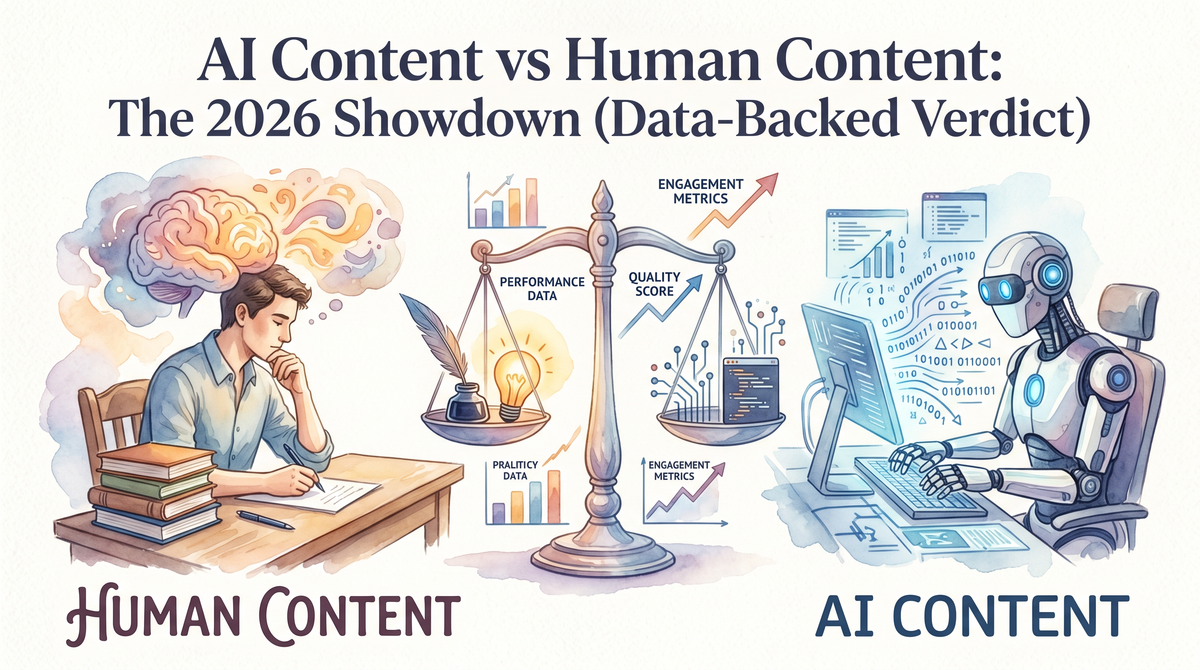
The short answer: neither wins outright. A Semrush study of 42,000 blog posts found that purely AI-generated content holds the #1 SERP position only 9% of the time, compared to 80% for human-written content. Yet a separate Semrush analysis of 20,000 URLs showed that 57% of AI content and 58% of human content appear in the top 10 — a near-identical page-one appearance rate. The gap concentrates at the very top, not across the whole first page. The real winner in 2026 is the hybrid approach: AI-generated structure with human editorial judgment layered on top.
This is not a diplomatic compromise. It is what the data shows. We evaluated AI content and human content across six criteria: SERP ranking performance, E-E-A-T signal strength, content velocity and cost, engagement metrics, conversion rate, and GEO (Generative Engine Optimization) citation potential. Here is the full breakdown.
What We Tested: Methodology
Our evaluation is grounded in three data pillars:
- Large-scale SERP studies — Semrush's analysis of 42,000 blog pages tied to 20,000 keywords, and Digital Applied's 16-month study of 4,200 articles across 140 domains.
- Engagement and conversion benchmarks — Data from Grafit Agency, Position Digital, and Digital Applied covering bounce rate, time-on-page, and conversion rate by content type.
- Practitioner surveys — Semrush's survey of 224 SEO professionals and Ahrefs' survey of 879 content marketers, both conducted in 2025.
We did not rely on vendor-published data from AI writing tools. Where studies conflicted, we note both findings rather than cherry-pick a preferred result.
The State of the Battlefield in 2026
74.2% of newly created web pages now contain AI-generated content, according to an Ahrefs study of 900,000 pages published in April 2025. Only 2.5% are pure AI. The rest are human-AI blends. That means the question businesses should be asking is no longer "AI or human?" It is "how much human oversight does our AI content need?"
AI-generated articles surpassed human-written articles in volume for the first time in November 2024, with 50.3% of new articles now AI-created. The content arms race is real. Genuine expertise, original research, authentic experience, and distinctive voice will become more valuable, not less, as the internet fills with AI output. The competitive moat for content creators will not be "can you produce AI content" — everyone can.
Head-to-Head: The Full Comparison Table
| Criteria | Pure AI Content | Pure Human Content | AI + Human (Hybrid) | Verdict |
|---|---|---|---|---|
| Rank #1 on Google | 9% of the time | 80% of the time | Within 4% of human | 🏆 Human wins |
| Page 1 appearance rate | 57% | 58% | ~60%+ | 🤝 Tie |
| Average ranking position | 23% lower than human | Baseline | Within 4% of human | 🏆 Hybrid wins |
| Content velocity (articles/month) | Very high (100s+) | Low (4–10) | High (30–50) | 🏆 AI wins |
| Cost per article | $1–$15 | $150–$600 | $20–$80 | 🏆 AI wins |
| E-E-A-T signal strength | Weak | Strong | Moderate–Strong | 🏆 Human wins |
| Bounce rate reduction | Baseline | Strong | Up to 73% reduction | 🏆 Hybrid wins |
| Conversion rate | 36% higher than human (landing pages) | Baseline | Highest overall | 🏆 AI wins (landing pages) |
| Trust / backlink acquisition | Weak | Strong | Moderate | 🏆 Human wins |
| GEO citation potential | Moderate | Moderate | High | 🏆 Hybrid wins |
Criterion 1: SERP Ranking Performance
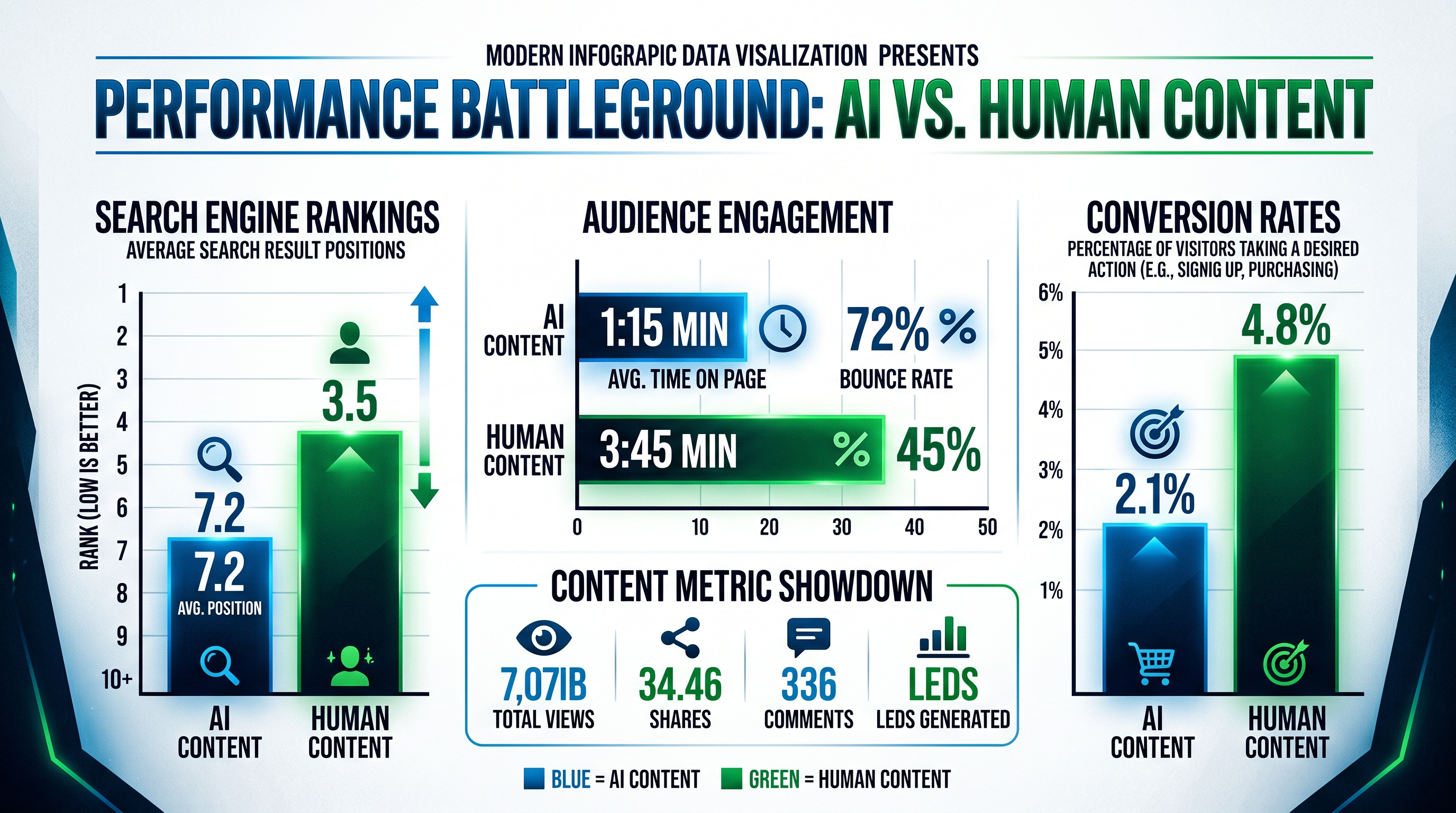
This is where the "AI content is just as good" narrative falls apart at the top of the SERP. The Semrush study of 42,000 blog posts found that purely AI-generated content holds the #1 SERP position only 9% of the time, compared to 80% for human-written content — an 8x gap at the very top of search results.
The Digital Applied 16-month study of 4,200 articles across 140 domains provides additional nuance: pure AI content ranked 23% lower on average than human-written articles. Yet AI-assisted content with substantive human editing performed within just 4% of fully human-written content — a gap that is statistically negligible for most business purposes.
Reboot Online took a more scientific approach with 25 paired websites — AI-written vs. human-written content competing head-to-head in Google. The verdict was clear: AI-generated content ranked lower on average in 21 of 25 tests.
Verdict: For #1 rankings on competitive keywords, human content wins. Period. For page-one presence on informational, low-competition keywords, AI-assisted content is close enough to deploy at scale.
Criterion 2: Google's E-E-A-T and Quality Signals
Google's January 2025 Search Quality Rater Guidelines update instructs evaluators to assign the lowest quality rating to pages where most main content consists of AI-generated text with little effort, little originality, or little added value. This is not a punishment for using AI — it is a punishment for not adding anything on top of it.
Google's March 2026 core update amplified this pattern. Sites with scaled AI publishing operations saw the largest ranking declines and a spike in deindexation. The update disproportionately penalized unedited AI content at scale.
Google does not penalize AI content for being AI-generated. It penalizes low-quality content regardless of how it was created. That distinction matters enormously for how you build your workflow. Quality is the filter, not origin.
"AI content is good for generating traffic but bad at building trust... it's like reading a Wikipedia page — even if you solve the reader's problem, they won't remember you." — Ahrefs Content Strategist
Criterion 3: Content Velocity and Cost
This is AI's strongest battlefield. A competent human writer produces 4–8 long-form articles per month at a cost of $150–$600 per piece. AI tools collapse that cost by 90%+ and can generate hundreds of drafts in a day. 93% of marketers report creating content faster with AI, and 81% report boosted brand awareness and sales.
A 2025 industry analysis found that nearly 70% of businesses reported improved ROI after integrating AI into their SEO workflows, while around 86% of marketers still edited AI-generated drafts before publication. That second figure is the key strategic signal: the fastest-moving teams use AI for volume and humans for quality control, not one or the other.
For SaaS founders and small business owners trying to build keyword coverage for small business sites, publishing 30+ well-structured articles per month via an AI-assisted workflow is the only realistic path to topical authority without an agency budget.
Verdict: For content velocity and cost efficiency, AI wins. Period.
Criterion 4: Engagement Metrics
The engagement data is more nuanced than most people expect. AI content scored 3% lower on quality perception but generated 31% higher engagement in one Grafit Agency study — likely because AI structures content with more scannable headers and lists that keep readers moving through a page.
However, depth and trust tell a different story. Pure AI-generated text that lacks insight or reads like it was written by a robot tends to fail at keeping readers interested. Terakeet's content quality test found that AI drafts were often formulaic, full of broad generalizations, and sometimes just a dry "wall of text."
Sites using AI with human editors saw bounce rate reductions of up to 73%. The key was human refinement of AI output, not raw AI content. This is the pattern that repeats across every engagement study: AI creates structure, humans create connection.
Criterion 5: Conversions
Here AI surprises most marketers. AI content landing pages generate 36% higher conversion rates, according to Position Digital's 2026 research. The likely reason: AI writes more direct, structured copy with cleaner calls to action and less editorial meandering.
For thought leadership content, case studies, and technical whitepapers, human authorship is not optional — it is a liability management decision as much as a quality one. High-consideration B2B buyers read deeply before converting and they detect generic content immediately.
Verdict: For top-of-funnel and transactional landing pages, AI wins on conversion rate. For bottom-of-funnel, trust-based content, human wins.
Criterion 6: GEO — Getting Cited by AI Search Engines
This is the newest front in the content war, and most brands are completely unprepared for it. For the first time, AI-powered search ranked as the #1 digital source people use when making buying decisions, ahead of traditional search engines, review sites, and brand websites. 50% of consumers now intentionally seek out AI-powered search tools.
When it comes to securing AI mentions and citations, content depth (sentence and word counts) and readability matter most, while traditional SEO metrics like traffic and backlinks have little impact. This is a fundamental shift. Content that is well-structured and authoritative — regardless of origin — is more likely to be cited.
Understanding which AI-powered SEO tools are built to optimize for GEO citation, not just traditional rankings, is quickly becoming a competitive differentiator for content teams in 2026.
Use Case Decision Framework
| Use Case | Best Approach | Reasoning |
|---|---|---|
| Informational blog posts (low-competition keywords) | AI + light human edit | Near-identical page-1 rate, 10x the volume |
| Competitive head-term articles (#1 target) | Human-written, AI-assisted | 8x better #1 ranking rate for human content |
| Landing pages / product pages | AI-drafted, human-refined CTA | 36% higher conversion rate for AI landing pages |
| Thought leadership / opinion pieces | Human-first, AI for research | Trust and backlinks require authentic voice |
| Technical whitepapers / regulated content | Human-written, AI for editing only | Factual accuracy + liability management |
| Topical authority at scale (30+ articles/month) | AI pipeline with human oversight | Only economically viable path for SMBs |
| GEO / AI Overview citation targeting | Hybrid with structured formatting | Depth and readability drive AI citations, not traffic |
The Hybrid Workflow: How Winning Teams Operate
87% of teams keep humans heavily involved in content creation. This is not because AI is bad at writing — it is because the highest-ROI workflow uses each resource for what it does best.
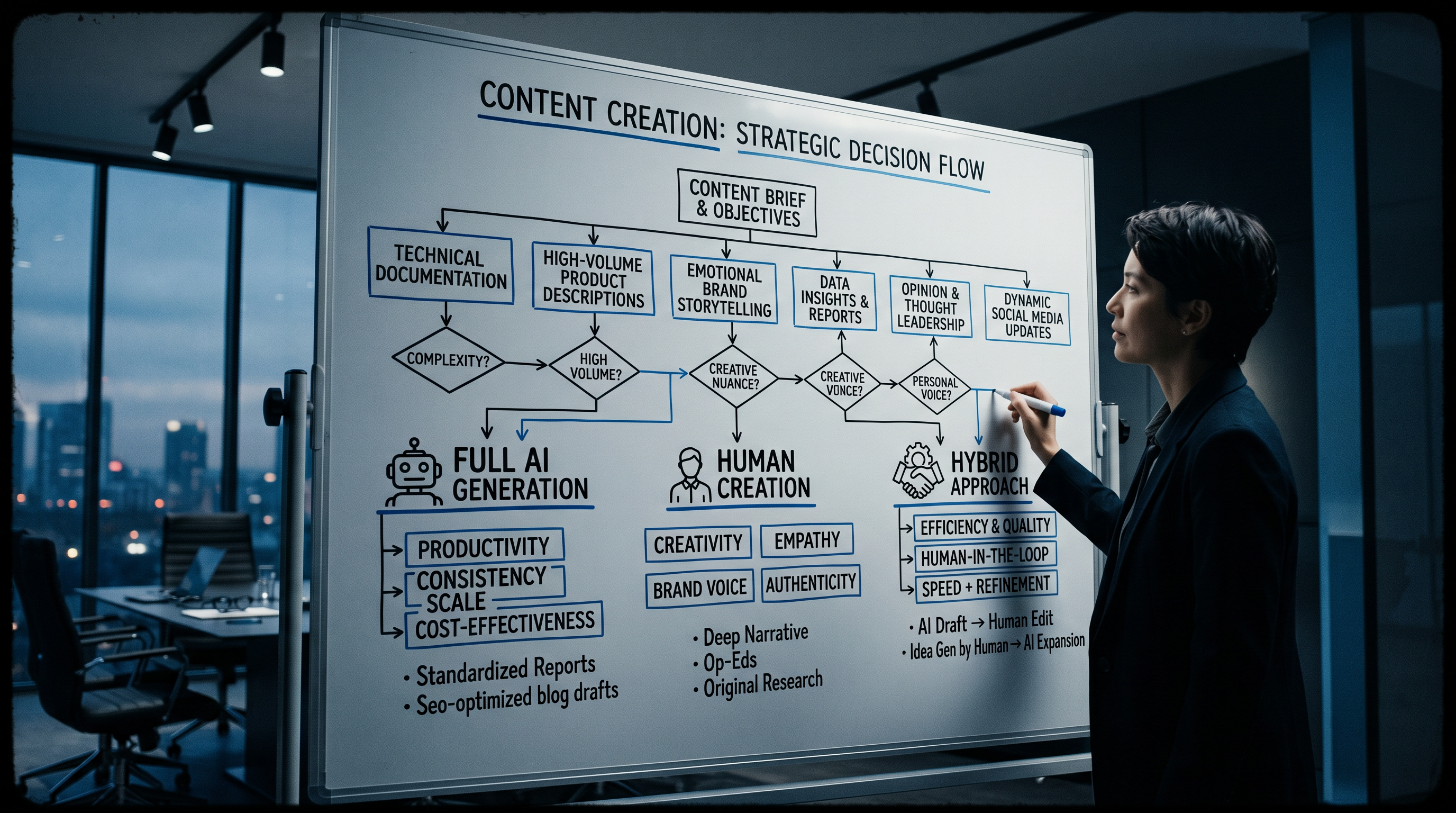
We use the hybrid model because it is the only approach that passes both the speed test and the trust test. Here is the exact workflow that delivers results:
- Human strategy — A human decides the target keyword cluster, audience angle, and unique point of view. AI does not pick the strategy; it executes it.
- AI research + outline — AI surfaces semantic gaps, related questions, and competitor angles in minutes.
- AI first draft — AI generates a structured draft with proper heading hierarchy, lists, and definitions that search engines parse efficiently.
- Human editing layer — A human adds firsthand experience, removes hallucinations, and sharpens the brand voice.
- AI optimization pass — AI tools handle internal linking, meta descriptions, and schema suggestions.
- Human final review — A human approves before publication. This is non-negotiable for regulated industries and brand-sensitive content.
Platforms like full-service SEO automation platforms are built to run steps 2–5 automatically, giving small teams the output of an agency without the headcount. The human layer at steps 1 and 6 is where competitive advantage actually lives.
The Hallucination Problem: AI's Real Achilles' Heel
AI tools hallucinate. That is not a metaphor. They generate plausible-sounding false information because they predict likely text, not verified truth. As of 2026, even the most advanced AI models carry a meaningful error rate on specific factual claims, statistics, and citations.
A single high-profile factual error in AI-generated content can cost more in reputation than the entire production budget saved. This is the strongest argument for keeping humans in the editorial loop — not writing speed, not creativity, but factual accountability.
Clear Verdicts by Scenario
- For ranking #1 on a competitive keyword: Human-written content wins. Period.
- For publishing 30 articles a month without an agency: AI-assisted content wins. Period.
- For landing page conversions: AI-drafted copy wins. Period.
- For earning backlinks and brand trust: Human content wins. Period.
- For topical authority at scale with Google compliance: Hybrid wins. Period.
- For getting cited in AI Overviews and Perplexity: Hybrid with structured formatting wins. Period.
FAQ
Does Google penalize AI-generated content in 2026?
Google does not penalize AI content for being AI-generated. It penalizes low-quality content regardless of how it was created. The risk is not the tool — it is the output. Unedited AI content that adds no original insight, expertise, or experience will be deprioritized under Google's E-E-A-T framework. AI content that has been substantively edited and enriched by humans performs within 4% of fully human content in ranking studies.
Which content type ranks faster: AI or human?
Broader industry data from late 2025 shows AI-written content plateauing and performing poorly in search overall, suggesting that the initial flood of AI-generated material has not translated into sustained rankings or traffic. AI content can rank briefly, but it rarely sticks. Early visibility followed by a steady decline is the typical trajectory for pure AI content. Human-edited AI content holds rankings significantly longer.
Is AI content detectable by Google?
Google has publicly stated it does not use AI detection as a ranking signal. Its systems focus on quality signals, not origin detection. However, 72% of SEOs said AI content performs as well as or better than human content, yet ranking data showed a clear human advantage at the top. The perception gap is large. Trust your ranking data, not the marketing claims from AI writing tool vendors.
What is the cost difference between AI and human content at scale?
A human-written long-form article typically costs $150–$600 depending on the writer's expertise and research depth. AI-assisted articles with a human edit layer cost $20–$80 on average. At 30 articles per month, that difference is $3,900–$16,500 per month, or $46,800–$198,000 per year. For most SMBs, this cost gap is the primary driver of AI adoption, and the data shows it is economically justified for informational content at scale.
How does AI content perform in AI-powered search (GEO)?
Q&A is the best format for AI search. Structured content using headings and lists is almost as effective for non-question queries, while dense paragraphs perform worst. AI-generated content actually has a structural advantage here because it naturally defaults to heading hierarchies and bullet lists. The content that gets cited in AI Overviews is well-structured and deep — qualities that hybrid content delivers better than either pure approach.
Rankcow is built for exactly the hybrid reality this data describes — AI-generated, brand-aligned content published automatically to your CMS at 30 articles per month, with built-in internal linking, E-E-A-T optimization, and support for 150+ languages. If you are done managing the content pipeline manually and want to see what an 8.4x average traffic lift looks like in practice, start your Rankcow subscription today.