Keyword Research for Dummies: A Plain-English Guide to Finding Keywords That Actually Rank
Keyword research is the process of finding the exact words and phrases people type into Google when they're looking for something — and then building your content around those terms. It is, simply put, the difference between writing content that gets found and writing content that disappears. If you have a website and you want organic traffic, keyword research is where everything starts.
This confused me too, once. I remember staring at a spreadsheet full of numbers — search volume, keyword difficulty, CPC — and having absolutely no idea what to do with any of it. This guide breaks all of it down from scratch, in plain English, with no assumed knowledge.

Why Keyword Research Actually Matters 🎯
Think of Google like a massive library, and keyword research like finding out which shelf your ideal reader visits most often. You could write the best book in the world, but if it's shelved in the wrong section, nobody finds it.
Most pages fail because they skip keyword research entirely. Long-tail keywords are easier to rank for AND convert at a significantly higher rate than short, broad terms. That's not a minor footnote — it's the core reason why two websites in the same niche can have wildly different traffic numbers.
B2B companies using strategic keyword research achieve 702–1,389% ROI from SEO, according to First Page Sage research. Even if you're a solo blogger or a small business owner, that principle scales down perfectly well to your context.
One more number worth knowing: with 58.5% of searches now resulting in zero clicks, understanding search intent has become more important than chasing volume. More on intent in a moment.
The Core Concepts, Explained Simply
What Is a Keyword?
Keywords — sometimes called "SEO keywords" — are any words or phrases a user types into a search engine to find information. The keyword is a gateway that leads people to the organic search results and, ultimately, to the website where they find what they're looking for.
So "best running shoes for flat feet" is a keyword. "Coffee shops near me open Sunday" is a keyword. Any phrase someone types into Google is, technically, a keyword.
Search Volume
Search volume tells you approximately how many times a keyword is searched per month. A keyword with 10,000 monthly searches sounds great — but it's probably dominated by massive sites. A keyword with 300 monthly searches might be very winnable. Volume is not the only number that matters.
Keyword Difficulty (KD)
Keyword difficulty measures how hard it is to rank for a keyword based on the current top-ranking pages and their authority. Competition usually refers to how many advertisers are bidding on a keyword in paid search. Both metrics help you prioritize which keywords to target.
Think of it like a local 5K race vs. the Olympics. Both are races. Only one is realistic for a newcomer.
Search Intent
In 2026, matching search intent is arguably more important than keyword density. Google's algorithm has become extremely good at understanding what a searcher actually wants — and it ranks content accordingly.
There are four main intent types:
| Intent Type | What the User Wants | Example Keyword |
|---|---|---|
| Informational | To learn something | "how does SEO work" |
| Navigational | To find a specific site | "Ahrefs login" |
| Commercial | To compare before buying | "best SEO tools 2026" |
| Transactional | To buy or sign up right now | "buy SEO software" |
A practical rule that works every time: before you start writing any piece of content, Google your target keyword and look at the top 3-5 results. If they're all listicles, write a listicle. If they're all step-by-step guides, write a guide.
Long-Tail vs. Short-Tail Keywords
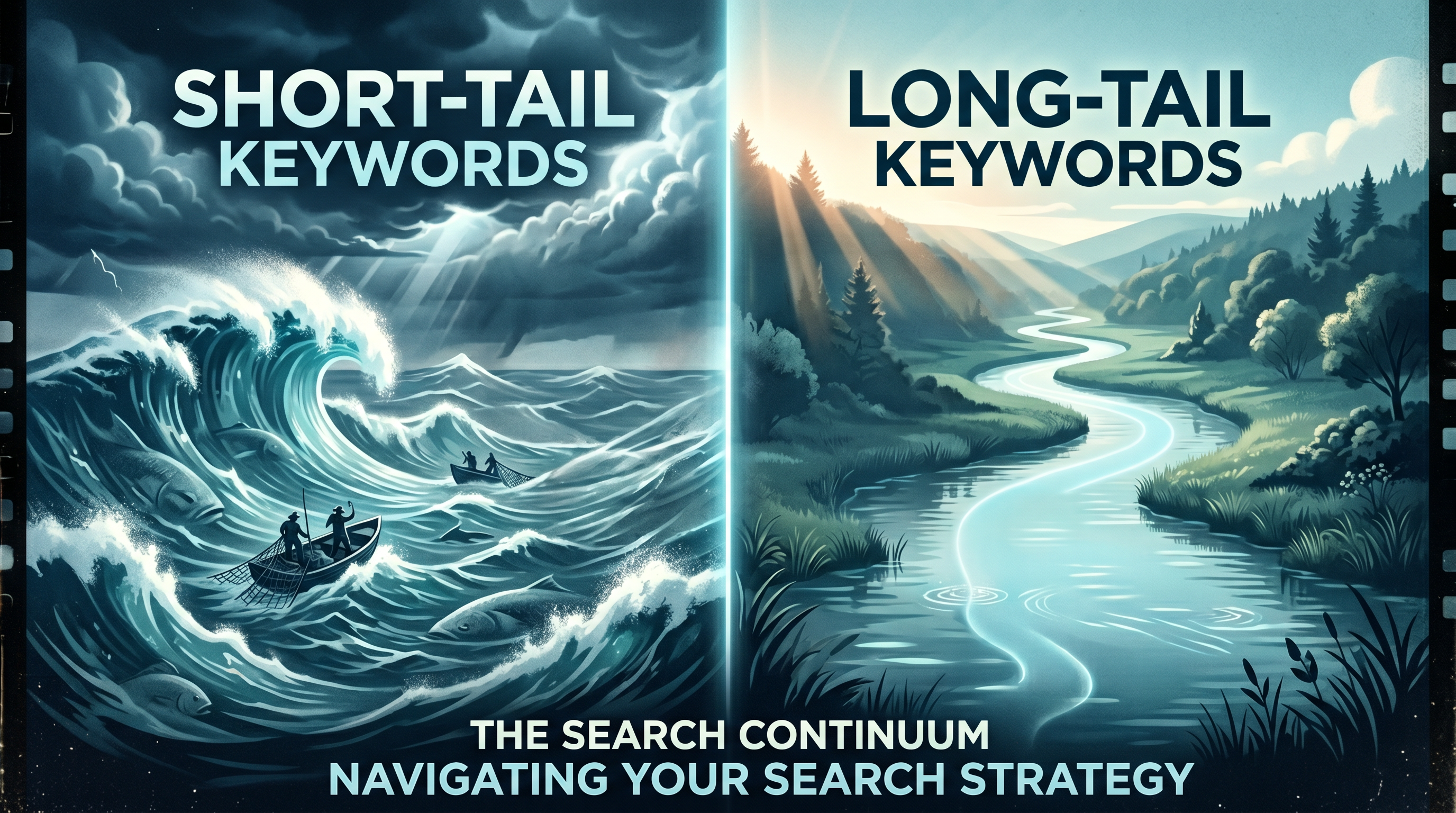
Short-tail keywords are broad and high-volume: "shoes," "SEO," "coffee." Long-tail keywords are specific and lower-volume: "waterproof trail running shoes for wide feet," "SEO for plumbers in Austin."
Long-tail keywords give faster wins and set up domain authority. Long-tail keywords — those containing 3 or more words with more specific intent — convert at 2.5x the rate of short-tail keywords and generate 91.8% of traffic.
For anyone starting out, long-tail and question keywords are the fastest path to ranking. They have lower competition, attract highly specific audiences, and are more likely to be featured in Google's People Also Ask boxes.
The Bookmark-Worthy Framework: SIFT 📌
Before you touch any tool, run every keyword through this mental model. Call it SIFT:
| Letter | Question to Ask | Why It Matters |
|---|---|---|
| S — Search Volume | Does anyone actually search this? | No volume = no audience |
| I — Intent Match | Does my content match what the searcher wants? | Wrong intent = high bounce rate |
| F — Feasibility | Can my site realistically rank for this? | High KD on a new site = wasted effort |
| T — Traffic Value | Will ranking here bring the right people? | Relevant traffic beats raw traffic |
Save this table. It replaces a lot of overthinking.
How to Do Keyword Research: Step by Step
Step 1 — Start with Seed Keywords
Seed keywords are broad terms describing your niche — starting points that tools will expand into hundreds of specific opportunities. To brainstorm, think about what your ideal reader would type into Google.
If you run an accounting software company, your seed keywords might be "bookkeeping," "small business taxes," "invoice software." Aim for 5-10 seeds to start. Don't overthink it — the tools do the heavy lifting next.
Step 2 — Use Tools to Expand Your List
This is where you go from a handful of ideas to a full content plan. Here's how the major tools stack up for beginners:
| Tool | Best For | Cost |
|---|---|---|
| Google Keyword Planner | Free volume data, straight from Google | Free (needs Google Ads account) |
| Google Search Console | Seeing which keywords already bring you traffic | Free |
| Ahrefs | Deep competitive analysis and keyword difficulty | From $29/mo |
| SEMrush | All-in-one: gaps, intent, SERP analysis | From $139.95/mo |
| AnswerThePublic | Question-based and long-tail ideas | Free (limited) / Paid |
The best keyword research technique to start with is simply going into Google and typing a keyword you want to rank for, then seeing what Google Autocomplete shows. From there, you analyze the links that appear and look for any mismatch in search intent or gaps. This is the core way of analyzing keywords in Google recommended for any beginner.
For new sites and small businesses, understanding low-competition keyword targeting is one of the fastest ways to build early organic traffic without going up against huge domains.
Step 3 — Analyze Intent and Filter
Once you have a big list, run each keyword through your SIFT framework above. Filter out anything where:
- The difficulty score is too high for your current domain authority
- The top results don't match the content type you can create
- The intent is transactional but you only have an informational page to offer
Step 4 — Map Keywords to Pages
This is the step where most keyword research breaks down. Teams produce a list of 200 keywords and then publish content based on instinct rather than search data. Keyword mapping fixes this by assigning specific keywords to specific pages before any content is created.
One keyword per page is the rule. You can target 2-4 closely related variants on the same page, but anchor each piece of content to one primary term.

Keyword Research for Specific Situations
For Small Businesses
Local and niche keywords are your best friend. Instead of targeting "accountant," target "small business accountant in Denver." If you're just getting started with SEO in a competitive niche, keyword research strategies built for small businesses prioritize local search terms and long-tail phrases where you can realistically compete on a limited budget.
For SaaS Companies
A B2B SaaS keyword with 200 monthly searches may drive $50K in pipeline if it targets VP-level buyers. Use CPC as a proxy for commercial intent — keywords with high CPC signal high-value traffic regardless of volume. High-value intent keywords — like "project management software for remote teams" — are worth more than generic terms with ten times the volume. You can find a deeper breakdown of this approach in a solid high-intent keywords guide that walks through exactly how to identify and prioritize these terms.
For Bloggers and Content Creators
Certain keywords experience temporal fluctuations. For instance, "Christmas gifts" surges during November and December, while "tax software" peaks around March and April. Google Trends illuminates such patterns. Developing seasonal content ahead of spikes provides Google with indexing time and improves ranking prospects.
Common Beginner Mistakes (and How to Avoid Them)
Mistake 1 — Chasing High Volume, Ignoring Difficulty
A keyword with 100,000 monthly searches means nothing if the first page is owned by Wikipedia, Forbes, and HubSpot. Always check who currently ranks before committing to a keyword.
Mistake 2 — Ignoring Zero-Volume Keywords
Keep an eye on zero-volume keywords. Research shows that some of the most valuable B2B queries — like "HubSpot onboarding agency Dubai" — may show no recorded search volume but represent high-intent buyers ready to act. Volume tells you what is popular. Intent tells you what converts.
Mistake 3 — Treating It as a One-Time Task
Keyword research is not a one-time activity. Search volumes change, new keywords emerge, competitors come and go, and algorithm updates reshape SERPs. Revisit your keyword strategy every 3-6 months, update older content to target emerging keywords, and continuously expand your topic clusters.
Mistake 4 — Forgetting About AI Search
Google's AI Overviews now appear at the top of results for many informational queries. For some keywords, AI Overviews reduce organic click-through rates. The best response is to target keywords where AI Overviews are not triggered — specifically more long-tail queries — or where being cited inside the AI Overview still builds brand authority.
Pairing your content strategy with the right tools matters more than ever in 2026. Looking at the best SEO tools for beginners can help you pick a starting stack without overspending or getting overwhelmed by enterprise-level platforms.

Frequently Asked Questions
How many keywords should I target per page?
One primary keyword per page, with 2-4 closely related secondary keywords in the same intent cluster. Trying to cram multiple unrelated keywords into one page confuses both Google and your reader. The primary keyword should appear naturally in your title tag, opening paragraph, at least one H2 subheading, and throughout the body copy.
What's the difference between keyword difficulty and competition?
Keyword difficulty measures how hard it is to rank for a keyword based on the current top-ranking pages and their authority. Competition usually refers to how many advertisers are bidding on a keyword in paid search. For organic SEO purposes, focus on keyword difficulty. Competition is more relevant if you're running Google Ads.
Do I need a paid tool to do keyword research?
No — not at the start. The best free keyword research tools include Google Keyword Planner, Google Trends, AlsoAsked, and Bing Webmaster Tools. All of these serve different purposes but are free to use, and are recommended starting points for any beginner. As your site grows and you need competitive data, upgrading to a paid tool like Ahrefs or SEMrush becomes worthwhile.
How long does keyword research take?
For a single article or page, a focused session of 20-30 minutes is enough to identify a primary keyword, check intent, review competitors, and confirm difficulty. For a full content strategy across a new website, expect 4-8 hours to build a proper keyword map covering your main topic clusters. The investment pays off: HubSpot saw a 50% traffic increase in a single month after reorganizing content around keyword clusters.
Is keyword research still relevant with AI search?
Keyword research in 2026 combines traditional search analysis with AI search optimization to identify the terms and topics your audience uses across Google, ChatGPT, and Perplexity. The process involves understanding search intent, building topical authority, and structuring content for both human readers and AI extraction. So yes — the practice has evolved, but it's more important than ever, not less.
If keyword research is the map, consistent content publishing is the vehicle — and that's exactly what Rankcow automates for you. Rankcow identifies high-intent, low-competition keywords and automatically generates, optimizes, and publishes up to 30 long-form articles per month directly to your CMS, delivering an average 8.4x traffic lift for its users. If you're ready to put your SEO on autopilot without hiring an agency, explore what Rankcow can do for your site.