SaaS SEO Strategy: The Complete Guide to Organic Growth in 2026
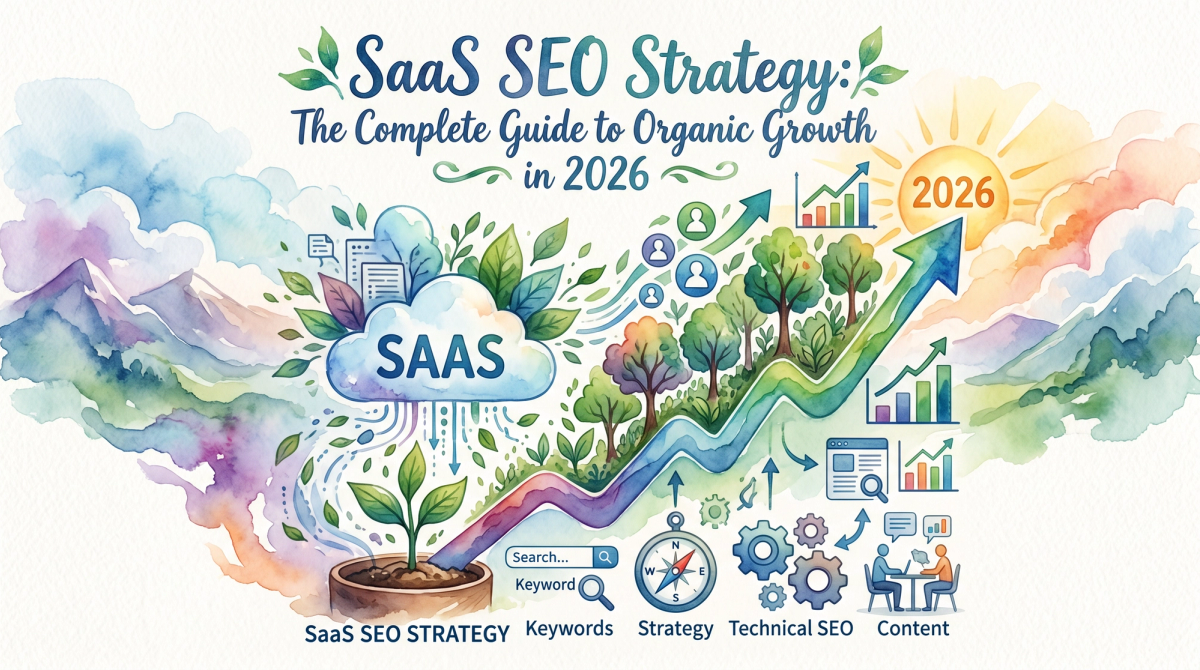
This confused me too when I first started: why does a SaaS company need a completely different SEO playbook from, say, a local bakery or an e-commerce store? After all, SEO is just SEO, right? Not quite. SaaS SEO strategy is its own discipline, built around long buyer cycles, subscription-based conversions, and content that has to win trust before a prospect ever considers a free trial. Get it right, and it becomes your best sales rep. Get it wrong, and you burn months publishing content that ranks but never converts. This guide breaks the whole system down, from first principles to advanced tactics.

Why SaaS SEO Is Different from Regular SEO
Think of traditional SEO like marketing a corner bakery. Someone searches "best croissants near me," they show up, they buy, done. The buying cycle is minutes long. SaaS is nothing like that.
SaaS buyers research for weeks or months before committing to a subscription. They compare tools, read reviews, test free trials, and evaluate pricing. Your SEO strategy must capture attention at every stage of this journey, from "what is project management software" all the way to "Monday vs Asana vs ClickUp."
There's also the revenue math. SaaS keywords like "best CRM" or "project management tool" are among the most contested on the internet because each conversion is worth hundreds or thousands in lifetime revenue. You aren't chasing one-time sales. You're fighting for recurring revenue, and your competitors know that just as well as you do.
The single biggest difference? Traditional SEO is about sending traffic to your site. SaaS SEO means business results. Traditional SEO focuses on impressions, clicks, and rankings. With SaaS SEO, it's about conversions like free trials, demos, and subscriptions. This makes SaaS SEO more strategic, where every effort is tied to revenue growth, not just visibility metrics.
The Business Case: Why Organic Search Cannot Be Optional
Before building your strategy, it helps to understand what's at stake. The numbers here are hard to ignore.
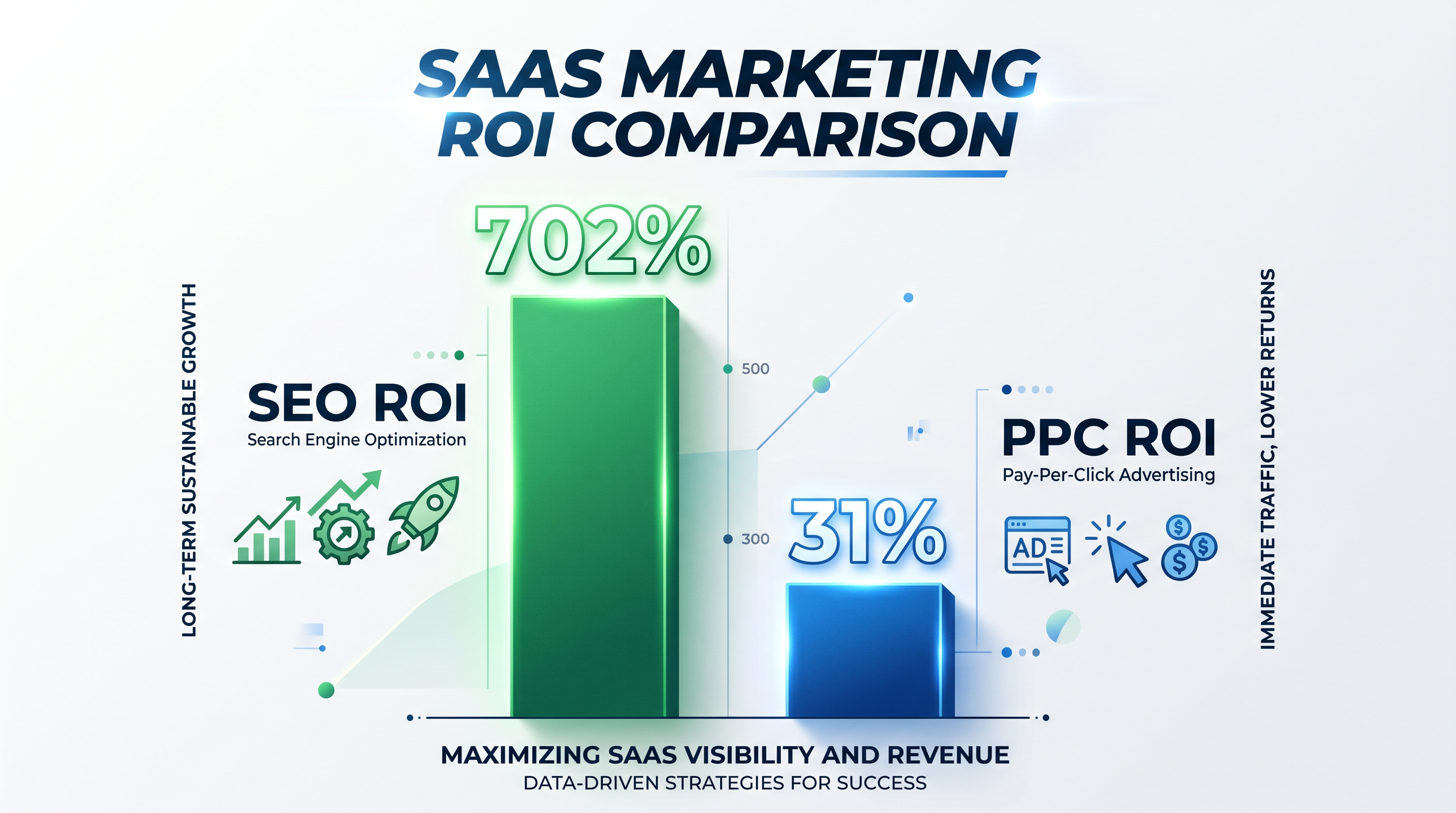
Organic search drives approximately 53% of total SaaS website visits, making it the most cost-efficient growth channel. And at the revenue level, SEO is one of the highest-return marketing channels in B2B SaaS. Over a three-year average, B2B SaaS companies saw a 702% ROI from SEO campaigns.
Compare that to paid ads: the average customer acquisition cost for organic channels is $205, while paid channels cost roughly $341 per customer acquired, meaning investing in SEO can save you around 39.9% in marketing costs compared to PPC.
57% of B2B decision-makers start their product research using search engines. And 83% of B2B buyers conduct self-research before ever speaking to a sales rep. If you're not visible during that research phase, you don't exist in their consideration set.
The Four Pillars of a SaaS SEO Strategy
SaaS SEO combines four core disciplines: Technical SEO (the foundation), On-page SEO (the content), Off-page SEO (the authority), and GEO (AI visibility). Each plays a critical role in how search engines and AI systems discover, understand, and recommend your pages. Here's how each pillar works in practice.
Pillar 1: Technical SEO (The Foundation)
Think of technical SEO like the plumbing in a house. Guests never see it, but without it, nothing works. Core Web Vitals, mobile optimization, and structured data are non-negotiable for SaaS visibility in 2026. Specifically, you need a clean XML sitemap submitted to Google Search Console, schema markup on key page types (Organization on homepage, Article on blog posts), and proper use of robots.txt to prevent indexing of low-value pages like filtered views or admin sections.
Pillar 2: Keyword Research and Intent Mapping
This is where most SaaS teams go wrong. They chase volume instead of intent. Keyword research for SaaS SEO in 2026 prioritizes intent, value, and conversion potential over raw search volume. Low-volume, high-intent keywords often generate higher-quality demos and signups.
A smart way to structure this is by funnel stage. The SaaS buying journey has three stages: awareness, consideration, and decision-making. In the awareness stage, users seek problems or education. In the consideration stage, they compare tools. In the decision phase, they look at price, features, and product fit. Your keyword map should cover all three layers.
Don't dismiss low-volume terms either. All SEO tools underreport low-volume keywords. When you see "10" or "0" searches in your research, don't dismiss them. Ranking for these "zero volume" terms can generate real traffic because you end up ranking for dozens of related queries alongside them. Matching keyword research to specific buyer pain points rather than generic high-volume terms is what separates good SaaS content from content that just collects dust.
Pillar 3: Content Architecture (The Hub-and-Spoke Model)
Think of your content like a solar system. Your pillar page is the sun, and your cluster articles are the planets orbiting it. Each cluster article strengthens the pillar, and the pillar passes authority back to each cluster. This is called the hub-and-spoke model, and it's the dominant content architecture for SaaS SEO in 2026.
Bottom-of-funnel keywords (alternatives, vs, pricing) drive 40-60% of organic SaaS conversions. Hub-and-spoke content architecture is the most effective SaaS SEO strategy: a pillar page links to 10-30 supporting articles, building topical authority that Google rewards with higher rankings across the entire cluster.
Ranking isolated blog posts is no longer enough. You need a content ecosystem that supports the full decision journey. Blog posts, glossaries, and "how it works" guides help prospects discover your domain and clarify concepts.
Internal linking is the connective tissue holding your content cluster together. Scalable, authority-building, structured content systems are the foundation of enterprise SEO. This involves heavy internal linking, big content clusters, and advanced optimization techniques, which allow for long-term growth and strong authority positioning in competitive SaaS markets. Reviewing the best internal linking tools available can help you automate this process at scale.
Pillar 4: GEO (Generative Engine Optimization)
This is the new pillar most SaaS teams haven't fully built yet, and it may be the most consequential one in 2026.
SaaS SEO in 2026 means optimizing for two discovery surfaces at once: traditional search engines and AI answer engines. 94% of B2B buying groups now use large language models during their purchase journey. If your content isn't structured to be cited by AI models like ChatGPT, Perplexity, and Google's AI Overviews, you're invisible to a growing slice of your potential buyers.
Only 15% of top 500 SaaS domains appear inside AI Overviews. SaaS companies using schema markup and FAQ structures are 35% more likely to appear in AI-driven summaries. The practical fix: write concise, direct answers to common buyer questions, use structured data, and aim for authoritative, in-depth content that can be cited by AI answer engines.
📊 The SaaS SEO Strategy Framework (Save This)
This mental model maps every core activity to its purpose. Bookmark it.
| SEO Layer | Core Activity | Primary Goal | Timeline to Impact |
|---|---|---|---|
| Technical SEO | Site speed, Core Web Vitals, schema, sitemaps | Crawlability and indexing | 1–4 weeks |
| TOFU Content | Educational blog posts, glossaries, how-to guides | Brand awareness and traffic | 3–6 months |
| MOFU Content | Comparison pages, alternative pages, use-case guides | Trial signups and demos | 4–8 months |
| BOFU Content | Pricing pages, feature pages, competitor vs. pages | Direct conversions | 2–6 months |
| Link Building | Original research, link-worthy tools, outreach | Domain authority | 6–12 months |
| GEO / AEO | FAQ schema, direct answers, entity building | AI citation and visibility | 2–5 months |
How Long Does SaaS SEO Actually Take?
This is the question every founder asks, and the honest answer is: longer than you want, but worth the wait.
SEO for SaaS typically shows initial ranking shifts and traffic gains within 3 to 6 months through technical audits, keyword clustering, and content publishing. Meaningful organic traffic growth that impacts pipeline usually takes 6 to 12 months. Long-tail informational content can rank in 90 days, while competitive commercial keywords like alternatives and comparison pages take 6 to 12 months depending on domain authority. Full ROI from a sustained SaaS SEO program materializes over 12 to 24 months as compounding traffic and backlink authority build.
The compounding nature of SEO is what makes it so valuable over time. A blog post written today generates traffic for years with zero incremental cost. The companies dominating organic search in 2026 did not get there in 6 months. They executed a consistent SaaS SEO strategy for 2-3 years and now generate millions in organic traffic that costs nothing incremental per visit.
Practical Applications: Putting the Strategy to Work
Start With Bottom-of-Funnel Keywords
Most teams start at the top of the funnel, writing broad educational content. The smarter move is to start at the bottom, where purchase intent is highest. Pages targeting "[your product] vs [competitor]," "[your product] pricing," and "[competitor] alternatives" convert at dramatically higher rates because the reader is already close to a buying decision. Build those pages first, then expand outward.
Build for E-E-A-T
Experience, Expertise, Authority, and Trust (E-E-A-T) is a big deal for SaaS websites. Strong E-E-A-T boosts credibility and ranking results in competitive industries. This is how SEO for SaaS companies creates trust signals for search engines to determine the quality of content. Practically, this means attributing content to named authors with credentials, publishing original data, and earning mentions on credible third-party sites like G2, Reddit, and industry publications.
Match Content Velocity to Your Domain Authority
A new SaaS site with low domain authority shouldn't try to rank for "best CRM software" out of the gate. Start by publishing 2-4 high-quality articles per month targeting keywords with a keyword difficulty (KD) under 20. Win those rankings, build authority, then work toward harder terms. It's the same logic as a new gym member starting with light weights before attempting a personal record.
Platforms like the best AI SEO tools available in 2026 can help automate keyword discovery, content generation, and publishing at a pace that would be impossible for a small team working manually. Rankcow, for example, automates the entire pipeline including keyword research, long-form content creation, and CMS publishing at a rate of 30 articles per month, which removes the consistency problem that kills most SaaS content programs.

Common Mistakes (and How to Avoid Them) ⚠️
Mistake 1: Optimizing for Traffic, Not Pipeline
Getting 10,000 monthly visitors who never convert is worse than getting 500 visitors who book demos. Tie every content piece back to a conversion goal. Track organic trial signups and demo requests, not just sessions.
Mistake 2: Ignoring the AI Search Layer
Gartner predicted that traditional search engine volume would drop 25% by 2026 due to AI chatbots and virtual agents. AI Overviews now appear in 48% of Google queries and reduce organic click-through rates by 61%. Ignoring GEO optimization is no longer a minor oversight. Structure content with clear, direct answers and proper schema so AI models can extract and cite your brand.
Mistake 3: Publishing Without Internal Links
Content without internal links is like building rooms in a house with no hallways. Your new content can't inherit authority from your existing pages, and Google can't efficiently crawl your site structure. Every new article should link to at least 2-3 relevant existing pages and receive at least 1-2 links from existing content.
Mistake 4: Treating Content as One-Off Projects
Content is the engine that powers SaaS SEO. Without a consistent publishing strategy, even the best technical setup will underperform. Sporadic publishing doesn't build topical authority. Google rewards sites that consistently demonstrate expertise on a topic over time.
Mistake 5: Measuring Too Early
Many SaaS teams abandon their SEO investment after three months because they don't see dramatic results. This is equivalent to canceling a savings account after 90 days because it "isn't rich yet." SEO compounds. Expect early signals in months 1-3, meaningful traffic in months 4-8, and real pipeline impact from month 6 onward.
Frequently Asked Questions
What is a SaaS SEO strategy, exactly?
SaaS SEO is the practice of optimizing a software-as-a-service website to attract, educate, and convert high-intent buyers through organic search. As buyer behavior, AI-driven discovery, and trust-based decision-making reshape how software is found and evaluated, SaaS SEO in 2026 goes beyond rankings and traffic. It focuses on answering real buying questions and guiding prospects through their decision journey.
How is SaaS SEO different from B2B SEO?
B2B SEO focuses on attracting business customers through strategies that address complex buying processes with multiple stakeholders, while SaaS SEO specifically optimizes for software-as-a-service products with recurring subscription models. The key difference lies in the conversion goals: B2B SEO might target various business models, while SaaS SEO zeros in on driving trial signups, demonstrations, and subscription conversions. SaaS SEO also faces unique challenges like explaining technical products to non-technical decision-makers and demonstrating product value without face-to-face sales conversations.
What keywords should a SaaS company target first?
Start with three categories: BOFU commercial keywords (your brand vs. competitor, your product alternatives, pricing-related terms), long-tail problem-aware queries your exact persona searches, and glossary or definitional terms in your niche that have consistent search demand. Target audience pain points, not just search volume. Keywords with 10-50 monthly searches that your target persona actually types are more valuable than high-volume generic terms. Someone searching "how to secure n8n workflows" is far more qualified than someone searching "what is AI security."
How much should a SaaS company budget for SEO?
A typical SaaS allocation to SEO is roughly 20-30% of the overall marketing budget. In dollar terms, SaaS SEO budgets typically range from $3,000 to $15,000 per month for early-stage companies. That said, automation platforms have substantially changed the cost equation. A tool that publishes 30 optimized articles per month at a flat subscription rate can deliver agency-level content volume at a fraction of the traditional agency price.
Does publishing more content actually help SaaS SEO?
Yes, but with an important caveat: volume without quality and topical focus does more harm than good. The average SaaS site earns traffic from about 1,200-2,000 ranking keywords within six months of consistent publishing. Long-tail keywords now generate roughly 68% of SaaS organic traffic, up from 58% in 2023. Consistent, topically focused publishing is what builds the cluster authority Google rewards with broad ranking lifts.
Rankcow takes the execution burden off SaaS teams entirely, automatically identifying high-intent keywords, generating brand-aligned long-form content, and publishing directly to your CMS at 30 articles per month. With an 8.4x average traffic lift across 1,000+ customer sites and support for 150+ languages, it's the fastest way to build topical authority without hiring an agency or burning out your content team. Start your organic growth engine today.