Long Tail vs Short Tail Keywords: The Complete Strategic Showdown (2026)
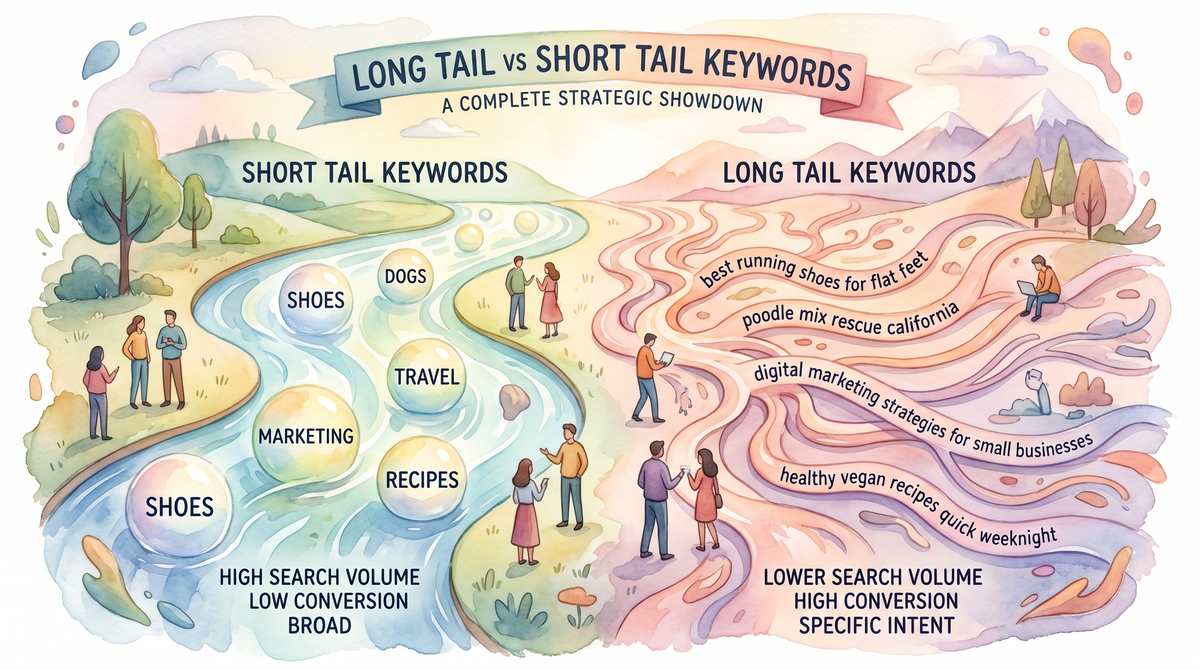
Long tail keywords are specific, lower-volume phrases (3+ words) that convert at up to 36%, while short tail keywords are broad 1-2 word terms that drive high traffic volumes but convert at just 2.35%. For most businesses competing in 2026, long tail keywords are the smarter starting point because they are easier to rank for, attract buyers closer to a decision, and are far less dominated by authority sites. That said, short tail keywords still belong in a mature SEO arsenal — just not at the top of your priority list if you're resource-constrained.

We evaluated both keyword types across three hard criteria: ranking accessibility (how realistically can a new or mid-authority site rank?), conversion efficiency (what quality of traffic does each deliver?), and scalability (how does each type hold up as your content program grows?). This is the framework we used, and every verdict below ties back to these three tests.
What We Tested: Methodology
Before declaring winners, here is how we structured this comparison:
- Ranking accessibility: We assessed keyword difficulty distributions across short and long tail term categories, using publicly available keyword database analyses to measure realistic ranking timelines for sites with domain authorities under 40.
- Conversion efficiency: We benchmarked average conversion rates by keyword type, drawing on published studies and analytics data from digital marketing firms that have tracked goal completions by query length.
- Scalability: We examined how each keyword type compounds over time, particularly in relation to topical authority, content cluster growth, and AI-driven search behavior in 2026.
The result is a head-to-head verdict you can act on today, not a fence-sitting "it depends" non-answer that wastes your time.
Defining the Combatants
Short Tail Keywords
Short tail keywords (also called "head terms") are broad, generic search phrases typically one to two words long. Think "running shoes," "email marketing," or "project management." Short tail keywords represent about 18.5% of all online searches, indicating their immense potential for broad audience reach. The upside is undeniable: massive search volumes and brand awareness potential. The downside is equally clear: one- and two-word keywords pull over 65% of all search volume, which means every major brand, agency-backed competitor, and domain authority giant is gunning for the same real estate. For a site without years of link equity, you're showing up to a knife fight with a spoon.
Long Tail Keywords
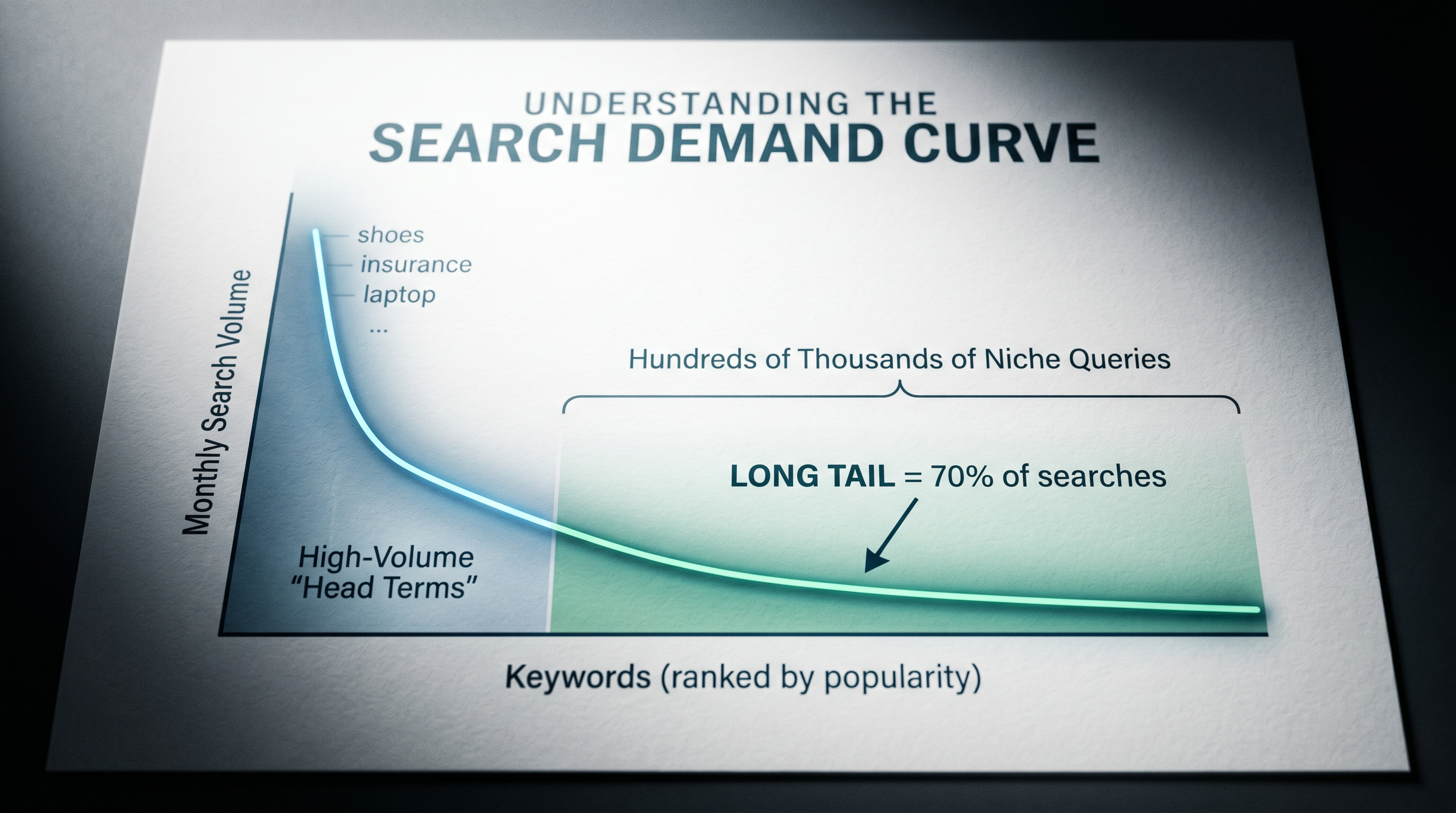
Long tail keywords are specific search phrases typically three or more words long that reflect precise user intent. "Best CRM for real estate agents under $50/month" is a long tail keyword. "CRM" is not. According to Backlinko's analysis of 306 million keywords, 91.8% of all search queries are long tail keywords. Individually, they carry modest search volumes. Collectively, they dominate search. The head terms account for only about 10 to 15% of all searches, while roughly 70% of page views come directly from long tail keywords.
Why This Comparison Matters More in 2026
The keyword debate has gotten sharper this year, not quieter. In 2026, long tail keywords are more important than ever because Google's AI Overviews often answer broad, short tail searches directly in the results page, leaving little organic traffic for websites. When Google's AI scoops up the answer to "what is email marketing" before any organic result is clicked, the short tail strategy loses one of its last selling points. Long tail queries, by contrast, are specific enough that a well-written article with real context still beats a synthesized AI snippet. This shifts the competitive landscape decisively. If you're still building your SEO strategy around head terms alone, you're optimizing for a shrinking pool of clicks.
Voice search is accelerating this shift. Voice searches are naturally more conversational, longer, and more specific than typed searches, reflecting how people speak rather than how they think in keywords. That creates natural long tail phrasing because users speak naturally rather than compressing their intent into short keywords.
Head-to-Head Comparison: The Full Breakdown
| Criteria | Short Tail Keywords | Long Tail Keywords | Winner |
|---|---|---|---|
| Avg. Monthly Search Volume | 10,000 – 1,000,000+ | 10 – 1,000 | Short Tail |
| Avg. Conversion Rate | ~2.35% | ~36% | Long Tail 🏆 |
| Keyword Difficulty | High (60–100 KD) | Low-Medium (10–40 KD) | Long Tail 🏆 |
| Ranking Timeframe | 12–24+ months | 2–6 months | Long Tail 🏆 |
| Share of All Searches | ~10–18.5% | ~70–91.8% | Long Tail 🏆 |
| User Purchase Intent | Low to Medium | Medium to High | Long Tail 🏆 |
| Brand Awareness Potential | Very High | Low to Medium | Short Tail |
| Content Scalability | Limited (fewer unique terms) | Near-infinite | Long Tail 🏆 |
| Cost per Click (PPC) | High ($5–$50+) | Low ($0.50–$5) | Long Tail 🏆 |
| AI Overview Vulnerability | High | Low | Long Tail 🏆 |
| Verdict | Brand awareness, PPC testing | Conversions, SEO growth, new sites | Long Tail overall |
Deep Dive: Short Tail Keywords
The Case For Them
Short tail keywords are not useless. They are just misused by most small and mid-sized businesses who lack the domain authority to compete for them. For established brands with strong link profiles, ranking for a head term is a brand amplifier. Showing up for "CRM software" signals market legitimacy in a way that "best CRM for freelance graphic designers" does not. Short tail keywords also function well in paid advertising as awareness-stage campaigns, where reach matters more than immediate conversion.
The Case Against Them (for Most Businesses)
If you are not a major industry player, competing for short tail keywords may be a waste of time. Yes, your keywords are searched thousands of times per month, but what's the point if all that traffic goes to your competitors? Short tail keyword pages take an average of 12 to 24 months to rank without a serious backlink campaign. The cost, in time, content, and link building, rarely justifies the return for businesses that need traffic now.
"Short tail keywords deliver volume but poor conversion. Optimizing for long tail search improves both lead quality and cost per acquisition." — Neil Patel
When Short Tail Wins
- You already have a Domain Authority of 50+ and existing topical clusters built
- You're running paid search campaigns where broad match terms test market demand
- Your goal is brand awareness or venture-backed growth, not immediate ROI
- You're defending existing rankings from competitors, not building from scratch
Deep Dive: Long Tail Keywords
The Conversion Machine
The numbers here are hard to argue with. The average conversion rate for long tail keywords is 36%, compared to just 2.35% for short tail keywords. That 15x gap exists because long tail search intent is tightly scoped. Someone searching "best project management software for construction companies under $30/month" is not browsing. They are buying. They have already narrowed their category, set a budget, and specified their industry. Your content just needs to show up and close the deal.
When building an SEO content strategy, targeting high-intent search terms is one of the fastest ways to generate revenue from organic traffic, because the searcher arrives pre-qualified.
The Ranking Opportunity
Long tail keywords are the secret weapon for any site without a years-long head start on domain authority. Keyword difficulty drops dramatically as keywords get longer, meaning top-ranking websites have fewer backlinks, less-optimized content, and lack other signals of authority. This is the opening. A well-structured, detailed article targeting a 3-5 word phrase with a KD under 30 can rank in 60 to 90 days on a relatively new site. The same effort targeting a KD 80 short tail term might not produce a first-page result for two years. Targeting low-competition search phrases early in your SEO journey compounds over time as each ranked article builds domain authority for the next.
Volume vs. Cumulative Impact
The one objection worth taking seriously is volume. A single long tail keyword might only generate 50 searches per month. But your strategy is never a single keyword. Build a content cluster of 30 targeted long tail articles and you are accumulating 1,500+ potential monthly visits from pages that actually rank. Semantic architecture built around topic clusters signals deep topical authority, which can increase organic traffic by an average of 43%. That is the compounding effect that separates long tail strategies from one-off content plays.

When Long Tail Wins
- New or growing sites with Domain Authority under 50 (long tail wins here, period)
- SaaS and B2B companies where a single converted visitor is worth $500+ in LTV
- E-commerce stores targeting buyers who know exactly what they want
- Bloggers and content marketers building topical authority from scratch
- Businesses targeting local, niche, or industry-specific audiences
The Hybrid Strategy: Using Both as a Weapon System
The smartest SEO programs do not choose one type over the other forever. They sequence them. Here is how the best operators run this play:
Phase 1: Long Tail First (Months 1-12)
New sites start with long tail keywords exclusively. Build 30-50 articles around specific, intent-rich queries in your niche. Rank these pages, accumulate backlinks naturally, and let domain authority grow. This phase generates real traffic and conversions while the foundation strengthens. Teams doing keyword research for growing businesses should stack this phase with bottom-of-funnel terms first, then work backward toward broader terms as authority accrues.
Phase 2: Mid-Tail Expansion (Months 6-18)
Once you have a cluster of ranked long tail pages, start targeting mid-tail (2-3 word) keywords that naturally incorporate your long tail content as support. Your ranked articles signal topical relevance to Google, making mid-tail targets far more attainable. This is where internal linking strategy becomes critical.
Phase 3: Head Term Assault (Month 18+)
Now you have domain authority, a cluster of supporting content, and a track record of ranking. Head terms become realistic. Use your long tail content as a hub-and-spoke network pointing to short tail pillar pages. This is how major brands actually rank for competitive head terms — not by targeting them cold from day one.
| Business Stage | Recommended Focus | Keyword Type Split | Expected Timeline to Traffic |
|---|---|---|---|
| New site (0-12 months) | Long Tail Only | 100% Long Tail | 60–120 days per article |
| Growing site (12-24 months) | Long + Mid Tail | 70% Long / 30% Mid | 30–90 days per article |
| Established site (24+ months) | Full Spectrum | 50% Long / 30% Mid / 20% Short | Faster across all types |
| Enterprise / High DA | Short Tail Defense + Expansion | 30% Long / 30% Mid / 40% Short | Immediate to 6 months |
The Scenario-Based Verdict Framework
Stop overthinking the strategy. Here is the decision tree:
| Your Situation | The Winner | Why |
|---|---|---|
| New site, no DA, need traffic in 90 days | Long Tail. Period. | Short tail won't rank; long tail will |
| SaaS founder, high LTV per customer | Long Tail. Period. | 36% conversion rate matters at high LTV |
| E-commerce, competitive products | Long Tail. Period. | Product-specific queries = purchase-ready buyers |
| Local business targeting specific area | Long Tail. Period. | 82% of local voice searches use long tail phrases |
| Enterprise brand, DA 70+, brand defense | Short Tail. | You have the authority; use it for visibility |
| Paid search (PPC), awareness campaigns | Short Tail. | Volume-based reach justifies broad match spend |
| Blogger building topical authority | Long Tail. Period. | Cluster depth is how Google rewards niche sites |
| Content marketer on limited budget | Long Tail. Period. | Lower CPC, faster ranking, better ROI per piece |
"We use long tail keywords as the primary engine for every new content program we run. The conversion data is too lopsided to ignore, and the competitive picture is simply more winnable. Short tail terms get added to the mix only after we've built real topical authority."
Common Mistakes That Blow Your Keyword Strategy
Mistake 1: Targeting Long Tail by Word Count, Not Intent
A four-word keyword is not automatically long tail in the way that matters. The "long tail" refers to the visual shape of a search demand curve, not the physical length of words typed into a search bar. "Nike Air Max 2026" is four words but still a navigational query with limited strategic value for most sites. Real long tail targeting is about low competition, specific intent, and realistic ranking potential combined.
Mistake 2: Treating Long Tail as One-Off Articles
The power of long tail is in the cluster, not the individual piece. Publishing one article about "best CRM for freelancers" and calling it a strategy is not a strategy. The compounding effect only kicks in when you build interconnected topic clusters where each page reinforces the others through internal linking. This is also how you build the topical authority that eventually lets you chase bigger head terms.
Understanding topical authority through content clusters is what separates sites that plateau at 5,000 monthly visits from those that break through to 50,000.
Mistake 3: Ignoring Search Intent Within Long Tail
Not all long tail keywords have the same intent. "How to set up a CRM for freelancers" (informational) and "best CRM for freelancers under $20 per month" (commercial) both qualify as long tail, but they need completely different content treatments and serve different stages of the buyer journey. Map your long tail targets to funnel stage before you write a single word.
Mistake 4: Buying into the "Short Tail for Traffic, Long Tail for Conversions" Oversimplification
This framing causes businesses to prematurely allocate resources to short tail chasing in the name of "brand awareness," before they have the domain authority to compete. The actual result is wasted content effort and zero rankings. The traffic-first narrative is marketing agency logic designed to justify longer retainers, not to produce fast ROI for resource-limited teams.
Tools for Finding Both Types of Keywords
Your keyword tool stack matters. Here is what each major tool does well across both types:
| Tool | Best For | Long Tail Capability | Short Tail Capability |
|---|---|---|---|
| Google Search Console | Existing rank data | ✅ Strong (queries report) | ✅ Strong |
| Google Keyword Planner | PPC-oriented data | ⚠️ Limited (groups terms) | ✅ Strong |
| Answer The Public | Question-based long tails | ✅ Excellent | ❌ Not designed for it |
| Keyword Planner + Google Autocomplete | Free long tail discovery | ✅ Good for ideation | ✅ Moderate |
| Rankcow | Automated long tail pipeline | ✅ Fully automated identification + content | ⚠️ Focus on high-intent, rankable terms |
Rankcow's platform is specifically built to identify high-intent, low-competition long tail keywords and then automatically produce, optimize, and publish content around them at scale. For SaaS founders or business owners running a lean content operation, this solves the single biggest long tail problem: volume. Long tail SEO only compounds if you publish consistently. A tool that handles the full pipeline, from keyword discovery through to published article, removes the bottleneck entirely. The best AI-powered SEO platforms in 2026 are doing exactly this: collapsing the strategy-to-publish gap that used to require an entire agency team.
The Honest State of Short Tail SEO in 2026
Short tail SEO has a marketing BS problem worth naming directly. Too many agencies sell short tail keyword rankings as a prestige metric because they are easy to present on a dashboard and hard for clients to contextualize. "You're now ranking #4 for 'digital marketing'" sounds impressive until you realize that position 4 might get 3% of the click volume on a term that AI Overviews now answer directly without a click. Google's AI Overviews often answer broad, short tail searches directly in the results page, leaving little organic traffic for websites. The click-through rate on organic results for head terms has dropped materially since AI-generated answers became the default SERP feature. This does not make short tail irrelevant, but it does make it a weaker standalone play than it was even two years ago.
FAQ
What is the main difference between long tail and short tail keywords?
Short tail keywords are 1-2 word broad search terms with high volume and high competition (e.g., "SEO tools"). Long tail keywords are 3+ word phrases with specific intent, lower volume, and far lower competition (e.g., "best free SEO tools for beginners"). The average conversion rate for long tail keywords is 36%, compared to just 2.35% for short tail keywords, which makes long tail the better choice for most sites focused on revenue over raw traffic numbers.
Should a new website target short tail or long tail keywords?
Long tail keywords, without exception. A new site has no domain authority, no backlink history, and no ranking track record. Short tail keywords for competitive topics require years of authority-building before first-page rankings become realistic. Long tail articles on a new site can rank within 60-120 days. This is not a matter of preference; it is the only viable path to early organic traffic.
Do long tail keywords actually drive meaningful traffic?
Yes, at scale. A single long tail article may generate 30-100 monthly visits. But a content program of 30 well-targeted long tail articles generates 900-3,000+ monthly visits from pages that actually rank. According to Backlinko's analysis of 306 million keywords, 91.8% of all search queries are long tail keywords, which means the cumulative demand across the long tail dwarfs what any single head term delivers. The key is publishing consistently rather than treating long tail as a one-and-done effort.
How do I find long tail keywords for my niche?
Start with Google Autocomplete and the "People Also Ask" section on any SERP. Use Answer The Public for question-based long tail discovery. Google Search Console's queries report reveals long tail terms your existing pages already rank for, giving you immediate expansion opportunities. For teams that want to automate the entire discovery-to-publishing pipeline, Rankcow identifies high-intent, rankable long tail keywords and generates full articles around them automatically, making consistent volume achievable without a dedicated content team.
Are long tail keywords better for voice search?
Yes. Voice searches are naturally more conversational, longer, and more specific than typed searches, reflecting how people speak rather than how they think in keywords. When someone asks a voice assistant "what is the best waterproof running jacket for cold weather under $100," they are generating a natural long tail query. 82% of searches using voice search in near-me queries rely on long tail keywords to find local businesses. If local, mobile, or voice traffic is part of your audience profile, long tail is the only sensible strategy.
Rankcow is built for exactly the strategy this article describes: identifying high-intent, low-competition long tail keywords and automatically generating, optimizing, and publishing content around them at a rate of 30 articles per month. If your SEO program is stalling because publishing consistently is the real bottleneck, Rankcow's fully automated pipeline handles the entire workflow from keyword discovery to live article, without needing an agency or a content team. Start scaling your long tail strategy on autopilot at rankcow.com.