Topical Authority SEO: What It Is and How to Build It in 2026
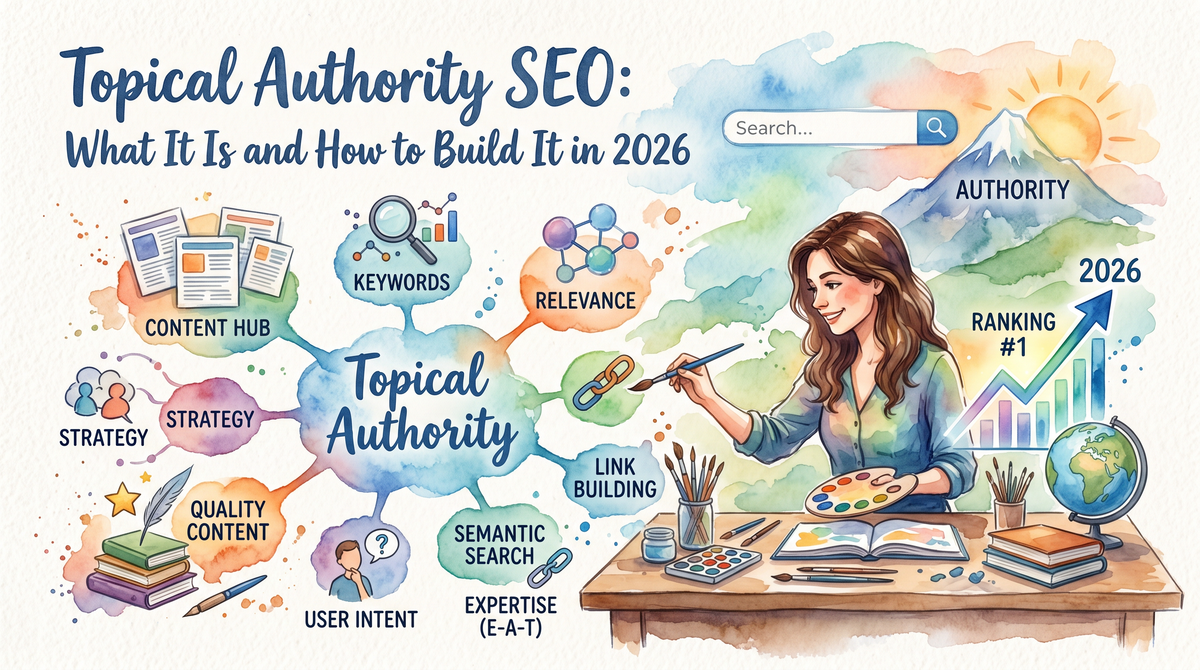
Topical authority SEO is the practice of making your website a trusted, go-to expert on a specific subject by publishing comprehensive, interconnected content that covers that topic end to end. Search engines and AI tools reward websites that cover a topic deeply, connect related content clearly, and consistently solve user problems. A site with 20 interconnected articles on a specific subject will consistently outrank a site with one 5,000-word guide on the same subject, even if the single article is technically superior in isolation.
This confused me too when I first encountered it. I assumed SEO was about finding the one perfect keyword and writing one brilliant post about it. Turns out, that's a bit like trying to prove you're a doctor by memorizing a single medical fact. Google wants to see the whole degree, not just one trivia answer.

Why Topical Authority Matters More Than Ever in 2026
Search engines no longer just match keywords. They understand topics, entities, and relationships. As of 2026, this shift means brands are optimizing to become recognized concepts within search engines' Knowledge Graphs, not just keyword matches.
The shift to topical authority as the primary content quality signal has been building since Google's Helpful Content updates (2022–2024) and was crystallized by Google's March 2026 Core Update. Put simply: the rules changed, and keyword-stuffing without context no longer cuts it.
Here's where the numbers get interesting. Sites that implement content clusters correctly see an average 40% increase in organic traffic compared to non-clustered content strategies. Businesses transitioning from keyword-focused SEO to topic cluster models report traffic increases ranging from 50% to 300% within 6–12 months.
Research also shows that sites with strong topical authority gain traffic 57% faster than those without, while ranking faster for new content within their established expertise areas. That compounding speed advantage is what makes topical authority so worth the upfront investment.
Topical Authority vs. Domain Authority: A Quick Comparison
A lot of people mix these two up. Think of it this way: domain authority is like your general credit score, while topical authority is your specialist reputation. A general practitioner and a cardiologist can both be "good doctors," but only one of them is getting called in for heart surgery.
| Feature | Domain Authority | Topical Authority |
|---|---|---|
| What it measures | Overall backlink strength and site popularity | Depth and breadth of coverage on a specific subject |
| How it's built | Acquiring high-quality backlinks over time | Publishing interconnected, intent-matched content clusters |
| Longevity | Can decline if link profile weakens | Compounds over time as content library grows |
| Accessibility for small sites | Hard to compete with large brands | Small sites can beat big brands in focused niches |
| AI citation benefit | Indirect | Direct (comprehensive coverage = AI reference preference) |
Smaller sites outrank big brands by focusing deeply on one topic instead of spreading content across many areas. Big brands often publish broad content for traffic, while niche sites publish content for expertise. When a smaller site covers every subtopic, question, and use case, Google identifies it as the best match for users searching that subject.

The Core Building Blocks of Topical Authority
1. Topic Clusters (The Library System)
Think of your website like a library. A well-organized library doesn't just stack random books. It groups them by subject, puts a clear index at the front, and makes sure every book relates to others nearby. In SEO terms, this means one central pillar page (the index) surrounded by multiple cluster articles (the individual books).
Your pillar page structure acts as the authoritative hub for a broad topic, while each cluster article dives into a specific subtopic and links back to the pillar. This architecture signals to Google that your site doesn't just mention a subject — it owns it.
💡 Mental Model Worth Saving: Topical authority = one topic, many angles, all connected. The goal is to answer every question a reader could reasonably ask about your subject, before they need to go elsewhere.
2. Search Intent Alignment
Topical authority is not about publishing more content. It is about publishing the right content, in the right structure, with clear intent alignment. Every article in your cluster needs to match the specific stage of a reader's journey, whether that's learning, comparing, or buying.
For example, a SaaS company building authority around "project management" might create:
- Informational posts: "What is project management?"
- Comparison posts: "Agile vs. Waterfall project management"
- Tutorial posts: "How to set up a sprint in Jira"
- High-intent posts: "Best project management software for remote teams"
Targeting high-intent keywords within your topic cluster is particularly valuable because those queries drive conversions, not just traffic. Each piece in your cluster feeds the next stage of the reader's journey.
3. Internal Linking (The Nervous System)
Internal links are the connective tissue that makes a topic cluster actually work. Without them, you just have a pile of unrelated articles. With them, you have a structured ecosystem that tells Google exactly how your content relates. A clean site architecture ensures that your core service pages and supporting blog posts reinforce each other, making it effortless for Google to crawl and index your value.
Good internal linking tools can identify orphaned pages, suggest contextual links, and help you build a consistent linking pattern at scale — something that's nearly impossible to maintain manually once your content library grows past 30–40 articles.
4. E-E-A-T Signals
Google's ranking systems rely on core signals from your website. According to its Search Quality Rater Guidelines, this includes a page's E-E-A-T score, covering experience, expertise, authoritativeness, and trustworthiness.
In practice, this means:
- Author bios that establish credentials
- First-hand examples, case studies, or original data
- Clear sourcing and citations
- Consistent brand voice across all cluster content
How to Build Topical Authority: A Step-by-Step Framework
Here's the framework, broken into four stages you can actually follow:
- Choose your core topic. Pick one subject your brand can credibly own. Narrow is better than broad. "Email marketing for e-commerce" beats "digital marketing."
- Map your subtopics. List every question a person could ask about your core topic. Group them by intent (informational, navigational, transactional). This becomes your content roadmap.
- Build your pillar and clusters. Write your comprehensive pillar page first, then systematically fill in each cluster article. Publish consistently — at least 4–8 pieces per month.
- Connect everything. Add internal links between related pieces. Update older posts to link to newer ones. The web of connections is what Google reads as authority.
- Maintain and expand. Authority requires ongoing maintenance through regular content updates and expansion into emerging subtopics. Monitor search trends to identify new questions within your topic area. Update statistics in existing content annually. Publish fresh content addressing new developments in your field.
Topical Authority and AI Search: The New Frontier
For AI systems, the authority signal works through a parallel mechanism. When ChatGPT, Perplexity, or Google AI Overviews need to cite a source on a specific topic, they draw from sources their training data and real-time retrieval systems recognize as consistently accurate and comprehensive on that subject.
Clear definitions, concise answers, FAQ schema, topic completeness, structured data, and natural-language formatting all increase the likelihood that a brand's content surfaces in AI Overviews and generative answers. In short: building topical authority doesn't just help you rank on Google. It helps you get cited by every AI tool that your potential customers are using right now.

Common Mistakes to Avoid
Spreading Yourself Too Thin
In 2026, Google and AI-driven search tools no longer reward scattered content. Publishing random articles across unrelated topics weakens trust. A cooking blog that suddenly publishes five articles about cryptocurrency is sending a confusing signal, no matter how well-written those articles are.
Treating Every Article as an Island
Publishing content without internal links is like building a city with no roads. The neighborhoods exist, but no one can get between them. Google's crawlers work the same way — if your articles don't reference each other, the authority signals don't transfer.
Optimizing for Keywords Alone
Targeting individual keywords without thinking about the full topic ecosystem is the old way. Google has developed a deeper understanding of user intent and how to provide relevant results. Today, content must be designed for keyword clusters that share the same intent, otherwise known as topics.
Expanding Too Fast
Many sites fail during scaling because they expand too fast or into unrelated topics. Topical authority grows best when expansion is intentional and aligned with existing expertise.
How to Measure Topical Authority Growth
Topical authority is not a single score you can look up in a dashboard. It is an emergent quality that becomes visible through a combination of ranking improvements, impression growth, content coverage, and engagement signals.
Practical ways to track it:
- Track cluster rankings as a group. Watch how your pillar page and its supporting articles rank together rather than judging each page in isolation. When the whole cluster climbs, that's a sign your topical authority strategy is paying off.
- Analyze organic traffic and engagement. Google Search Console and Analytics show you which queries bring visitors in. Rising impressions, clicks, and time on page across related articles point to real momentum.
- Monitor share of voice. Share of voice tracks how often your site appears in results for a defined set of queries compared to your competitors. Watching this number grow tells you whether you're pulling ahead in your niche or still catching up.
Frequently Asked Questions
How long does it take to build topical authority?
Topical authority isn't something you build in a weekend. It comes from steady, thoughtful work: picking the subjects your business should own, covering them from every useful angle, and updating your content as your field evolves. Most sites start seeing measurable cluster ranking improvements at the 3–6 month mark, with strong authority signals typically visible within 6–12 months of consistent publishing.
Do I still need backlinks if I have strong topical authority?
Topical authority and backlinks are even more powerful when combined. A site with high topical authority is more likely to generate natural, relevant backlinks, as the content is trustworthy and reliable. Think of topical authority as what earns backlinks organically over time, rather than something you need to choose between.
How many articles do I need to build a topic cluster?
There's no universal magic number, but a functional topic cluster typically needs a pillar page plus 8–15 supporting cluster articles to cover a subject with enough depth. For competitive niches, 20–30+ pieces covering every subtopic and intent variation is common. The right SEO automation platform can help you reach and maintain that volume without burning out your team.
Can a small website compete with big brands using topical authority?
You don't need a huge SEO budget to build strong topic authority. In many cases, it's easier for smaller organizations to compete with enterprise-level websites with the same content. The key is focus. A small site that completely owns one niche will beat a massive brand that only partially covers it.
What's the difference between topical authority and topical relevance?
Topical relevance means a specific page is related to a given topic. Topical authority is a broader, site-level signal that you are the trusted expert on that topic across many pages. Relevance is the foundation; authority is what you build on top of it through consistent, interconnected coverage over time.
Building topical authority takes a clear strategy and a consistent publishing cadence, two things that are hard to maintain when you're also running a business. Rankcow automates the entire content pipeline — from identifying the right topic clusters and keywords to generating, optimizing, and publishing 30 brand-aligned articles per month directly to your CMS. If you're ready to build real topical authority on autopilot, Rankcow is built exactly for that.