SEO Keyword Analysis: The Complete Beginner-to-Advanced Guide
SEO keyword analysis is the process of researching, evaluating, and selecting the exact words and phrases your target audience types into search engines, then using that intelligence to plan content that ranks. It goes beyond a simple list of terms: done right, it reveals what your audience wants, how competitive a topic is, and which opportunities your site can realistically win. Think of it like a restaurant owner reading customer reviews before designing a menu — you're not guessing at what people want, you're reading the signals they've already left.
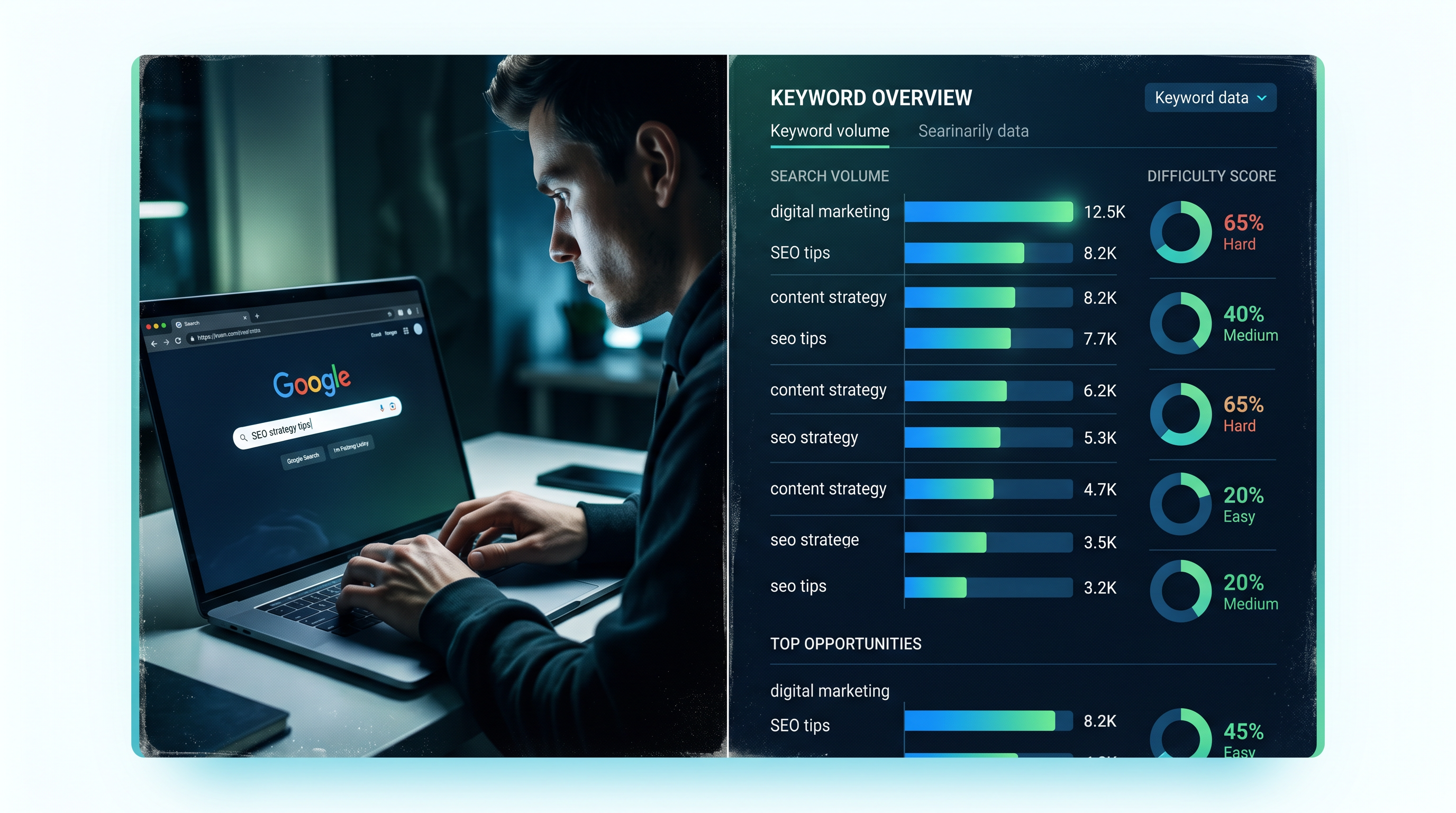
This confused me too at the start: I thought keyword analysis just meant finding the most searched words and then stuffing them into articles. In reality, volume is only one slice of the picture. You also need to understand intent, competition, and relevance — and balancing those three factors is where the real skill lives.
Why SEO Keyword Analysis Actually Matters
About 53% of all website traffic comes from organic search. That single number explains why keyword analysis is the starting point for almost every content strategy. If you skip it, you're essentially writing for an empty room — producing content no one asked for and no search engine has a reason to surface.
Long-tail keywords account for roughly 70% of search queries, and organic search leads have an average 14.6% close rate, significantly higher than outbound marketing channels. Those two facts together tell a clear story: the right keywords don't just bring traffic, they bring buyers. Understanding why keyword research shapes organic growth is one of the most important mindset shifts you can make as a content marketer.
The Core Concepts, Explained Simply
Search Volume
Search volume is the average number of times a keyword is searched per month. A term like "CRM software" might pull 100,000 monthly searches; "CRM software for freelance photographers" might pull 200. Neither number is automatically better. High-volume terms are fiercely competitive. Low-volume terms are often easier to rank for and convert more reliably.
Keyword Difficulty (KD)
Keyword difficulty is a score (usually 0-100) that estimates how hard it would be to rank on page one for a given term. Think of it like a leaderboard for a video game: if the top players have 10,000 hours each, a newcomer with 50 hours isn't going to beat them anytime soon. You want to find keywords where the current page-one players are beatable.
Search Intent
This is the why behind a query. A person searching "what is keyword analysis" wants information. Someone searching "buy keyword research tool" wants to make a purchase. Someone searching "Rankcow vs competitor" is comparing options before deciding. Matching your content type to the intent is non-negotiable. Content quality and search intent are the #1 active strategy in 2026, named by 54% of SEO professionals surveyed.
The four intent categories are:
- Informational — "how does X work"
- Navigational — "X brand login"
- Commercial — "best X tool for Y"
- Transactional — "buy X online"
Long-Tail vs. Short-Tail Keywords
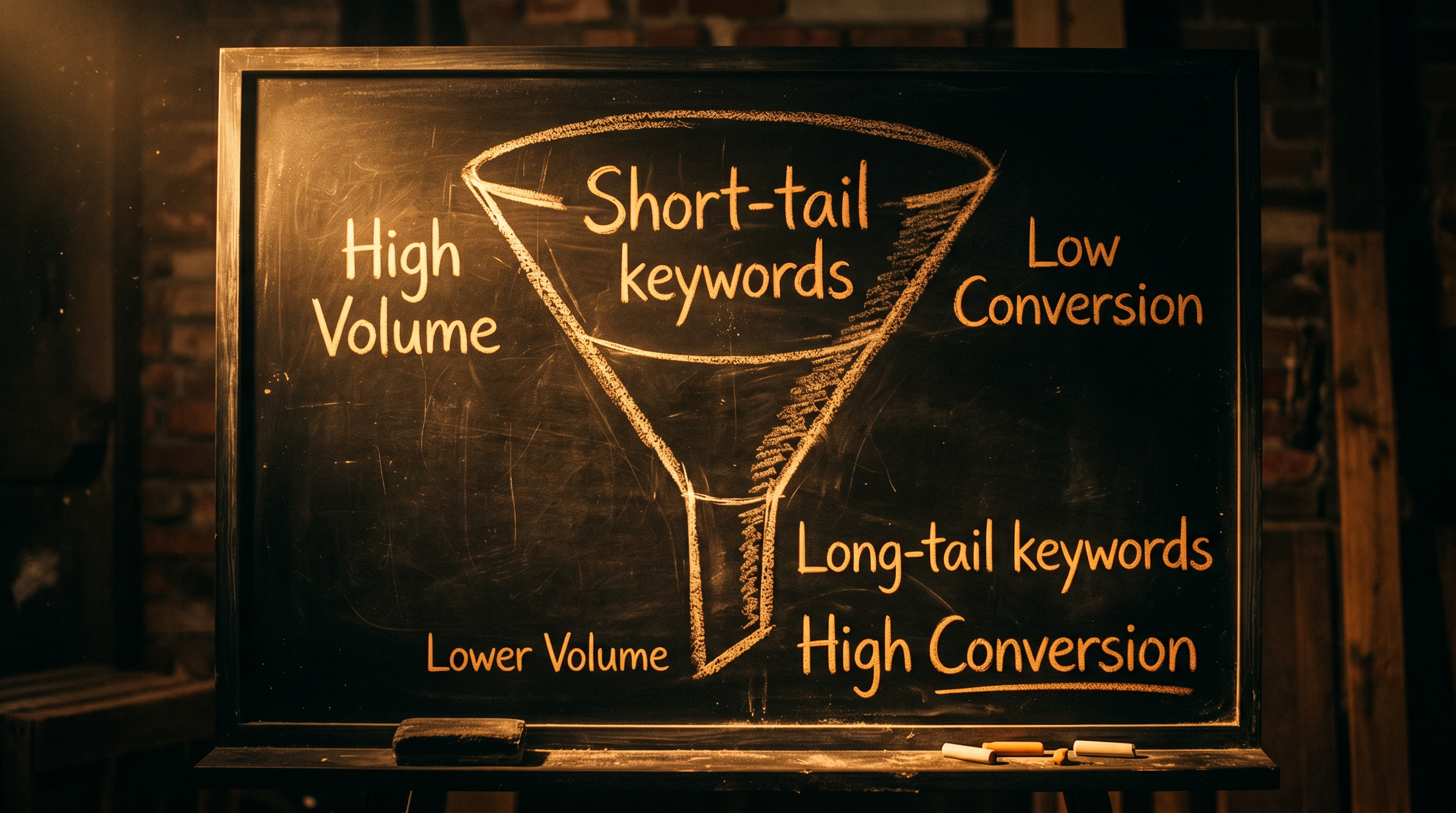
Short-tail keywords are broad and short (one to two words). Long-tail keywords are specific phrases, usually three words or more. Search terms that are 10-15 words long receive 1.76 times more clicks than single-word queries. The analogy that works best here: a short-tail keyword is like a billboard on a highway — seen by everyone, remembered by few. A long-tail keyword is like a handwritten sign outside a specialty shop — smaller audience, far more interested.
The SEO Keyword Analysis Process: Step by Step
Step 1: Seed Keyword Brainstorm
Start with broad terms that describe your business, product, or topic. If you run an accounting SaaS, your seeds might be "accounting software," "bookkeeping tools," or "invoice management." These seeds are not your final targets — they're the entry points you'll branch from.
Step 2: Expand with a Keyword Tool
Plug your seeds into a keyword research tool. The tool will surface related terms, questions people ask, and volume + difficulty scores for each. Good keyword research strategies always include competitor gap analysis at this stage: look at what terms your rivals rank for that you don't. Those gaps represent traffic you could be capturing.
Step 3: Evaluate and Filter
Not every keyword you find is worth targeting. Apply this three-part filter:
- Relevance — Does this keyword describe something your audience genuinely wants?
- Reachability — Is your domain authority competitive enough to rank for this term right now?
- Return — Will ranking for this term move a business metric (leads, sales, signups)?
Step 4: Group by Intent and Topic
Once you have a filtered list, group keywords by shared intent and topic. This is called keyword clustering. One cluster might be "accounting software for freelancers," "invoicing tool for self-employed," and "best bookkeeping app for solopreneurs" — those three terms can realistically be targeted in a single piece of content. Treating them as separate articles would mean competing with yourself.
Step 5: Prioritize and Publish
Order your keyword clusters by a mix of business impact and ranking potential. New or small sites should start with lower-difficulty, long-tail clusters and build domain authority over time before targeting high-competition head terms.
Key Metrics Reference Table
| Metric | What It Measures | Good Starting Target |
|---|---|---|
| Search Volume | Monthly searches for a term | 100–2,000 for new sites |
| Keyword Difficulty | Competitive strength of current rankings | Under 30 for new sites |
| CPC (Cost Per Click) | Advertiser spend; proxy for commercial intent | Higher CPC = higher buyer intent |
| Click-Through Rate | % of searchers who click organic results | Varies by intent and SERP features |
| Search Intent | Reason behind the query | Must match your content format |
| Topical Relevance | How closely a keyword fits your site's authority | Stay within your niche cluster |
Mental Model Worth Saving: The "Traffic Light" Keyword Framework
🟢 Green Light — Low difficulty (<30), clear informational or commercial intent, directly relevant to your product. Target immediately.
🟡 Yellow Light — Medium difficulty (30–60), high business value, requires moderate domain authority. Plan for in 3-6 months.
🔴 Red Light — High difficulty (>60), dominated by huge brands, minimal business intent. Avoid until your domain authority is strong.
Advanced Concepts: Going Deeper
Topical Authority
Google doesn't just evaluate individual pages in isolation — it looks at whether your site comprehensively covers a subject area. Writing 20 loosely related articles is less effective than building a tight cluster of 10 articles that all interconnect around one core topic. This is topical authority, and it's one of the most important advanced concepts in keyword analysis right now. The best AI search engine optimization tools in 2026 can now automate internal linking to help build this authority at scale.
SERP Feature Targeting
The search results page is not just ten blue links anymore. Featured snippets, People Also Ask boxes, AI Overviews, and video carousels all compete for attention. When analyzing a keyword, check which SERP features appear for it — then structure your content to win those features, not just a standard ranking position.
Keyword Cannibalization
This happens when two or more pages on your own site compete for the same keyword. It confuses search engines about which page to prioritize and often results in neither page ranking well. A proper keyword analysis process maps each keyword cluster to exactly one URL before any content is written.

Common Mistakes (and How to Avoid Them)
- Chasing volume, ignoring intent. A keyword with 50,000 monthly searches is worthless if the intent doesn't match what you sell. Always check intent first.
- Targeting head terms too early. New sites rarely rank for competitive head terms. Start with long-tail terms to build authority, then work up.
- Treating keyword analysis as a one-time task. Search trends shift. Regularly updated content is viewed as one of the best indicators of a site's relevancy, so quarterly content audits and updates are essential. Run a fresh keyword analysis every quarter.
- Ignoring competitor content. If five high-authority sites already cover a topic exhaustively, you need a genuine angle they've missed — not a slightly reworded version of the same article.
- Skipping keyword clustering. Treating every keyword as a standalone article leads to a bloated, cannibalized site. Group related terms and write one definitive piece per cluster.
For businesses with limited time or budget, the keyword research process for small businesses often looks different — prioritizing hyper-local or niche-specific terms that larger competitors overlook.
Frequently Asked Questions
How often should I do SEO keyword analysis?
A full keyword analysis is worth doing when you launch a site, launch a new product, or enter a new content vertical. After that, a lighter quarterly review is enough to catch shifts in search volume, new competitor content, and emerging long-tail opportunities. If you're in a fast-moving industry (AI, finance, health), monthly check-ins are smarter. What's still debated in the SEO community is exactly how quickly Google picks up on keyword-targeting changes — most practitioners see initial signals within 4-12 weeks, but a full ranking shift can take longer.
What is the difference between keyword research and keyword analysis?
Keyword research is the process of finding potential keywords. Keyword analysis is the deeper evaluation that comes after: assessing difficulty, intent alignment, SERP competition, and business value for each keyword you've found. Research casts the net; analysis decides which fish to keep. Most guides use the terms interchangeably, but in practice, analysis is what separates a random keyword list from an actionable content strategy.
Can I do SEO keyword analysis for free?
Yes, meaningfully so. Google Search Console shows which keywords your site already ranks for and which pages underperform. Google Keyword Planner gives volume and competition data directly from Google. Google's autocomplete and "People Also Ask" sections are free insight into real user queries. Paid tools go deeper and faster, but the free data sources are legitimate starting points, especially for smaller sites. Note that Google Keyword Planner has been shown to drastically overestimate search volumes in over 50% of cases, so treat its numbers as directional rather than precise.
How many keywords should I target per page?
There's no magic number, and this is genuinely debated. The practical answer: one primary keyword per page, supported by three to eight closely related secondary keywords that share the same search intent. These secondary terms naturally appear when you write a thorough, helpful article — you don't need to force them. The old practice of targeting exactly one keyword per page and nothing else is outdated; modern Google understands semantic relationships between terms.
Does keyword analysis still matter with AI Overviews changing search?
Yes, arguably more than ever. Long-tail keywords are less competitive, more intent-specific, and far less likely to be affected by AI Overviews than head terms — they remain the highest-leverage content opportunity in 2026. AI Overviews primarily target broad informational queries. Specific, transactional, and commercial intent keywords still drive clicks to websites. The keyword analysis process now also includes identifying which of your target keywords trigger AI Overviews, so you can structure content to be cited in those summaries rather than displaced by them.
Rankcow takes the work out of keyword analysis by automatically identifying high-intent, low-competition keywords for your niche and turning them into published, brand-aligned content — 30 articles per month, on autopilot. If keyword research and content production feel like a bottleneck, Rankcow's end-to-end SEO automation platform is built exactly for that problem. Start scaling your organic traffic without the manual grind at rankcow.com.