9 Keyword Research Strategies That Actually Drive Traffic in 2026
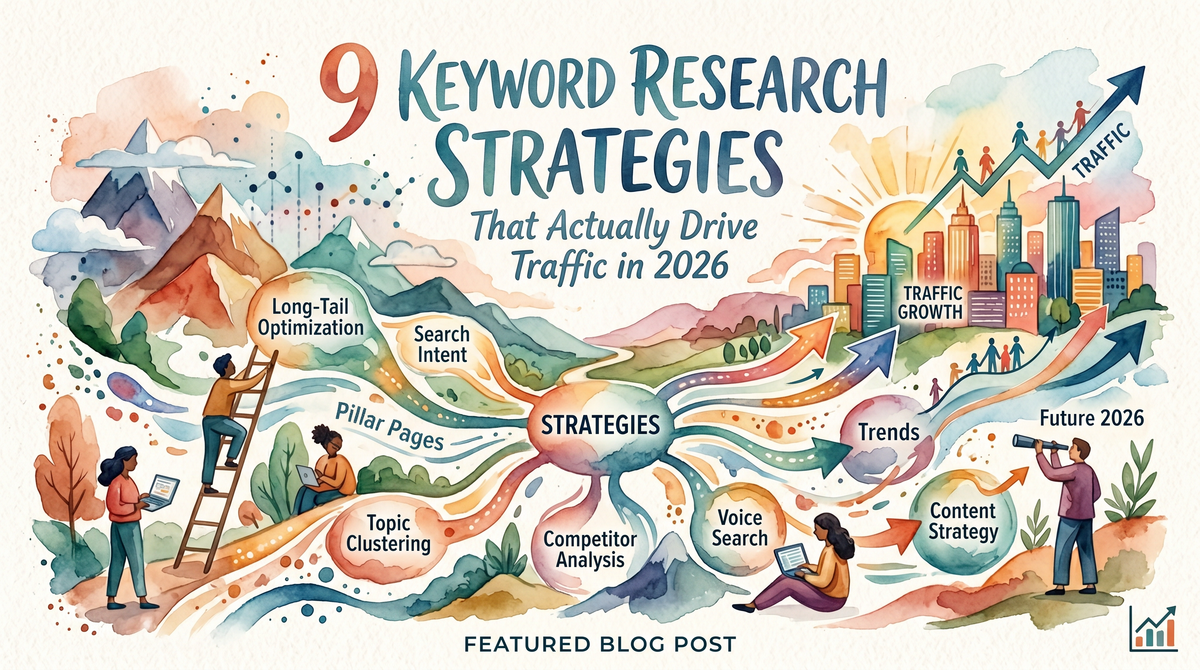
The most effective keyword research strategies in 2026 combine search intent mapping, long-tail targeting, competitive gap analysis, and topic cluster architecture to find high-converting, winnable terms. Volume alone is a dead metric. Zero-click searches now account for 69% of all queries, and 15% of daily Google searches have never been searched before, which means a rigid, volume-first approach leaves a massive amount of opportunity on the table. Let's get to it.

Before we run through the full list, here is what we actually use at Rankcow when running keyword research for clients across 150+ languages: a combination of intent-first filtering, long-tail hunting, and topic cluster mapping. These aren't theoretical ideas. They're the same approaches that have delivered an average 8.4x traffic lift across our user base.
1. Search Intent Mapping
Everyone recommends building a keyword list and sorting by volume. Honestly, that's the wrong starting point. The most important filter you can apply is intent, not volume. Google's algorithms have become sophisticated enough to classify intent accurately, meaning content that mismatches intent will not rank regardless of technical quality.
Real-world examples: HubSpot maps every article to one of four intent types before a single word is written. Notion's content team publishes separate pages for "what is a project brief" (informational) and "project brief template free" (transactional) rather than combining them into one confused piece.
When to Use This
At the very start of any keyword project, before you export a single spreadsheet. Intent mapping is the framework everything else hangs on. Businesses entering competitive markets especially need this because content that mismatches intent simply will not rank.
How to Implement It
- List your 20 most important target keywords.
- Manually Google each one and look at the SERP format: are the top results blog posts, product pages, comparison pages, or videos?
- Tag each keyword as Informational, Navigational, Commercial, or Transactional.
- Match your content format to the winning SERP format for that intent type.
2. Long-Tail Keyword Targeting
This one changed how I think about SEO entirely. The numbers on long-tail keywords are striking: long-tail keywords typically have a conversion rate 2.5x higher than head terms. And the average conversion rate for long-tail keywords is 36%, significantly higher than broad keywords. When you understand that, chasing head terms with a brand-new site starts to look a lot less appealing.
Understanding the trade-off between long-tail vs short-tail keywords is one of the most practical things you can do before you build a content calendar, because it directly shapes which battles you can actually win.
Brands like Zapier and Canva have built enormous organic footprints by targeting thousands of specific long-tail queries ("how to automate Gmail with Slack", "free instagram story template for food") rather than fighting for the generic head terms dominated by Wikipedia and G2.
When to Use This
Any site with a domain rating below 50. New sites, niche blogs, SaaS products with specific use cases. Also perfect when you need early wins to justify continued SEO investment to stakeholders.
How to Implement It
- Seed your research with 5-10 core topics relevant to your product or service.
- Use a tool like Google Search Console, Ubersuggest, or KWFinder to pull keyword expansions.
- Filter for keywords with 3+ words and low keyword difficulty (KD under 30 is a reliable starting threshold).
- Group related long-tail terms into content clusters of 5-10 related pieces.
3. Competitor Gap Analysis
Gap analysis is the fastest way to find proven keywords. If a competitor is ranking for something and you are not, you already have proof that the keyword works in your industry. You're not guessing. You're following a trail someone else already blazed.
Brands like Shopify and Stripe use gap analysis continuously to stay ahead of fintech and e-commerce challengers. They watch what competitors rank for and move to capture adjacent terms before those competitors build more topical authority.
When to Use This
When you've plateaued with your current keyword list. Also ideal for entering a new content vertical where you lack seed keyword ideas but have 3-5 identifiable competitors already producing content.
How to Implement It
- Identify 3-5 direct competitors in your niche.
- Export their ranking keywords using a tool like Ubersuggest, SpyFu, or Google Keyword Planner.
- Cross-reference against your own ranking keywords to identify gaps.
- Prioritize gaps where the competitor's ranking page has weak backlink authority, signaling a takeable position.
4. Topic Cluster Architecture
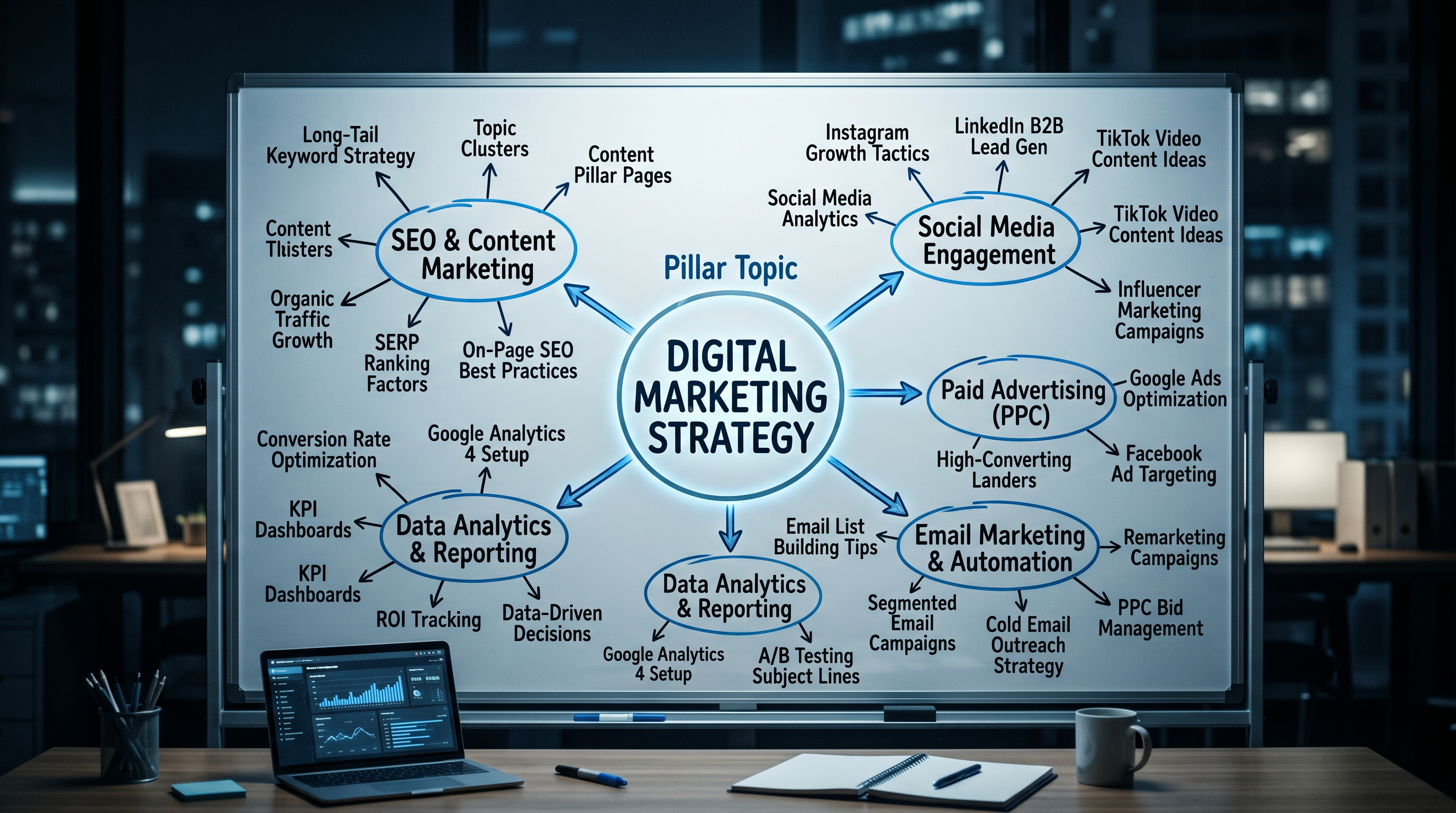
Topic clusters organize content around central pillar pages that comprehensively cover broad topics, with related cluster pages diving deep into specific subtopics. This is the structure Google rewards with topical authority, and it is why sites that publish systematically outperform sites that publish randomly.
A well-built topic cluster content strategy signals to Google that your site is a definitive resource on a subject, not just a collection of loosely related articles. That authority signal compounds over time.
Atlassian does this brilliantly for "project management" and Salesforce does it for "CRM." They own enormous clusters of interlinked content that make it nearly impossible for smaller competitors to dislodge them from the SERPs.
When to Use This
When you're ready to pursue topical authority in a specific niche rather than just ranking individual pages. This is a medium-to-long-term play (3-6 months minimum) that pays significant compounding dividends. Especially powerful for SaaS companies building search moats around their core product categories.
How to Implement It
- Pick one broad topic (your "pillar") that represents your main product or expertise area.
- Identify 10-20 subtopics that fall under that pillar using search suggestions and competitor content audits.
- Write a comprehensive pillar page (2,000+ words) targeting the head term.
- Publish cluster articles for each subtopic, linking each back to the pillar page with consistent anchor text.
5. High-Intent Keyword Targeting
A 500-search-per-month transactional keyword may drive more revenue than a 50,000-search-per-month informational keyword. That single stat explains why high-intent targeting belongs in every serious keyword strategy.
Mastering high-intent keyword research separates brands that generate traffic from brands that generate revenue. There is a real difference between the two, and most content teams confuse page views with business impact.
Brands like Notion, Monday.com, and Figma are aggressive about targeting high-intent comparison queries like "Notion vs Confluence" or "Monday vs Asana." These pages convert at significantly higher rates than generic informational content.
When to Use This
If you're a SaaS, e-commerce brand, or service business that needs SEO to actually move revenue. High-intent targeting is non-negotiable when stakeholders ask for conversions, not just traffic.
How to Implement It
- Target bottom-of-funnel query patterns: "[Product] vs [Competitor]", "Best [Category] for [Use Case]", "[Product] pricing", "[Product] alternatives".
- Create dedicated landing pages for each high-intent cluster.
- Ensure the page format matches intent: comparison tables, CTAs, and specific pricing data where relevant.
- Track conversions, not just rankings, to measure true ROI.

6. Low-Competition Keyword Mining
Here's an honest take that goes against most popular SEO advice: stop obsessing over keyword difficulty scores from tools. Those scores are estimates, not verdicts. A keyword with a KD of 45 can be cracked if the pages currently ranking have thin content and weak backlink profiles. Always look at the actual SERP, not just the number.
Digging into low-competition keyword opportunities is where smaller sites and new brands can punch way above their weight, especially in the first 12 months of a content program when domain authority is still climbing.
Smaller SaaS brands like Loom and Notion built early organic traction by targeting low-competition educational queries in their niches before they had the authority to compete for high-volume terms.
When to Use This
New sites (under 12 months old), brands with limited publishing budgets, or anyone who needs to see ranking results quickly. Low-competition mining is also smart for side projects and niche blogs where momentum matters more than prestige keywords.
How to Implement It
- Set your keyword tool's KD filter to under 20-30 (depending on your domain authority).
- Filter for keywords with at least 100 monthly searches to ensure viable traffic potential.
- Open the actual SERP for each candidate and audit the top 5 results: page quality, backlink count, and content depth.
- Prioritize keywords where top-ranking pages have fewer than 10 referring domains and thin content (under 800 words).
7. Question-Based and "People Also Ask" Mining
About 8% of all searches are questions, and these queries often trigger featured snippets. Targeting question keywords helps capture snippet positions and voice search results, providing visibility above traditional organic listings.
Google's "People Also Ask" (PAA) boxes are a goldmine that most content teams ignore. They show you exactly what follow-up questions real users have after typing a primary query, which means they hand you your content outline on a silver platter.
Brands like Healthline and NerdWallet dominate PAA boxes in their verticals by structuring content around specific question-and-answer formats with concise, extractable answers.
When to Use This
For any informational content targeting. Especially powerful in health, finance, legal, tech, and education verticals where users have layered questions. Also highly effective for FAQ sections on product and service pages.
How to Implement It
- Search your primary keyword on Google and collect all PAA questions that appear.
- Use AnswerThePublic or AlsoAsked to pull broader question clusters around your seed terms.
- Structure content with each question as an H3 subheading followed by a direct, concise answer (40-60 words) designed for snippet extraction.
- Internally link question-based cluster articles back to your pillar page.
8. SERP Feature Targeting
Most keyword researchers still only think about the 10 blue links. That's leaving traffic on the table. Featured snippets, image packs, video carousels, and local packs all represent positions you can target with intentional keyword research. The key is matching your content format to the feature you're gunning for.
Brands like Investopedia and Forbes have entire content templates built around capturing specific SERP features. It's not accidental; it's engineered.
When to Use This
For any established site (6+ months old) with existing rankings. SERP feature targeting is a high-leverage way to multiply traffic from content that already ranks on page one without publishing new articles.
How to Implement It
- Identify keywords where you already rank in positions 2-10 and where a featured snippet is present in the SERP.
- Audit your existing content for that keyword and add a concise, direct answer block near the top of the page.
- Use structured data markup (FAQ schema, HowTo schema) to increase eligibility for rich results.
- For video carousels, identify query patterns where YouTube videos appear and create supplementary video content.
9. Automated Keyword Research Pipelines
Thought leadership SEO with strategic keyword research delivers 748% ROI over three years, while basic content marketing without proper keyword research delivers only 16% ROI. The gap between those two numbers is entirely explained by consistency of execution. Most teams have great research for the first two months, then it falls apart because manual processes don't scale.
This is the strategy we're most bullish on at Rankcow, because it's the one that solves the real problem: not knowing what to research but finding the time and resources to act on it repeatedly. Rankcow automates the full pipeline, from identifying high-intent, low-competition keywords to generating and publishing optimized long-form content directly to your CMS, every month without manual input.
Automation doesn't replace strategic thinking. It removes the execution bottleneck that kills 90% of SEO programs before they reach their potential.
When to Use This
Any business publishing more than 4 articles per month where manual keyword research and content production creates a recurring bottleneck. SaaS founders, solo marketers, and small business owners who can't justify a full-time SEO team are the clearest fit for automated pipelines.
How to Implement It
- Define your core topic areas, target audience intent signals, and competitor domains to benchmark against.
- Set up an automated keyword discovery workflow using a platform that pulls from Google Search Console, keyword tools, and competitor data simultaneously.
- Connect keyword outputs to a content production pipeline with clear brief templates to eliminate decision fatigue.
- Schedule publishing cadences (weekly or monthly) and track cumulative topical authority growth rather than individual article rankings.

Master Comparison Table: All 9 Keyword Research Strategies
| Strategy | Best For | Difficulty | Time to Results | Traffic Potential | Conversion Impact |
|---|---|---|---|---|---|
| 1. Search Intent Mapping | All sites | Low | Immediate | High | ⭐⭐⭐⭐⭐ |
| 2. Long-Tail Targeting | New/small sites | Low | 1-3 months | Medium | ⭐⭐⭐⭐⭐ |
| 3. Competitor Gap Analysis | Established sites | Medium | 2-4 months | High | ⭐⭐⭐⭐ |
| 4. Topic Cluster Architecture | Authority building | High | 3-6 months | Very High | ⭐⭐⭐⭐ |
| 5. High-Intent Targeting | Revenue-driven SEO | Medium | 2-4 months | Low-Medium | ⭐⭐⭐⭐⭐ |
| 6. Low-Competition Mining | New sites, quick wins | Low | 1-2 months | Medium | ⭐⭐⭐ |
| 7. PAA / Question Mining | Snippet capture | Low | 1-3 months | Medium-High | ⭐⭐⭐ |
| 8. SERP Feature Targeting | Existing rankers | Medium | 1-2 months | High | ⭐⭐⭐⭐ |
| 9. Automated Pipelines | Scaling content ops | Low (once set up) | 3-6 months | Very High | ⭐⭐⭐⭐⭐ |
Key Takeaways
- Intent first, volume second. A 500-search transactional keyword beats a 50,000-search informational term for revenue impact every time.
- Long-tail keywords are the fastest path to traffic for most sites. Their 36% average conversion rate makes low search volume irrelevant.
- Topic clusters compound. Isolated articles get isolated results. Clusters build authority that lifts every page in the group.
- Manual research doesn't scale. The biggest SEO programs in 2026 run on repeatable systems, not heroic one-off efforts.
- Treat SERP features as a separate targeting layer. Featured snippets, PAA boxes, and video carousels are real estate most competitors ignore.
Your Action Plan: Next Steps
- Audit your current keyword list for intent mismatches. Take your top 20 target keywords, Google them, and check whether your content format matches what's actually ranking. Fix the mismatches first.
- Run a competitor gap analysis this week. Pick three direct competitors and export their top 50 ranking pages. Identify which keywords you're missing and add the best ones to your content calendar.
- Build one topic cluster from scratch. Choose your most important product or service category, write a pillar page, and plan 10 supporting cluster articles. This is your authority foundation.
- Mine PAA boxes for your next 5 articles. Before writing any new piece, search your target keyword and collect every PAA question. Treat each one as a section in your content outline.
- Set up a tracking system for cumulative cluster traffic. Stop measuring individual article rankings. Measure total impressions and clicks across your topic clusters each month.
- Evaluate whether your current production pace can sustain your strategy. If you're publishing fewer than 4 articles per month, your strategy is almost certainly outrunning your execution. Either hire, outsource, or automate.
Now it's your move. The research is only valuable if you act on it consistently. Pick two strategies from this list that match where your site is right now and build a 90-day plan around them. That's how organic growth happens: not in bursts, but in sustained, well-targeted execution.
Rankcow takes the execution burden off your plate entirely. While you focus on strategy, Rankcow's automated platform identifies high-intent, low-competition keywords, generates brand-aligned long-form content, and publishes 30 articles per month directly to your CMS, no agency required. If your keyword strategy is solid but your publishing pace is the bottleneck, Rankcow is built exactly for that problem.