Topic Cluster Content Strategy: The Complete Guide to Building Topical Authority
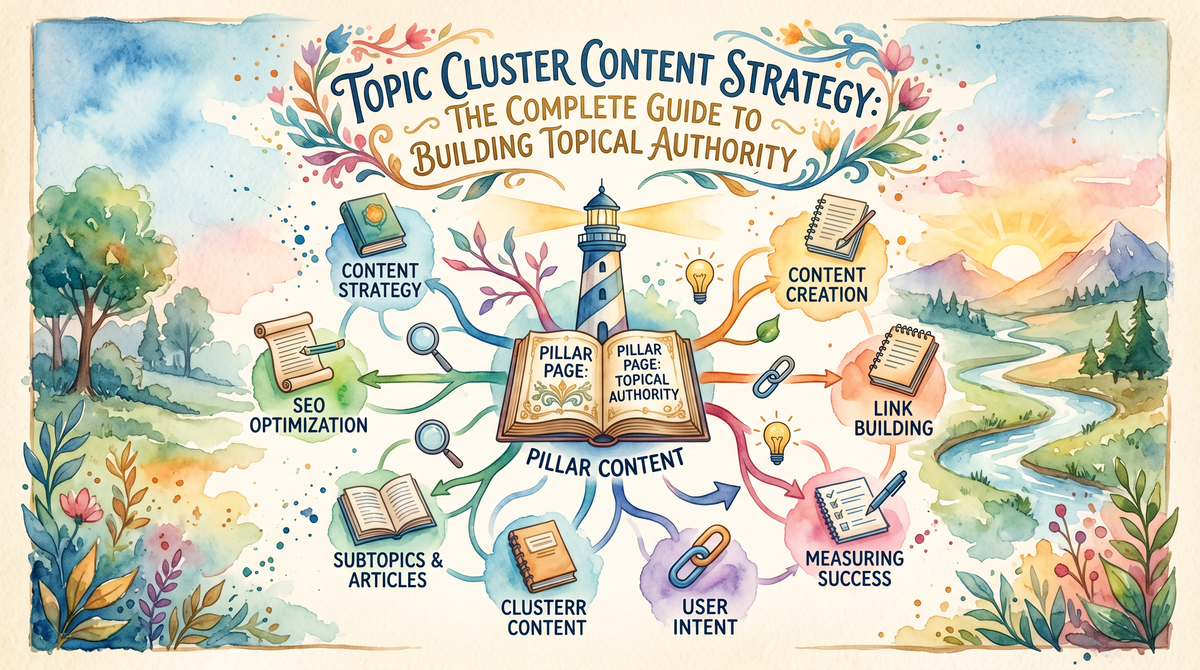
A topic cluster content strategy is a method of organizing your website's content around a central "pillar" page covering a broad subject, supported by a group of interlinked "cluster" articles that each go deep on a specific subtopic. The pillar page and cluster pages link to each other bidirectionally, signaling to Google that your site holds genuine authority over a topic rather than just chasing isolated keywords. Content grouped into topic clusters drives approximately 30% more organic traffic and holds rankings 2.5 times longer than standalone pieces, based on a 2025 analysis of clustered versus single-post content strategies.
This confused me too, at first. When I started learning SEO, I thought the goal was simple: find a keyword, write an article, repeat. The problem? Each article competed with the others. Old posts cannibalized new ones. And Google had no clear signal that my site was an expert on anything. Topic clusters solve all three of those problems at once.
Why Topic Clusters Work: The Library Analogy
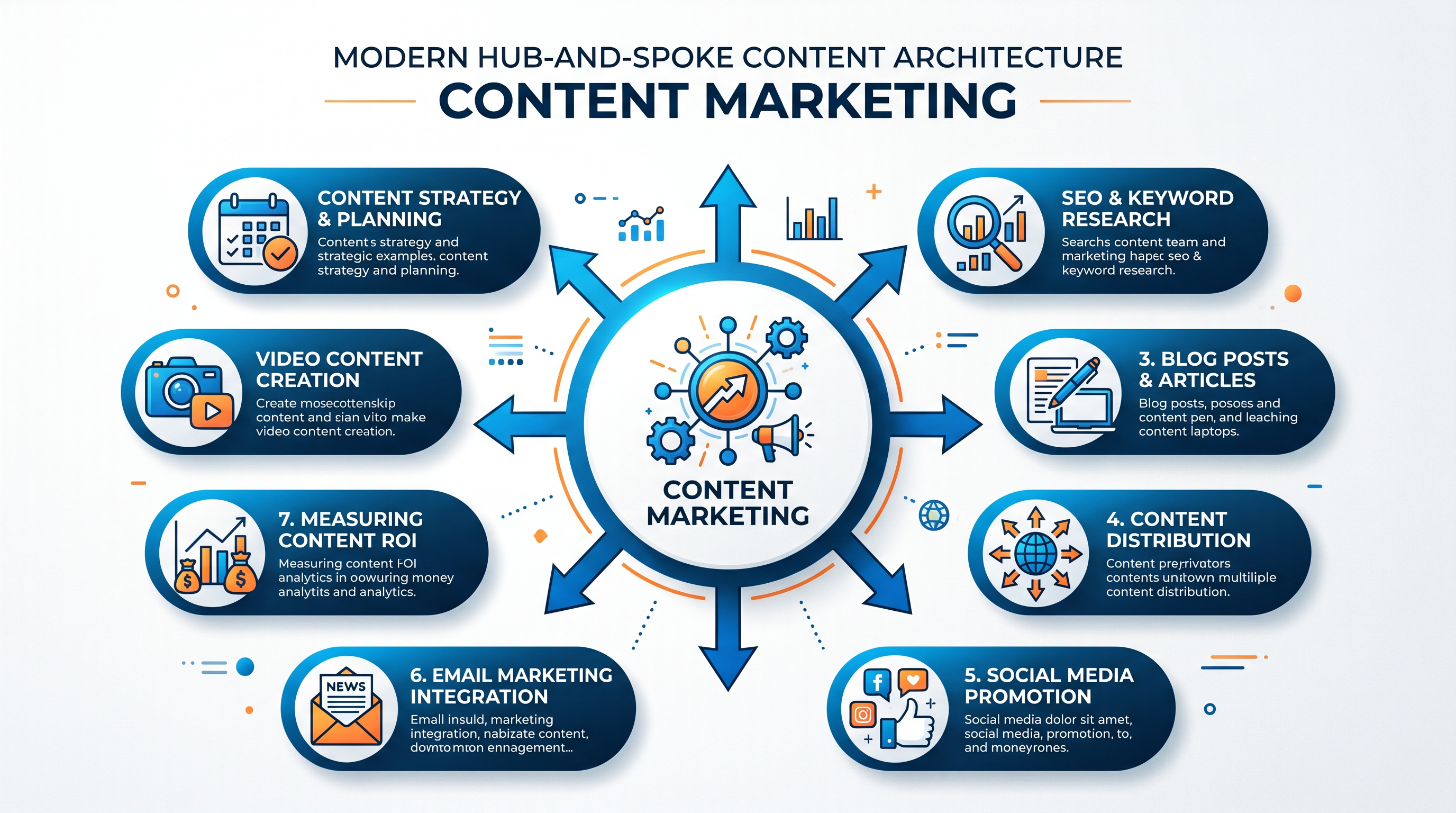
Think of your website like a public library. Without a proper filing system, books are scattered everywhere and nobody can find what they need. A topic cluster is the Dewey Decimal System: every book (cluster article) belongs to a section (topic), and every section has a master index (pillar page) that points you to the right shelf.
Google's Helpful Content system evaluates the depth and breadth of your coverage across a topic. A site with 20 interconnected articles on email marketing will consistently outrank a site with one 5,000-word guide, even if the single article is technically superior. That's a striking point. Breadth of coverage, properly linked, beats raw word count.
Building topical authority through SEO is no longer a nice-to-have. In 2026, topical authority has become the cornerstone of SEO success. Search engines have become sophisticated enough to evaluate whether your site genuinely understands a subject, not just whether a single page contains the right words.
The Three Core Components of a Topic Cluster
Every topic cluster, regardless of industry or niche, is built from the same three parts. Understanding each one clearly is the foundation for building anything that actually ranks.
1. The Pillar Page
The pillar article is the comprehensive, authoritative treatment of the core topic, designed to be the single best resource on that subject on your site, and ideally in your competitive space. Think of it as a "10,000-foot view" of a subject. It introduces the major subtopics but doesn't exhaust each one, because that's what the cluster articles are for. A full SEO pillar page guide can show you the exact structure these pages need to follow, but the core job is simple: be the most useful overview that exists on your topic.
Pillar articles are typically 3,000 to 6,000 words for most topics. This is not arbitrary; it reflects the depth required to genuinely cover a topic's primary questions, subtopics, and common confusions comprehensively.
2. Cluster Content (The Spokes)
Each cluster article drills into one specific subtopic that the pillar page touched on. If your pillar page is "The Complete Guide to Email Marketing," your cluster articles might cover subject line best practices, segmentation tactics, A/B testing methods, and email deliverability. Each one exists to win a specific, narrower search query while reinforcing the pillar's authority.
A functioning topic cluster starts with six to eight cluster articles. Quality and linking structure outweigh sheer volume. You don't need to publish 40 articles before seeing results. A tight, well-linked cluster of eight genuinely useful pieces is worth far more than 30 shallow ones.
3. Internal Links (The Glue)
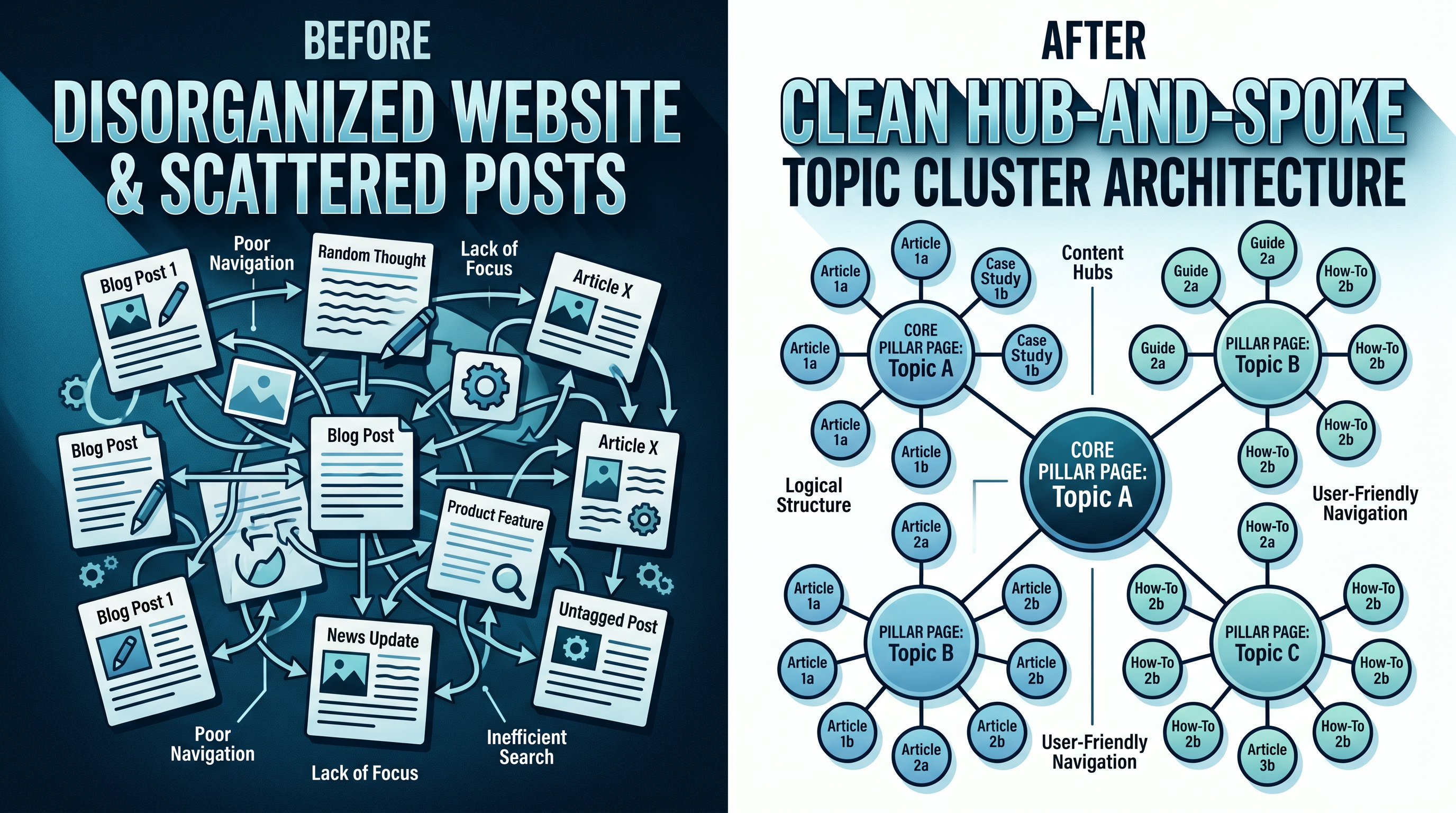
A bidirectional link structure where the pillar page links out to relevant cluster pages, and every cluster page links back to the pillar creates a thematic web that search engines can easily crawl, understand, and rank. This is the part most people skip or do inconsistently. Every cluster article must link back to its pillar. The pillar must link to every cluster. Without this, you just have a collection of loosely related posts. Using the right internal linking tools makes this bidirectional structure much easier to maintain as your cluster grows.
How to Build a Topic Cluster: Step by Step
The process is more structured than most people expect. Here's how to go from zero to a functioning cluster.
Step 1: Choose Your Core Topics
Pick 3 to 5 subjects that sit at the intersection of what your business does and what your audience searches for. Most B2B brands should have 3 to 7 well-developed topic clusters rather than 15 to 20 shallow ones. Resist the urge to cover everything. Deep, narrow authority beats wide, thin coverage every time. When choosing topics, focus on high-intent keywords that signal your audience is ready to take action, not just browse.
Step 2: Map Your Subtopics
For each core topic, brainstorm 8 to 12 subtopics that a curious reader would naturally want to explore. A good test: if someone reads your pillar page and wants to go deeper on one point, that deeper point is a cluster article. Write down every question your audience asks before, during, and after engaging with your product or service. Each question is a potential cluster page.
Step 3: Audit Existing Content First
Before writing anything new, review what you already have. You may already have cluster articles without a pillar to connect them to, or a solid pillar with no supporting cluster. Mapping your existing posts to a cluster structure first saves weeks of unnecessary writing and often produces ranking improvements quickly, because the architecture was missing, not the content.
Step 4: Create the Pillar Page
Write a long-form, comprehensive resource that covers your core topic at a high level. Use clear headers for each subtopic. Internally link to cluster pages as you create them. Treat the pillar as a living document you'll update as the cluster grows.
Step 5: Publish Cluster Articles Consistently
Content clusters do not produce overnight results. The authority signal accumulates as Google indexes more cluster pages and as internal links pass equity through the structure. Sites that sustain cluster publishing for 12 or more months see 40% higher organic traffic than comparable single-page strategies. Consistency is the differentiator. A publishing cadence of even four to six cluster articles per month, sustained over six months, compounds into measurable authority.
The Topic Cluster Model: Quick Reference Table
This table is worth bookmarking. It's the mental model that makes the whole system click into place.
| Component | What It Is | Typical Length | Primary Job |
|---|---|---|---|
| Pillar Page | Comprehensive overview of a broad topic | 3,000 – 6,000 words | Establish authority; link out to all cluster pages |
| Cluster Article | Deep-dive on one specific subtopic | 1,000 – 2,500 words | Rank for specific queries; link back to pillar |
| Internal Links | Bidirectional links connecting pillar and cluster | N/A | Pass authority; signal topic relationships to Google |
| Full Cluster | Pillar + 6 to 12 cluster articles + links | Varies | Build topical authority on one core subject |
Topic Clusters vs. Traditional Blog Strategy
The old way of blogging was essentially a numbers game: publish as many keyword-targeted posts as possible and hope some of them rank. That model worked when Google's algorithm was less sophisticated. It mostly doesn't anymore.
| Factor | Traditional Blog Strategy | Topic Cluster Strategy |
|---|---|---|
| Content organization | Standalone articles, loose categories | Structured clusters with pillar hub |
| Internal linking | Irregular, ad hoc | Systematic and bidirectional |
| Keyword cannibalization risk | High | Low (each article owns a clear subtopic) |
| Authority signal to Google | Weak, fragmented | Strong, concentrated |
| AI Overview citation potential | Low | High (structured, trusted source signals) |
| Long-term ranking durability | Low | 2.5x longer ranking retention |

Common Mistakes to Avoid
Most topic cluster efforts fail not because the strategy is wrong, but because of a handful of recurring execution errors.
- Skipping the audit. Publishing new cluster content without first mapping what already exists leads to duplicate content and wasted effort.
- Weak pillar pages. A 700-word pillar page is not a pillar page. It needs to be genuinely comprehensive. Thin pillar pages collapse the whole structure.
- One-way linking. Linking from the pillar to clusters but not back is the single most common internal linking mistake. Every cluster article needs a link back to the pillar.
- Choosing too many core topics. Spreading your cluster effort across 12 topics simultaneously produces 12 weak clusters instead of 3 strong ones. Start narrow.
- Treating it as a one-time project. A cluster is never finished. New questions emerge, subtopics get outdated, and cluster articles need refreshing. Plan for ongoing maintenance from the start.
- Ignoring search intent. Each cluster article should match the intent behind a specific query, not just target a keyword. A how-to article and a comparison article serve different intents, even if they share similar keywords.
Topic Clusters in 2026: AI Search and GEO
One major development worth noting: the rise of AI-generated search results (AI Overviews, Perplexity, ChatGPT Search) has made topic clusters even more valuable. AI-generated search results pull information from structured and trusted sources, so topic cluster strategies increase the chance of your content being cited in AI overviews. The same internal linking structure that convinces Google you're an expert also makes your content machine-readable in a way that AI retrieval systems favor.
In 2026, the topic cluster approach has evolved significantly: the structure is now explicitly serving both SEO and generative engine optimization (GEO) objectives simultaneously, the data inputs to cluster design have expanded beyond keyword research to include AI query analysis, and the measurement framework has grown to encompass cluster-level authority metrics alongside individual article performance. In short, the same architecture that helps you rank in Google also helps you get cited by AI.
Frequently Asked Questions
How many articles does a topic cluster need to be effective?
A minimum viable cluster is one pillar page plus six to eight well-written cluster articles, all properly interlinked. That said, larger clusters covering 15 to 20 subtopics tend to dominate their topics in search over time. Start with six to eight and expand based on what's ranking and what questions remain unanswered in your niche.
How is a topic cluster different from a content silo?
Content silos and topic clusters look similar on the surface but differ in their linking rules. A silo strictly restricts internal links to within the silo only, following a hierarchical structure. A topic cluster is more flexible: it uses bidirectional links between pillar and cluster and allows links to other clusters where relevant. In 2026, the cluster model is generally preferred because it mirrors how modern search algorithms read semantic relationships.
Can a small site or new blog use topic clusters?
Yes, and actually smaller sites benefit more from the structure. Search engines now reward expertise over a site's age or size. A new or smaller site with strong and well-linked topic clusters can outrank bigger domains that use an outdated SEO approach. A focused cluster on a narrow subject is one of the fastest paths to first-page rankings for a new domain.
How long before a topic cluster starts ranking?
Realistic expectations: most clusters start showing meaningful movement between months three and six, with compounding growth between months six and twelve. Early cluster articles may rank faster if you're targeting low-competition subtopics. Patience is required. The compounding nature of the strategy means results accelerate over time rather than arriving in a straight line.
Do I need a special tool to manage topic clusters?
You don't need any proprietary tool to plan or execute a topic cluster. A spreadsheet mapping your pillar topics, cluster subtopics, target keywords, and internal link status is enough to start. That said, platforms that automate content generation, internal linking, and publishing (such as Rankcow) remove the most time-consuming parts of maintaining a cluster at scale, especially if you're managing multiple clusters across a large site.
Rankcow automates the entire topic cluster pipeline for you: from identifying the right pillar topics and cluster subtopics to generating, optimizing, and publishing 30 SEO articles per month directly to your CMS, with internal linking handled automatically. If you recognize the value of topic clusters but don't have the bandwidth to execute consistently, Rankcow's hands-off platform is built exactly for that gap. Start building your topical authority on autopilot.