How to Find Low Competition Keywords: A Step-by-Step Guide for 2026

To find low competition keywords, filter your keyword research tool for a Keyword Difficulty (KD) score under 30, target phrases that are 3+ words long (long-tail), and verify the SERP manually to confirm the top results are weak or outdated. The sweet spot is a KD below 30 with at least 200 monthly searches and clear user intent behind the query. Once you nail that formula, ranking on page one becomes a matter of when, not if.
Let's be honest: most people waste months chasing keywords they have zero chance of ranking for. I've seen it happen. A brand new site targets "project management software" with a KD of 72, publishes ten articles, and wonders why nothing moves. Here's what I wish someone had told me earlier: winning at SEO starts with picking fights you can actually win. Low competition keywords are those fights.

What Are Low Competition Keywords?
Low competition keywords are search terms that people are actively searching for, but where few powerful websites are competing against them. They tend to be specific, often question-based, and frequently take a long-tail form. Low competition keywords have Keyword Difficulty scores below 30 in most tools, and they rank faster because fewer high-authority sites target them.
Understanding the nuances behind a keyword difficulty score matters more than most beginners realize. A KD of 28 on a niche phrase and a KD of 28 on a broad phrase can behave very differently in the real world. That manual SERP check you're tempted to skip? It's non-negotiable.
| KD Score Range | Difficulty Level | Best For |
|---|---|---|
| 0–14 | Very Easy | Brand new sites, immediate wins |
| 15–29 | Easy | Sites under 3 years old, DR below 40 |
| 30–49 | Medium | Established sites with some authority |
| 50–69 | Hard | Requires active link-building |
| 70–100 | Very Hard | High-authority domains only |
Why Low Competition Keywords Matter in 2026
Long-tail keywords, which are 4+ words and typically low competition, drive roughly 70% of all searches. That's not a small slice of the pie — that's where most real buying intent lives. A 2025 industry analysis found that Local Services is the most accessible niche, with 93 easy keyword opportunities for every difficult one, while Finance and SaaS are highly competitive with nearly a 1:1 ratio of easy-to-hard keywords.
Low competition keywords give you a realistic shot at appearing on page one, even for new sites, and instead of waiting months or years to see results, you start gaining traction sooner. That early momentum compounds. Google starts trusting your site, which opens doors to harder keywords down the road.
"The brands seeing the best organic ROI right now are not the ones with the highest domain authority. They picked keywords where they could realistically win, then built a content moat around them." — JetFuel Agency
The Step-by-Step Process to Find Low Competition Keywords

Step 1: Start With Seed Topics, Not Keywords
Before opening any tool, write down the problems your audience actually has. Before you open any tool, write down the problems, outcomes, objections, comparisons, and edge cases your audience cares about. Don't start with "CRM" — start with "CRM for roofing sales reps" or "best CRM for two-person agencies." Precision is where low competition usually lives.
This step takes longer than you'd expect. Budget 30–60 minutes just for brainstorming. It's the foundation everything else rests on.
Step 2: Expand Using Free Discovery Sources
Once you have 10–20 seed topics, run them through these free sources to generate hundreds of keyword variations:
- Google Autocomplete — type your seed and note every suggestion
- People Also Ask (PAA) — each question box is a potential article
- Google Search Console — find queries you already rank for on pages 2–3
- AI tools like ChatGPT or Perplexity — generate conversational question variations
In 2026, AI platforms like ChatGPT, Perplexity, and Google AI Overviews surface conversational queries before they attract SEO competition — these are the lowest-competition opportunities available right now. Use AI to widen the idea pool, then validate everything with a dedicated keyword tool.
Step 3: Filter by KD Score in a Keyword Tool
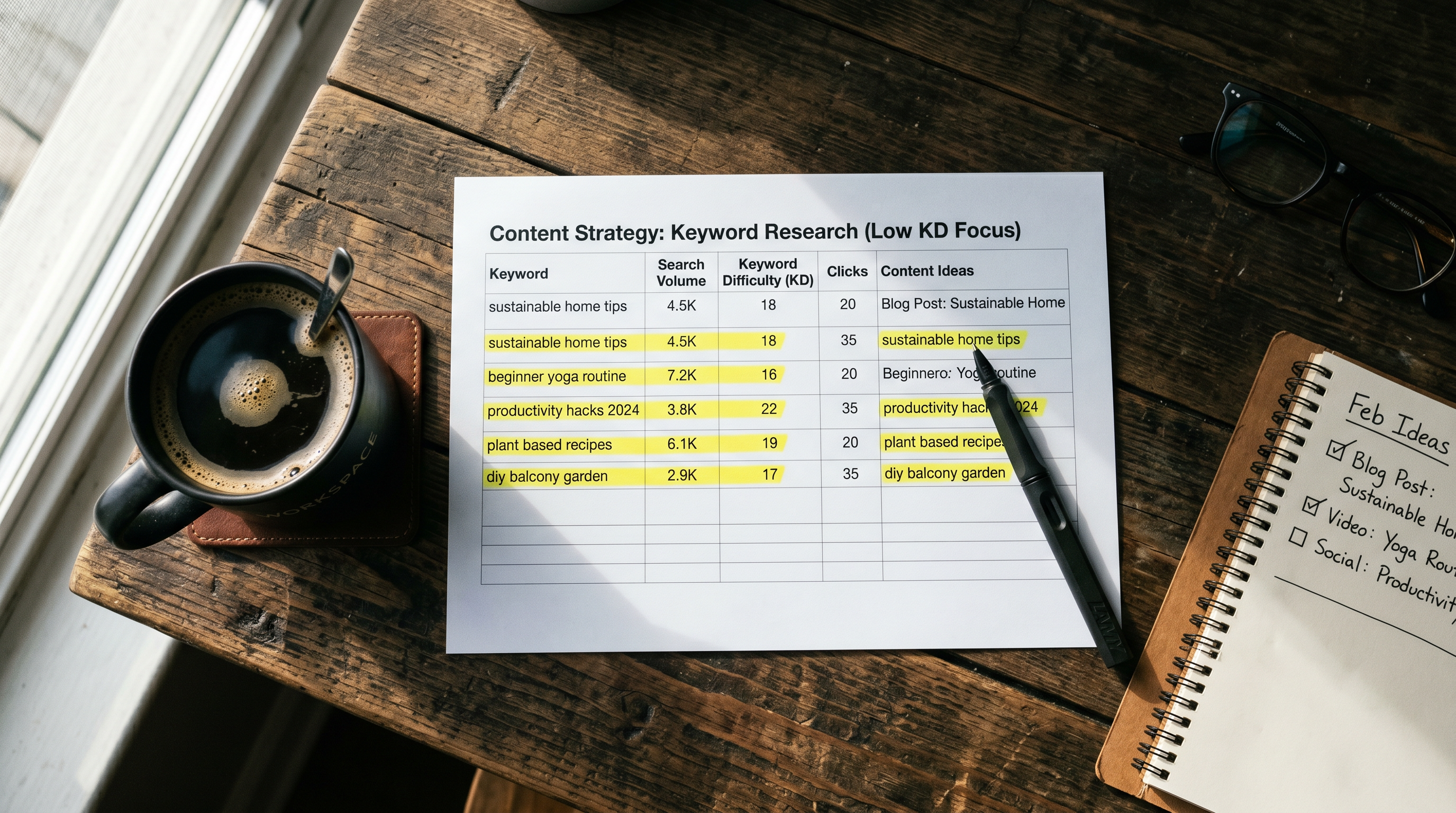
Run your expanded list through a keyword research tool and apply a KD filter of 30 or below. Set the ceiling at KD 30 and look for keywords with at least 200 monthly searches. Lower volume can work but requires more scrutiny to confirm the traffic justifies the production cost.
This is where tools like Google Keyword Planner, Ubersuggest, and SE Ranking earn their keep. If you're doing this for a blog, check out the top-rated keyword tools for bloggers to find the right fit for your workflow and budget.
Step 4: Verify Search Intent Against the SERP
Here's the thing most tutorials skip: a KD score alone does not tell you whether you can rank. You have to manually Google the keyword and look at what's on page one.
Signs that a keyword is genuinely winnable:
- 🟢 Forum posts (Reddit, Quora) ranking in the top 5 — weak content dominating
- 🟢 Outdated articles from 2019–2021 with thin content
- 🟢 Pages from low-authority domains (DR under 30) holding top spots
- 🔴 Featured snippet with a perfect, comprehensive answer
- 🔴 Multiple established brands with 10K+ backlinks
KD scores are estimates. A manual SERP review takes 60 seconds and tells you what the tool cannot — whether the actual ranking pages are weak enough to beat.
Step 5: Analyze Competitor Keyword Gaps
Find a direct competitor that's slightly ahead of you in authority. Run a keyword gap analysis to find keywords they rank for that you don't. Then filter that list by KD under 30. You'll often uncover 50–100 winnable keywords in a single session.
This works because your competitor already validated that the keyword drives traffic. You're not guessing — you're borrowing their research and doing it better. Structured keyword research strategies like this gap method consistently outperform guesswork-based approaches.
Step 6: Prioritize by Intent and CPC Value
Not every low-KD keyword is worth the same. Use CPC data as a commercial value signal. For an SEO strategist, CPC is the most reliable commercial value signal available. If advertisers are willing to pay $15 for a single click on a keyword, it objectively proves that keyword's profitability, indicating traffic that converts at a rate high enough to justify the spend.
Sort your shortlist by intent category:
- Informational ("how to...") — Build topical authority, attract top-of-funnel traffic
- Commercial ("best X for Y") — High buyer intent, strong conversion potential
- Transactional ("buy X online", "X pricing") — Lower volume, highest conversion rate
Step 7: Cluster and Publish, Don't Publish One-Offs
A single page targeting one low-competition keyword is fine. A cluster of 10–15 pages targeting related low-competition keywords under one pillar topic is a content moat. Group synonyms and related long-tail phrases, since a single authoritative page on a specific topic can rank for 50+ related keywords if the content architecture is correct.
Every cluster article must link back to its pillar. This internal linking structure is what turns isolated rankings into topical authority. For SaaS companies specifically, this clustering approach is a core component of a scalable SaaS keyword research strategy.
Tools for Finding Low Competition Keywords
| Tool | Best For | Free Tier? | KD Filtering? |
|---|---|---|---|
| Google Search Console | Mining existing rankings | Yes (free) | No |
| Google Keyword Planner | Volume & CPC data | Yes (free) | No |
| Ubersuggest | Beginners, bloggers | Limited | Yes |
| SE Ranking | Small business / SMB | Trial only | Yes |
| LowFruits | Niche site builders | Limited | Yes |
| Rankcow | Automated research + publishing | No (subscription) | Yes (automated) |
Common Pitfalls to Avoid
These are the mistakes that cost people months of wasted effort:
- Sorting by volume first. Volume is a starting point, not a verdict. High-volume keywords are often dominated by AI Overviews and major brands, making them nearly impossible for new domains to crack.
- Ignoring content-type match. If the SERP wants a tool, calculator, template, or product page, a blog post usually loses. Match the format first.
- One page per keyword variation. This creates keyword cannibalization and a weak topical footprint. Cluster related terms instead.
- Skipping zero-volume keywords. Ignoring zero-volume keywords is a mistake. Low tool volume does not equal low opportunity — some of the highest-converting pages target queries that tools barely register.
- Trusting KD scores blindly. Always do the manual SERP check. A KD of 22 with Forbes and HubSpot on page one is not actually easy.
Quick-Reference Checklist (Bookmark This) ✅
- Brainstorm 10–20 seed topics based on your audience's real problems
- Expand using Google Autocomplete, PAA, Search Console, and AI tools
- Run your list through a keyword tool; filter KD to 30 or below
- Target at least 200 monthly searches (lower volume okay with high CPC)
- Manually check the SERP for each shortlisted keyword (look for weak results)
- Run a competitor keyword gap analysis and filter by KD under 30
- Prioritize by intent: informational → commercial → transactional
- Check CPC data to identify high-value hidden gems
- Cluster related keywords into content groups, not isolated pages
- Interlink every cluster article to its pillar page
- Publish consistently and monitor rankings at 30, 60, and 90 days
- Revisit and update content that's stuck on page 2–3

Frequently Asked Questions
What is a good KD score for a new website?
For a brand new website, target keywords with a KD of 0–14 (Very Easy) for the first 3–6 months. These give you real ranking wins fast, which builds Google's trust in your domain. Once you have 20–30 pages indexed and ranking, you can start pushing into the 15–29 range. Think of it as a progression: easy wins first, then harder targets as your authority grows. Working a structured low competition approach from day one is what separates sites that gain traction from those that stall for years.
How is low competition different from low traffic?
These are two separate things that beginners often conflate. Low competition means few strong sites are targeting that keyword — it's about ranking ease. Low traffic means few people search for it — that's about volume. You want keywords that are low competition AND have at least some traffic potential. The ideal combination is a KD under 30 with 200–2,000 monthly searches and a clear, specific intent behind the query. Low volume does not mean low value — 50 targeted visitors can convert better than 5,000 vague ones.
Can I find low competition keywords without a paid tool?
Yes, you can get surprisingly far with free tools. Google Autocomplete, the People Also Ask section, and Google Trends are genuinely powerful for generating ideas with no cost. Google Search Console is free and shows you the queries your site already appears for — these are prime candidates for optimization. The limitation is that free tools don't give you a reliable KD score, so you have to rely more on manual SERP analysis to gauge difficulty. If you're serious about scaling, a paid tool that automates the filtering is worth the investment.
How many low competition keywords should I target per article?
Focus on one primary keyword per article, then weave in 3–5 closely related secondary keywords naturally. Your secondary keywords should support and expand the main topic, not compete with it. Use one primary keyword per page with 5–10 semantically related variations worked in naturally. Trying to rank for 20 unrelated keywords on one page dilutes topical focus, and Google rewards pages that clearly address one topic in depth.
How long does it take to rank for a low competition keyword?
With a KD of 0–29, you can realistically see movement within 4–12 weeks for a well-optimized page on a site with even modest authority. That said, "movement" means crawling into positions 20–50 first, with page one appearing over the following months. New sites often take 3–6 months to see meaningful traffic even from very easy keywords. The timeline shortens significantly the more content you consistently publish, since topical authority accelerates individual rankings across your whole cluster.
Rankcow takes everything in this guide and puts it on autopilot — automatically identifying high-intent, low-competition keywords for your site and publishing 30 fully optimized, brand-aligned articles per month directly to your CMS. If manual keyword research and content production is the bottleneck holding your SEO back, Rankcow's end-to-end platform removes it entirely. Start growing your organic traffic without the grind.