Keyword Difficulty Score: The Complete Explainer Guide for SEO Beginners and Beyond
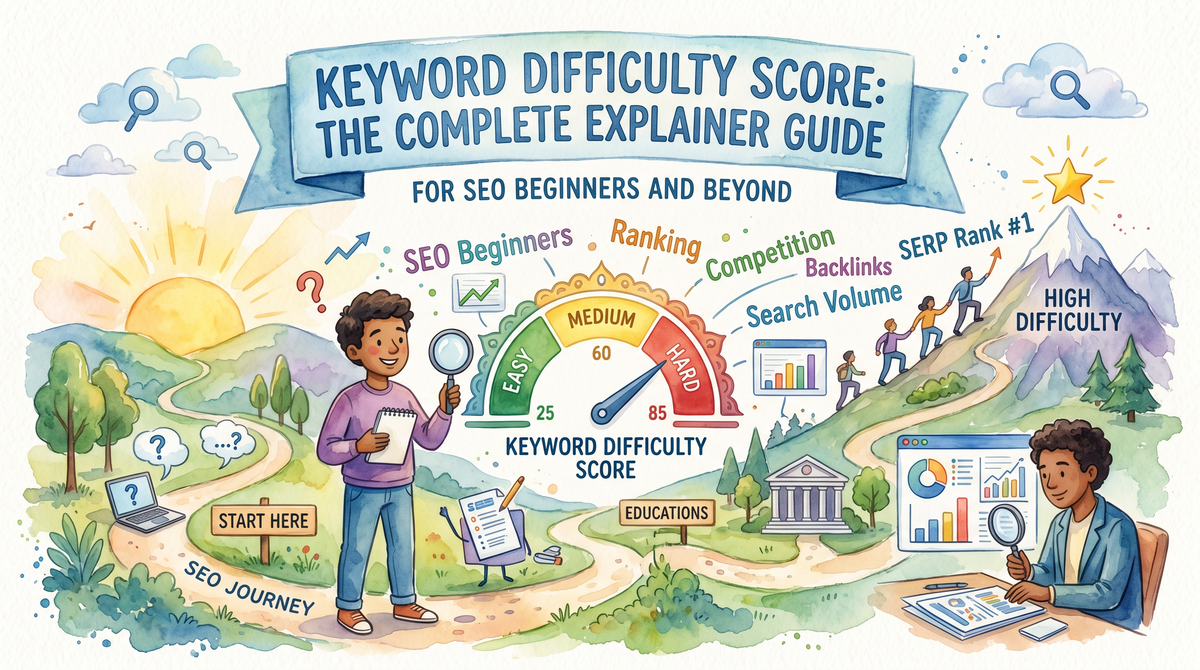
A keyword difficulty score (KD) is a number between 0 and 100 that estimates how hard it would be to rank on Google's first page for a specific keyword. Most SEO tools use a 0–100 scale, where higher scores mean tougher competition. The higher the number, the more authority, backlinks, and content depth you'll need to compete. Think of it like a difficulty dial: 10 is a quiet side street, 90 is the highway at rush hour.
This confused me too when I first started doing keyword research. I assumed a keyword with 50,000 monthly searches was automatically worth chasing. Then I kept publishing articles and ranking on page 4 or 5. The problem wasn't the content. It was that I was ignoring the difficulty score entirely and picking fights I couldn't win yet.

Why Keyword Difficulty Scores Matter for Your SEO Strategy
Here's the honest truth: search volume alone tells you how popular a keyword is, but it tells you nothing about whether you can actually win it. Keyword difficulty is the metric that determines whether you'll rank in weeks or never rank at all — while everyone obsesses over search volume, this critical number predicts how hard it will be to appear on page one for a specific term.
Think of it like applying for jobs. If you're two years out of college, applying to be a Fortune 500 CEO is not a great use of your time. You'd target roles that match your current experience level, build a track record, and then aim higher. Focusing your strategy on viable keywords optimizes your resources — you won't spend hours producing a 2,000-word guide for a keyword with a high difficulty score that your site simply doesn't have the power to target yet.
Understanding why keyword research shapes your whole SEO approach starts with recognizing that difficulty scores are the filter that separates realistic opportunities from wishful thinking. Without them, you're flying blind.
How Is a Keyword Difficulty Score Calculated?
Here's where it gets genuinely interesting. Google doesn't provide keyword difficulty scores directly. Every SEO tool builds its own proprietary model to estimate difficulty by analyzing the pages that already rank on page one. So a KD of 55 in one tool might look like 45 in another — and both can be right within their own frameworks.
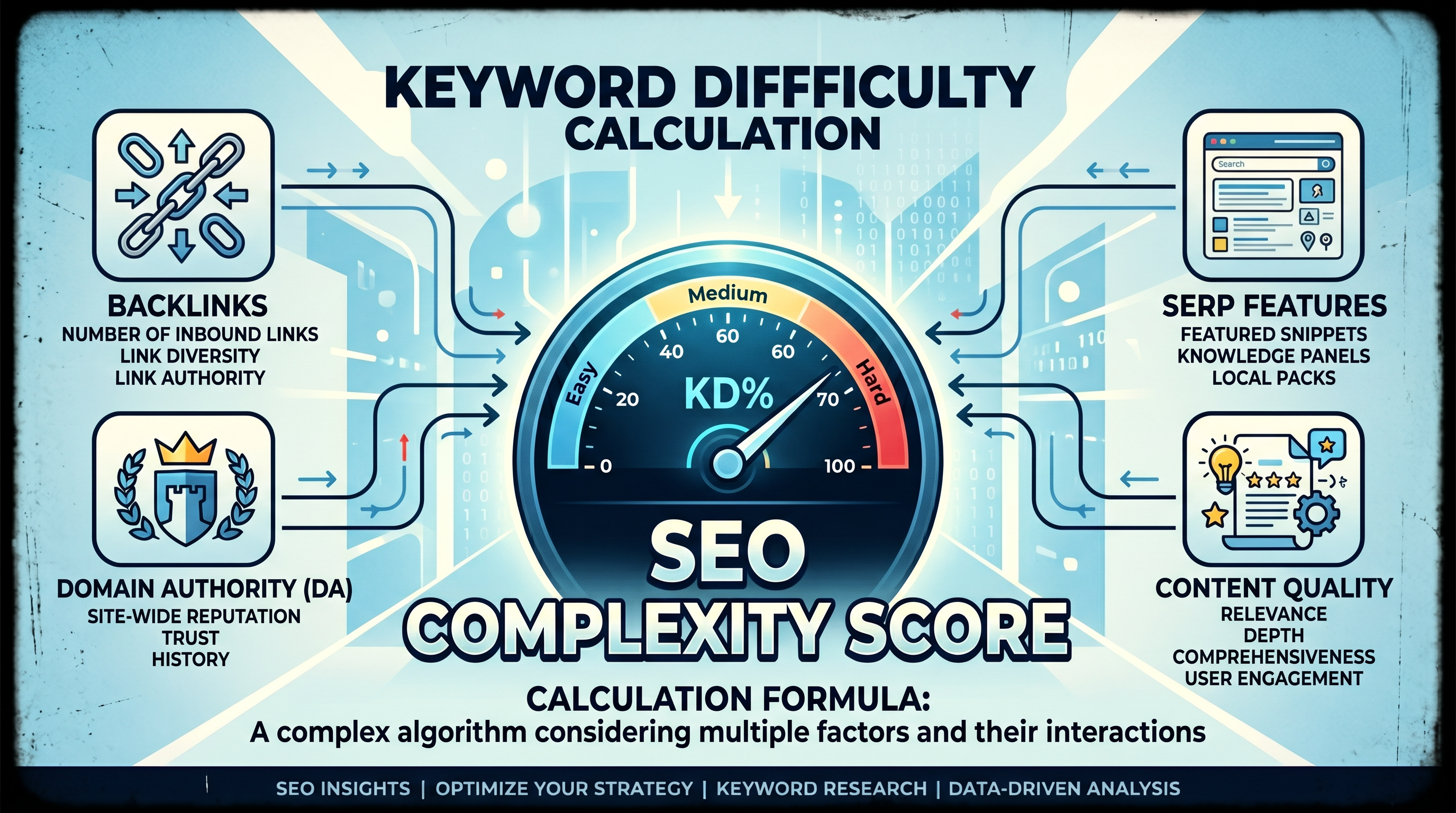
Most tools weigh a combination of signals from the current top 10 search results. The core ingredients look something like this:
- Backlink profiles: How many high-quality links point to pages already ranking? The more high-quality backlinks a top-ranking page has, the more difficult the keyword appears.
- Domain authority: Sites with a long track record and strong reputations push the difficulty score up.
- SERP features: SERP features like featured snippets, instant answers, local packs, and knowledge panels make earning organic clicks harder, which increases the difficulty score.
- Content quality and relevance: Some tools factor in how well the top pages actually cover the topic.
- User engagement signals: User engagement signals such as dwell time, bounce rate, and CTR can also influence rankings, with websites offering a better user experience tending to rank better and adding to the overall difficulty.
One important nuance: Ahrefs calculates difficulty solely by counting backlinks to the top 10 search results, while tools like Semrush use multiple factors including referring domains, dofollow/nofollow link ratios, authority scores, and search result features like knowledge panels and local packs. This is why you'll always see score differences across platforms for the same keyword.
The practical takeaway? Pick one tool and stay consistent. Comparing scores across tools will only give you a headache.
The Keyword Difficulty Score Scale: What Each Range Really Means
Let's make this concrete. Here is how the 0–100 scale breaks down in practice, and what each range implies for your content strategy.
| KD Score Range | Difficulty Level | Who Should Target It | Typical Timeline to Rank |
|---|---|---|---|
| 0–30 | Low | New sites, blogs under 12 months old | Weeks to a few months |
| 31–60 | Medium | Sites with some authority and content history | 3–6 months |
| 61–80 | High | Established sites with strong backlink profiles | 6–12+ months |
| 81–100 | Very High | Authority domains with years of SEO investment | 1–2+ years (or never) |
Keywords in the 0–29 range might show ranking results in weeks, while those in the 70–100 range could take months or years of consistent effort. For new sites, those just starting out should narrow their efforts to keywords with a KD rating of less than 30.
Mental model worth saving: Your keyword difficulty "budget" scales with your domain authority. A new site has a small budget — spend it only on low-KD terms. As you rank, earn backlinks, and build topical authority, your budget grows and you can afford harder keywords.
Keyword Difficulty vs. Keyword Competition: These Are Not the Same Thing
This trips up a lot of people, so let's clear it up directly. When you open Google Keyword Planner and see a "Competition" column showing Low, Medium, or High — that is not the same as keyword difficulty.
Keyword Competition relates to paid search terms and indicates the level of competition when bidding for a keyword in ads, while Keyword Difficulty measures your likelihood of ranking for a particular phrase in organic search results. One is about ad auctions. The other is about organic rankings. A keyword can have Low ad competition but a KD of 70 organically, because the advertisers targeting it are few but the content competition is fierce.
Always use a dedicated SEO tool (not just Google Keyword Planner) to get your actual keyword difficulty score.
What Is a "Good" Keyword Difficulty Score?
There is no single correct answer here. The debate is real and ongoing among SEO professionals. There's no one-size-fits-all number — a score that makes sense for a growing business might be a poor choice for a brand-new site. And since SEO tools calculate scores differently, what looks easy in one tool could look tough in another.
That said, there are some reliable guidelines based on where your site currently sits:
- Brand-new site (0–6 months): Target KD 0–20. Build wins first.
- Growing site (6–18 months): Target keywords with difficulty scores under 20–30; growing sites that are 6–18 months old can tackle scores of 15–40.
- Established site (18+ months, solid backlinks): KD 30–60 is a realistic sweet spot.
- Authority site (3+ years, strong backlink profile): Authority sites with 3+ years of history and robust backlink profiles can pursue scores of 40–80.
A useful rule of thumb from the data: a keyword with 500 monthly searches at 25% difficulty often brings better ROI than one with 5,000 searches at 65% difficulty. The math on actually ranking matters more than the headline volume number.
How to Use Keyword Difficulty in Your Real Workflow
Step 1: Pair KD with Search Volume
Never look at KD in isolation. A KD of 15 with zero monthly searches is not an opportunity. You want the intersection of a manageable difficulty score and enough search volume to justify the effort. Most experienced SEOs aim for keywords with decent traffic potential (even 100–500 monthly searches) and a KD score aligned with their site's current strength.
Step 2: Build a Tiered Keyword Portfolio
Think of your content calendar as a portfolio with different risk levels. Not every article should be a long-shot high-difficulty target. A healthy mix looks something like this:
- 60–70% low-difficulty keywords for consistent traffic and quick wins
- 20–30% medium-difficulty keywords as your site grows in authority
- 5–10% high-difficulty keywords as long-term authority plays
Knowing the mechanics of targeting low-competition keywords is the foundation for this approach — those early wins compound over time into the authority you need to tackle harder terms later.
Step 3: Look Past the Number and Check the SERP Manually
Even a KD of 55 might be beatable if the pages actually ranking are thin, poorly structured, or misaligned with search intent. Always analyze the pages ranking for a keyword individually rather than looking at KD in isolation — all you need is one weak link in the SERPs that you can overtake for a keyword to be worth pursuing.
Step 4: Prioritize High-Intent, Low-Difficulty Combinations
The most overlooked opportunity in keyword strategy is the value of high-intent search terms that happen to have low difficulty scores. These are keywords where someone is actively looking to buy, sign up, or solve a specific problem — and yet the competition hasn't fully woken up to them yet. These are the keywords that drive conversions, not just traffic.

Common Mistakes When Using Keyword Difficulty Scores
Mistake 1: Treating the Score as an Absolute Truth
The score is an estimate, not a guarantee. The score is dynamic and can change over time as competitors' strategies evolve, new content is created, or backlinks are acquired. A keyword that's KD 40 today might be KD 55 in six months if a wave of brands start targeting it. Always re-check scores before committing major content resources.
Mistake 2: Only Chasing Low-Difficulty Keywords
Going exclusively for low-KD terms sounds safe, but it has a downside. Low-difficulty keywords often have low search volume or poor buyer intent. If you only produce easy content, you may get traffic from people who were never going to convert anyway. Balance matters.
Mistake 3: Comparing Scores Across Different Tools
This one causes real confusion. A keyword might score 38 in one tool and 62 in another. Neither is "wrong." They use different data sources and formulas. It's important to stick to one tool for consistency since they all calculate KD a little differently.
Mistake 4: Ignoring Your Domain's Personal Difficulty
Some tools now offer a "Personal Keyword Difficulty" metric that adjusts the score based on your specific domain's authority. Relying solely on the general keyword difficulty score can mislead you — a personal KD reveals keywords that seem too competitive based on general difficulty but are actually achievable for your domain. If your tool offers this feature, use it.
Mistake 5: Setting It and Forgetting It
Your keyword strategy needs regular review. As your domain authority grows from publishing quality content, some keywords that were out of reach six months ago become real opportunities. Platforms like the leading SEO tools refresh their KD data continuously, so your opportunity window can change faster than you think.
The Bookmark-Worthy KD Strategy Framework
Here is the mental model to save and reference every time you do keyword research:
| Your Site Stage | KD Target Range | Primary Focus | Secondary Focus |
|---|---|---|---|
| Brand new (0–6 months) | 0–20 | Long-tail, niche-specific terms | Building topical clusters |
| Growing (6–18 months) | 15–40 | Mid-volume, intent-rich keywords | Internal linking structure |
| Established (18+ months) | 30–60 | Category-defining terms | Competitor gap analysis |
| Authority (3+ years) | 40–80 | High-volume, high-intent terms | Featured snippet targeting |
Frequently Asked Questions
Is a keyword difficulty score of 0 always a good sign?
Not necessarily. A KD of 0 usually means very few sites have targeted the keyword, which could mean it has almost no search volume or the topic is extremely niche. Always pair a KD score with search volume data. A KD of 0 with 0 monthly searches is not an opportunity worth your time.
Do keyword difficulty scores change over time?
Yes, and more than most people expect. As more sites publish content targeting a keyword, more backlinks accumulate to the top pages, and KD scores creep upward. The reverse can also happen if top-ranking pages lose backlinks or authority. Check scores before starting any new content project, not just when you first build your keyword list.
What's the difference between keyword difficulty and domain authority?
Domain authority is a measure of your site's overall strength and credibility (based on your backlink profile and history). Keyword difficulty is a measure of how strong the competition is for a specific search term. Domain authority is about you; keyword difficulty is about them. Understanding how to apply research strategies at a strategic level means knowing both numbers and using them together to find winnable gaps.
Can I rank for a high-difficulty keyword with great content alone?
Sometimes, but it's rare. A high-difficulty keyword with a weak-ranking site shows that content quality or intent alignment can influence rankings more than backlinks alone in certain cases. But as a general rule, great content gets you in the game; a strong backlink profile wins it. For most high-KD terms, you need both.
How many keywords should I target at each difficulty level?
There's no fixed rule, but a good starting framework for a new site is to publish 80% of content targeting KD 0–30, 15% at KD 31–50, and 5% at KD 51+. As your domain authority grows, rebalance toward higher difficulty ranges. Tracking which difficulty tiers are actually generating traffic for your site is the most accurate guide you'll ever have.
Rankcow takes keyword difficulty analysis off your plate entirely. The platform automatically identifies high-intent, low-competition keywords matched to your domain's current authority, then generates, optimizes, and publishes the content for you — 30 articles per month, on autopilot. If you're tired of staring at spreadsheets and want SEO that actually compounds, see what Rankcow can do for your site.