How to Create an SEO Strategy for a SaaS Product (Complete 2026 Guide)
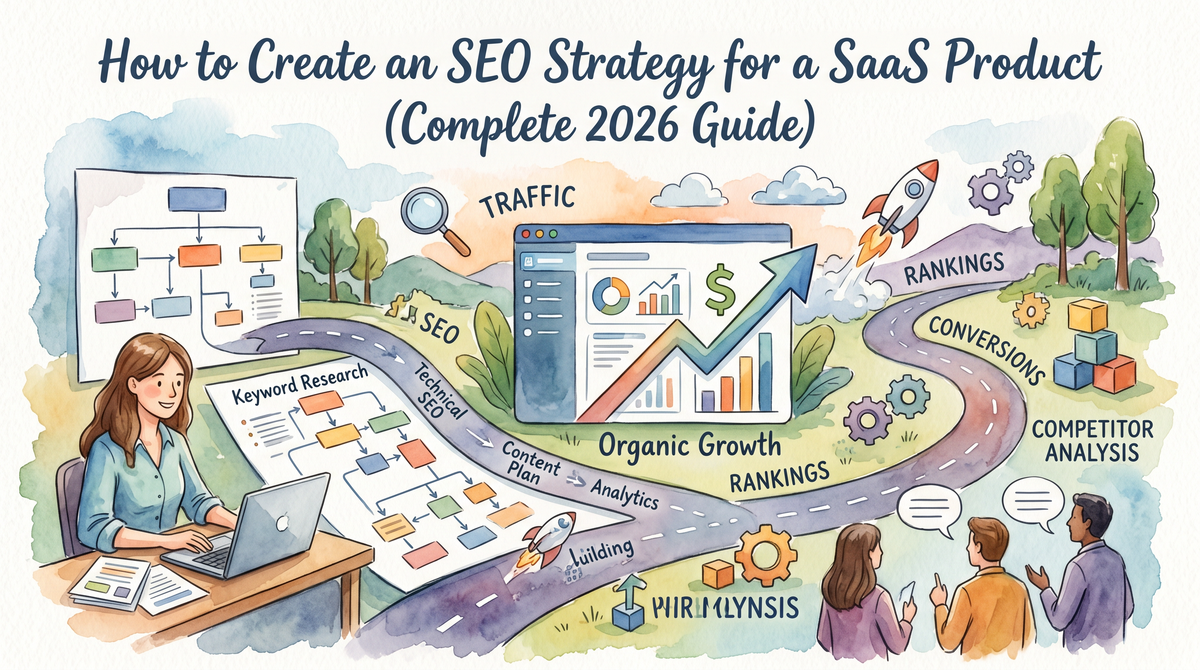
To create an SEO strategy for a SaaS product, you need to map keywords to your buyer's funnel, build topic clusters around your core product categories, publish consistently at scale, and optimize your technical foundation so Google can crawl and rank every page. That's the full picture in one sentence. Everything else in this guide is about doing each of those things well, in the right order, without wasting six months figuring out what actually moves the needle.
Here's what I wish someone had told me upfront: SaaS SEO is not regular SEO with a different logo on the brief. The buying cycles are long, the keywords are often low-volume but brutally competitive, and the content you publish today may not rank for four to six months. That's the honest reality. But the payoff? B2B SaaS companies generate a 702% return on investment from SEO, with a break-even time of just 7 months. No paid channel reliably comes close to that number.

Why SaaS SEO Is Different From Everything Else
Let's be honest: most general SEO advice is written for e-commerce brands or local businesses. SaaS products have a fundamentally different relationship with organic search, and understanding that difference is step one.
Organic search drives approximately 53% of total SaaS website visits, making it the most cost-efficient growth channel. But here's what makes it tricky: your buyers aren't googling "buy CRM software." They're googling "how to manage customer follow-ups," "best way to track sales pipeline," or "HubSpot alternative for small teams." The search intent is spread across hundreds of different queries, most of them informational or comparative in nature.
A staggering 83% of B2B buyers conduct self-research before ever speaking to a sales rep, and that research happens almost entirely through search engines. Your content library is, in effect, your sales team's pre-game warm-up. The articles you publish are the first handshake a potential customer has with your brand.
Organic channels are almost 40% cheaper than paid channels but convert 110% better. That's the business case for prioritizing SEO, right there.
A well-built SaaS SEO strategy accounts for long buyer journeys, multiple decision makers, and content that maps to each stage of the funnel — from awareness to evaluation to decision. Get that architecture right and organic becomes your best-performing channel. Get it wrong and you'll publish 50 articles that get traffic but never generate a single signup.
The Quick-Reference Checklist (Bookmark This)
Before we go deep, here's the complete step-by-step framework at a glance. Return to this any time you need a bearing.
- ✅ Define your SEO goals tied to pipeline metrics, not just traffic
- ✅ Audit your current state (technical health, existing rankings, content gaps)
- ✅ Build your keyword universe mapped to funnel stages
- ✅ Create your topic cluster architecture (pillar pages + cluster content)
- ✅ Publish at a consistent, high-volume cadence
- ✅ Optimize your technical SEO (Core Web Vitals, crawlability, internal linking)
- ✅ Build domain authority through backlinks and original research
- ✅ Measure what matters (trials, demos, MQLs from organic)
- ✅ Refresh and update aging content regularly
- ✅ Add an AEO layer to capture AI search visibility
Step 1: Set Goals That Actually Connect to Revenue
Here's the thing: "rank number one for our main keyword" is not an SEO goal. It's a vanity benchmark. Real SaaS SEO goals are tied to business outcomes: demo requests, free trial signups, MQLs attributed to organic, and pipeline generated from search traffic.
Pipeline, leads, or revenue are the North Star goals for every good SaaS SEO strategy. Measure this directly or estimate the value by tracking MQLs, SQLs, demo requests, and trial signups that originated from organic search or AI referral traffic.
Before you write a single piece of content, connect Google Search Console to your CRM. Know which organic queries are already sending you trial users. That baseline is your foundation. Everything you build should try to replicate and expand on what's already working.
"Any agency still reporting on traffic as a primary KPI is running a 2019 playbook." — Optimist (B2B SaaS SEO agency)
Set a 90-day goal, a 6-month goal, and a 12-month goal. SEO compounds, so early results will look modest. Stick with the plan through month four before drawing any major conclusions.
Step 2: Run a Baseline SEO Audit
You can't build a strategy without knowing where you're starting from. A baseline audit takes longer than you'd expect — budget at least two full weeks for a thorough job — but it prevents you from wasting months optimizing the wrong things.
Technical audit checklist
- Are your core marketing pages accessible to Googlebot, or hidden behind login walls?
- Is your site's Core Web Vitals score passing? SaaS sites loaded with demos and animations often fail here.
- Do you have duplicate content created by dynamic, user-specific app URLs?
- Are your XML sitemap and robots.txt files clean and accurate?
- Is HTTPS implemented correctly across every subdomain?
Content audit checklist
- Which pages currently rank in positions 1-10, 11-20, and 21-50?
- Which existing pages get impressions but have low CTR? (These need better titles and meta descriptions.)
- Which pages once ranked well but have slipped? (These need updates, not new content.)
- Where are the obvious topic gaps compared to your top competitors?
SaaS platforms often have structural quirks that quietly create technical SEO problems. Block dynamic, user-specific app URLs via robots.txt to prevent crawl budget waste, and ensure all feature pages and pricing pages are accessible to crawlers, not hidden behind login walls.

Step 3: Build Your Keyword Universe
This is the most important step in the entire strategy and the one most founders rush. Slow down here. The keywords you choose determine what kind of traffic you attract — and whether that traffic ever converts.
SaaS keyword research operates across four major intent categories:
| Intent Type | What the User Wants | Example Query | Funnel Stage |
|---|---|---|---|
| Informational | Learn about a problem or concept | "what is churn rate" | Top of funnel (TOFU) |
| Commercial | Compare options before deciding | "best project management software" | Middle of funnel (MOFU) |
| Transactional | Ready to sign up or buy | "Asana pricing plans" | Bottom of funnel (BOFU) |
| Navigational | Looking for a specific brand/tool | "[Competitor] alternative" | BOFU (high-intent) |
Most SaaS companies make the mistake of only targeting informational keywords. That gives you traffic with no conversion potential. You need a balanced mix across all four. In particular, do not ignore BOFU. Comparison pages and alternative pages are relatively low-effort to create and disproportionately high-converting.
Long-tail keywords now generate roughly 68% of SaaS organic traffic, up from 58% in 2023. This means hyper-specific, lower-volume keywords are where the bulk of your actual traffic will come from. Don't chase the giant head terms — build a wide, dense keyword footprint instead.
Effective SaaS keyword research also means cataloguing your competitors' keyword gaps, finding queries where your product solves a specific workflow problem, and identifying clusters of terms around each core feature of your product.
How to prioritize keywords
Use a simple scoring framework before committing to any keyword. Score each on three factors (1-5 each):
- Business relevance — How likely is someone searching this to need your product?
- Ranking opportunity — Can you realistically reach page one given your current domain authority?
- Search volume — Is there enough demand to justify the investment?
Prioritize keywords that score 10 or higher. Kill keywords that score below 7 regardless of volume.
Step 4: Design Your Topic Cluster Architecture
Google no longer rewards individual well-optimized pages in isolation. It rewards topical authority: the demonstrated expertise of an entire domain within a subject area. The mechanism for building topical authority is the topic cluster model.
Topical authority refers to a website's perceived expertise within a subject area, built through comprehensive, interconnected, and high-quality content coverage. The practical implication is that you need pillar pages supported by clusters of related content, all cross-linked deliberately.
Here's how the model works:
- Pillar page: A long-form, comprehensive guide targeting a broad core topic (e.g., "Project Management for Remote Teams"). This page links out to all cluster pages.
- Cluster pages: Focused articles on specific subtopics (e.g., "How to Set Sprint Goals," "Best Slack Integrations for Project Management," "Agile vs. Waterfall"). Each links back to the pillar.
- Product and landing pages: Your feature and pricing pages, woven into the cluster via contextual internal links.
A well-structured pillar page approach helps search engines understand your site's subject depth, which accelerates rankings across the entire cluster — not just the pillar. When one page gains authority, it lifts all the connected pages with it.
Internal linking is one of the most underutilized levers in SaaS content strategy. Strategic internal links distribute page authority across your site, helping newer content rank faster, and create logical pathways that guide users deeper into the funnel.
Step 5: Publish at Scale, Consistently
This is where most SaaS companies fall apart. They publish five articles, wait two months, see no rankings movement, and declare SEO doesn't work. The real talk is: content velocity is a ranking signal. Consistency is the strategy.
Companies publishing 9 or more blog posts monthly increased organic traffic by 35.8% year-over-year. That's a meaningful benchmark. It tells you that occasional publishing doesn't cut it. You need a steady, high-volume output.
Top SaaS blogs publishing two or more long-form articles per week average 2.4x faster traffic growth than those publishing monthly. The math on this is brutal if you're running a lean team. Producing 8-10 well-researched, properly optimized articles per month while also running a product, managing sales, and staying sane is genuinely difficult. This is why so many founders eventually look to automation or content platforms to maintain the cadence without burning out.
What I wish someone had told me earlier: publishing cadence matters more than perfection. A good-enough article published consistently beats a perfect article published sporadically, every time. The SEO algorithm rewards freshness and frequency.
For each piece of content, follow this publishing checklist:
- Target one primary keyword and 3-5 semantically related secondary keywords
- Match the content format to search intent (guide, comparison, tutorial, list)
- Aim for 1,500-2,500 words for most blog posts; 2,000-3,000 words for comparison and feature pages
- Include at least 2-3 internal links to relevant cluster content and product pages
- Add schema markup (FAQ, HowTo, Article) to every applicable post
- Optimize the title tag (under 60 characters) and meta description (under 155 characters)
Step 6: Fix the Technical Foundation
Technical SEO doesn't generate leads on its own. But poor technical SEO silently kills every other effort. Think of it as the plumbing: nobody notices it when it works, but everything floods when it breaks.
Core Web Vitals
Google uses Core Web Vitals as a ranking factor. SaaS marketing sites are particularly prone to failing these because they're often packed with interactive demos, animations, and video embeds. Audit your Largest Contentful Paint (LCP), Cumulative Layout Shift (CLS), and Interaction to Next Paint (INP). LCP should be under 2.5 seconds. Fix image sizes, lazy-load below-the-fold resources, and minimize render-blocking JavaScript.
Crawlability
Make sure your feature pages, blog posts, and landing pages are all crawlable. It's common for SaaS platforms to accidentally block critical marketing pages behind login-required authentication or to noindex pages that should rank.
Site architecture
No page on your site should be more than 3 clicks from the homepage. Flat architectures help search engines discover and index content faster. Run a crawl simulation monthly to catch orphaned pages and broken internal links.
Structured data
Implement schema markup for FAQs, pricing, product reviews, and how-to content. Structured data increases your chances of appearing in rich results, which lifts CTR even at lower ranking positions.
Step 7: Build Domain Authority Through Backlinks and Original Research
Backlinks remain one of Google's top three ranking factors. For SaaS companies, the most reliable link-building strategies are the ones that earn links rather than beg for them.
Link-building methods that actually work for SaaS
| Strategy | Effort Level | Link Quality | Why It Works |
|---|---|---|---|
| Original research / data studies | High | Very high | Journalists and bloggers cite original data |
| Free tools / calculators | Medium-High | High | Naturally earn links from resource roundups |
| Competitor alternative pages | Low-Medium | Medium | Capture traffic from dissatisfied competitor users |
| Guest posts on niche SaaS blogs | Medium | Medium | Targeted to relevant audiences in your space |
| PR and HARO/Qwoted responses | Low-Medium | High | Earns editorial links from authoritative publications |
| Integration and partner pages | Low | Medium-High | Get listed on partner and integration directories |
SaaS websites offering original research saw 29.7% organic traffic increases versus 9.3% for those without. That's a significant premium for putting in the extra effort to produce proprietary data. A simple annual survey of your user base, or an analysis of aggregate (anonymized) product data, can generate enough material for a report that earns backlinks for years.
Websites with free tools increased organic traffic by 35.6%. If your SaaS product has a natural free-tool derivative — a calculator, a template generator, a readability checker — build a standalone landing page for it. These pages attract backlinks passively and introduce your brand to prospects who aren't ready to pay yet.
Step 8: Measure What Actually Matters
Most SaaS founders get excited about keyword rankings and organic traffic. Those are fine leading indicators. But the metrics that determine whether your SEO strategy is working are further down the funnel.
The metrics that matter
- Organic-attributed free trials and demo requests (connect Google Search Console to your CRM)
- Organic lead cost (CPL): In SaaS, organic traffic generates leads at roughly $147 per lead vs. $280 for paid search. Track whether your investment is reflecting this efficiency advantage.
- Keyword rankings by funnel stage — track awareness, consideration, and decision-stage terms separately
- Share of voice vs. competitors on your core category terms
- MQL-to-SQL conversion rate from organic — organic SEO leads should outperform paid leads here
- Organic revenue attribution over 30, 60, and 90-day windows
SEO-sourced leads significantly outperform other channels with a 51% MQL-to-SQL conversion rate compared to just 26% for PPC traffic. This is the metric that should make your CFO love SEO. Leads that come from organic search are already educated, already problem-aware, and already further along in the buying journey.
Set up a simple monthly reporting template. Include rankings movement, organic sessions, organic conversions (trials/demos), and organic CPL. Compare to the previous month and to the same period last year once you have the data. Consistency in measurement, as one framework puts it, is what makes trends visible and actionable.

Step 9: Refresh and Update Existing Content Regularly
Publishing new content is only half the job. The other half is maintaining what you've already built. Content decays. Statistics go stale. Rankings slip when competitors publish better versions of your articles.
Articles that have lost rankings often need only targeted updates — refreshed data, expanded sections, improved internal links — to regain their position. A quarterly content audit should identify your top 20-30 pages that have experienced ranking drops, then systematically update them with fresh data, new examples, and improved depth.
Prioritize updates for pages that:
- Ranked in positions 5-20 (close enough to benefit significantly from a boost)
- Have strong impressions but declining CTR (title or meta needs work)
- Target keywords with significant search volume and clear commercial intent
- Are more than 12 months old and reference outdated statistics or tools
Step 10: Add an AEO Layer for AI Search Visibility
Here's something the 2023 SEO playbooks won't tell you: AI search is now part of the SaaS buyer journey. When a founder asks ChatGPT or Perplexity "what's the best SEO tool for a bootstrapped SaaS," the answer shapes their consideration set just as much as a Google results page does.
AI Overviews reduce organic CTR by 61% for affected queries, but brands cited within AI Overviews achieve 35% higher organic CTR than brands that are not cited. The implication is clear: you don't just want to rank, you want to be cited. That requires different content choices.
Answer Engine Optimization (AEO) means structuring your content so AI models can extract and recommend it. Practical tactics:
- Write clear, direct answers in the first paragraph of every article (exactly what you see at the top of this one)
- Use FAQ sections with questions phrased exactly as a user would ask them
- Include structured data (FAQ schema, HowTo schema) to signal answer-format content
- Build brand mentions across third-party sites (review platforms, industry publications, partner pages) so AI models see your brand as a credible, recurring reference
- Create original, citable data that gets referenced by other sites
8 out of 10 SaaS content teams now include "AEO" (Answer Engine Optimization) as part of their keyword strategy planning. If your team isn't there yet, this is the adjustment to make in 2026.
Tools You Need to Execute This Strategy
You don't need 15 different tools. You need the right ones for each layer of the strategy. Here's a clean, practical stack:
| Category | What You Need It For | Options |
|---|---|---|
| Keyword Research | Building your keyword universe and gap analysis | Google Keyword Planner, Ubersuggest, KWFinder |
| Technical SEO | Crawl audits, Core Web Vitals, indexing issues | Google Search Console, Screaming Frog (free up to 500 URLs) |
| Content Creation & Optimization | Writing and publishing at scale with SEO alignment | Rankcow (automated content pipeline), Surfer SEO (manual) |
| Rank Tracking | Monitoring keyword positions over time | Google Search Console, SerpRobot |
| Link Analysis | Identifying backlink opportunities and monitoring growth | Majestic, Google Search Console Links report |
| Analytics | Connecting organic traffic to pipeline and revenue | Google Analytics 4, your CRM's UTM tracking |
The biggest time sink in this entire stack is content production. Researching, writing, optimizing, and publishing a single well-structured article can take 4-8 hours when done manually. At 8-10 articles per month, that's a full-time job on its own, before you touch any other growth work. Platforms like Rankcow solve this specifically by automating the entire pipeline — from keyword identification to content generation to CMS publishing — which is why SaaS founders with lean teams increasingly choose automation over agency retainers.
For a broader view of what modern AI-powered tools can handle, the landscape of free AI SEO tools has matured considerably in 2026, giving even bootstrapped teams access to capabilities that cost thousands per month just two years ago.
Common SaaS SEO Mistakes to Avoid
These aren't theoretical mistakes. They're the ones that show up repeatedly when SaaS companies audit their organic growth after 12 months and can't figure out why it didn't work.
Mistake 1: Publishing only awareness content
Over-indexing on awareness content is a common risk. Publishing only informational articles builds traffic but not a pipeline. If your content doesn't touch decision-stage queries, organic visitors won't convert into trials, and SEO will look like it isn't working even when it technically is.
Mistake 2: Chasing volume over intent
A keyword with 10,000 monthly searches dominated by Salesforce and HubSpot will never send you a single visitor regardless of how good your article is. Prioritize keywords where you have a realistic shot at page one, even if the volume is modest. Win the beachhead first, then expand.
Mistake 3: Ignoring the product pages
Your feature pages, integrations pages, and use-case landing pages are SEO assets. Many SaaS companies treat their blog as the only SEO property and leave product pages thin and uncrawlable. Product pages should be keyword-optimized, content-rich, and cross-linked into the blog cluster.
Mistake 4: Not setting up tracking before publishing
This is the one that stings. If you publish 30 articles before connecting Search Console to your CRM, you lose months of attribution data. Set up tracking infrastructure on day one, before a single piece of content goes live.
Mistake 5: Expecting results in 60 days
Across most industries, meaningful returns typically begin to appear after six to twelve months, once authority builds, content matures, and search visibility stabilizes. Set this expectation with your team, your board, and yourself. Anyone promising page-one rankings in 30 days is selling something that doesn't exist.

How to Accelerate Results: The Publishing Frequency Lever
If there's one lever that produces the clearest, most consistent impact on SaaS organic growth, it's publishing frequency. The data on this is remarkably consistent across every source.
The average SaaS site earns traffic from about 1,200-2,000 ranking keywords within six months of consistent publishing. "Consistent" here means publishing multiple times per week, not multiple times per month. The sites that hit that 1,200-2,000 keyword threshold in six months aren't doing anything magical with their content — they're just showing up with more of it, more often.
The practical challenge: most SaaS marketing teams are one or two people. Producing 8-10 SEO-optimized articles per month while managing everything else is genuinely not feasible without either significant headcount or automation. This is the gap that platforms like Rankcow were built to fill — 30 articles per month, automatically researched, written, optimized, and published to your CMS, with internal linking and brand-tone alignment built into the pipeline.
Frequently Asked Questions
How long does it take for a SaaS SEO strategy to show results?
Realistically, you'll start seeing ranking movement for lower-competition keywords within 3-4 months. Meaningful organic traffic growth typically appears between months 5-8. Significant pipeline impact from organic, where you're attributing trials and demos to SEO at scale, usually arrives at the 9-12 month mark. This timeline compresses significantly when you publish at higher frequency (8-10+ articles per month) versus lower frequency (1-2 per month).
How many articles should a SaaS company publish per month?
The research is clear that more frequency produces faster results. Publishing 9 or more articles per month produces 35.8% year-over-year organic traffic growth. A realistic minimum for a startup trying to build topical authority is 6-8 articles per month. To compete aggressively in established SaaS categories, 15-30 articles per month is the pace set by the market leaders. If your team can't sustain that manually, content automation platforms are the practical alternative to hiring a full content team.
Should a SaaS company invest in SEO or paid search first?
The real talk is: it depends on your runway and timeline. If you need customers in the next 90 days and have budget for ads, paid search fills the gap while SEO builds. But over any period longer than 12 months, SEO almost always generates higher-quality leads at a lower cost. The ideal play for most SaaS companies is to run both in parallel — use paid search for immediate conversions while organic builds in the background. Never let paid become the only channel, because the moment you stop spending, the traffic stops with it.
What's the most important page type for SaaS SEO?
Comparison and alternative pages consistently outperform other content types on a revenue-per-visitor basis. A page titled "[Competitor] alternative" or "[Your Product] vs. [Competitor]" captures users who are actively evaluating tools and are a single demo away from becoming customers. These pages are often underinvested because they feel uncomfortable to write — but they're where the bottom-of-funnel conversions happen. Build them early and keep them updated as competitors change their pricing and features.
How does AI search (ChatGPT, Perplexity) affect SaaS SEO strategy?
AI search is an additive channel, not a replacement. Traditional SEO still drives the majority of SaaS traffic. But AI-powered tools are increasingly influencing product discovery, especially at the early awareness stage when buyers are formulating what they even need. The right response is to add an AEO (Answer Engine Optimization) layer to your existing SEO strategy: write content with direct, extractable answers, build brand mentions across credible third-party sources, and use structured data to help AI systems understand and cite your content. The comparison between traditional SEO and modern AEO-integrated strategies shows that companies running both consistently outperform those running either one alone.
Keeping up with SaaS SEO's publishing demands is the hardest part of this entire strategy — and it's exactly where most founders run out of steam. Rankcow was built to solve that specific problem: an end-to-end SEO automation platform that identifies high-intent keywords, generates brand-aligned long-form content, and publishes it directly to your CMS — 30 articles per month, on autopilot. If you're ready to build a compounding organic growth engine without the manual grind, start with Rankcow.