SaaS SEO Strategy Showdown: Which Approach Actually Wins in 2026?
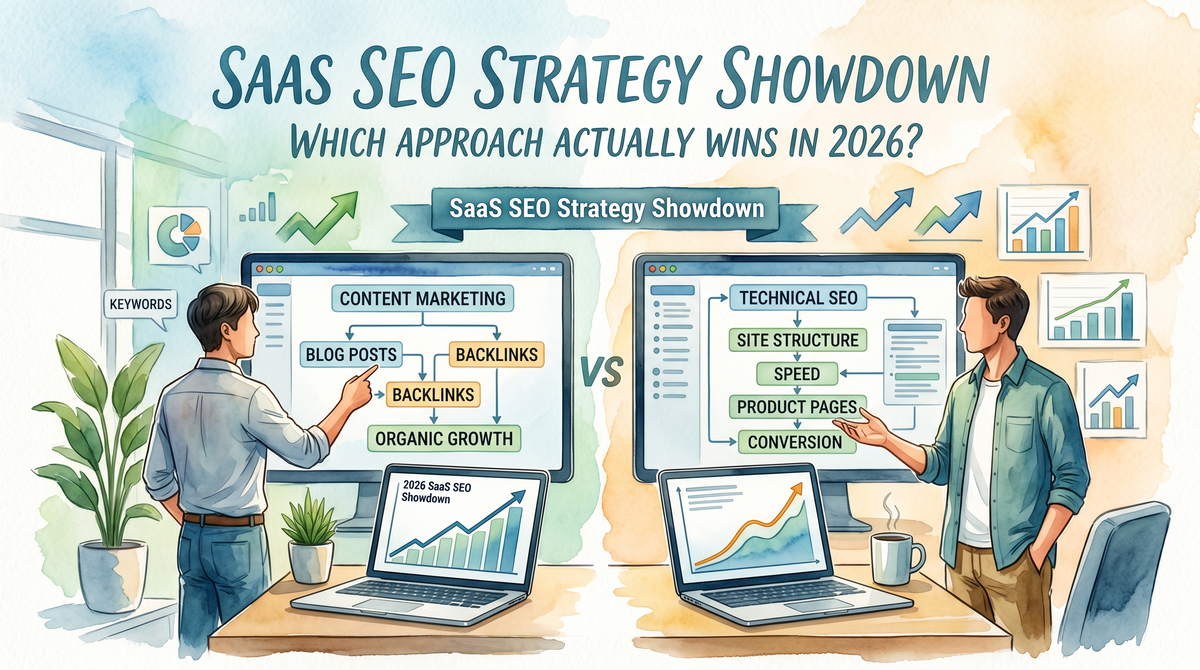
The best SEO strategy for SaaS in 2026 combines a content-led, pillar-cluster architecture with automated publishing at scale, targeted keyword research focused on commercial and bottom-of-funnel intent, and Answer Engine Optimization (AEO) to capture AI search citations. No single tactic wins alone, but the evidence is clear: content velocity paired with topical authority building consistently outperforms every other approach for compounding organic growth. Over a three-year average, B2B SaaS companies saw a 702% ROI from SEO campaigns, making it the highest-return acquisition channel in the industry. The strategic question is not whether to invest in SEO, it's which approach to deploy given your stage, team size, and competitive landscape.

Why This Comparison Matters Right Now
The SaaS SEO arena has fractured in 2026. With over 98,000 SaaS products competing for buyer attention, 88% of them in the B2B space, the difference between compounding organic growth and expensive paid dependency often comes down to knowing what the numbers actually say. Founders are now choosing between four fundamentally different SEO playbooks, each with distinct cost curves, time horizons, and risk profiles. Pick the wrong one for your stage and you waste 12 months on the wrong bets. Pick the right one and you build a traffic engine that runs while you sleep.
Organic channels are almost 40% cheaper than paid channels, but convert 110% better. That gap is widening. Meanwhile, Forrester's 2025 Buyers' Journey Survey says 94% of B2B buyers are already using AI in their buying process, meaning your content now needs to rank in Google AND get cited by ChatGPT, Perplexity, and Google AI Overviews. The strategy that ignores AEO is already fighting with one hand tied behind its back.
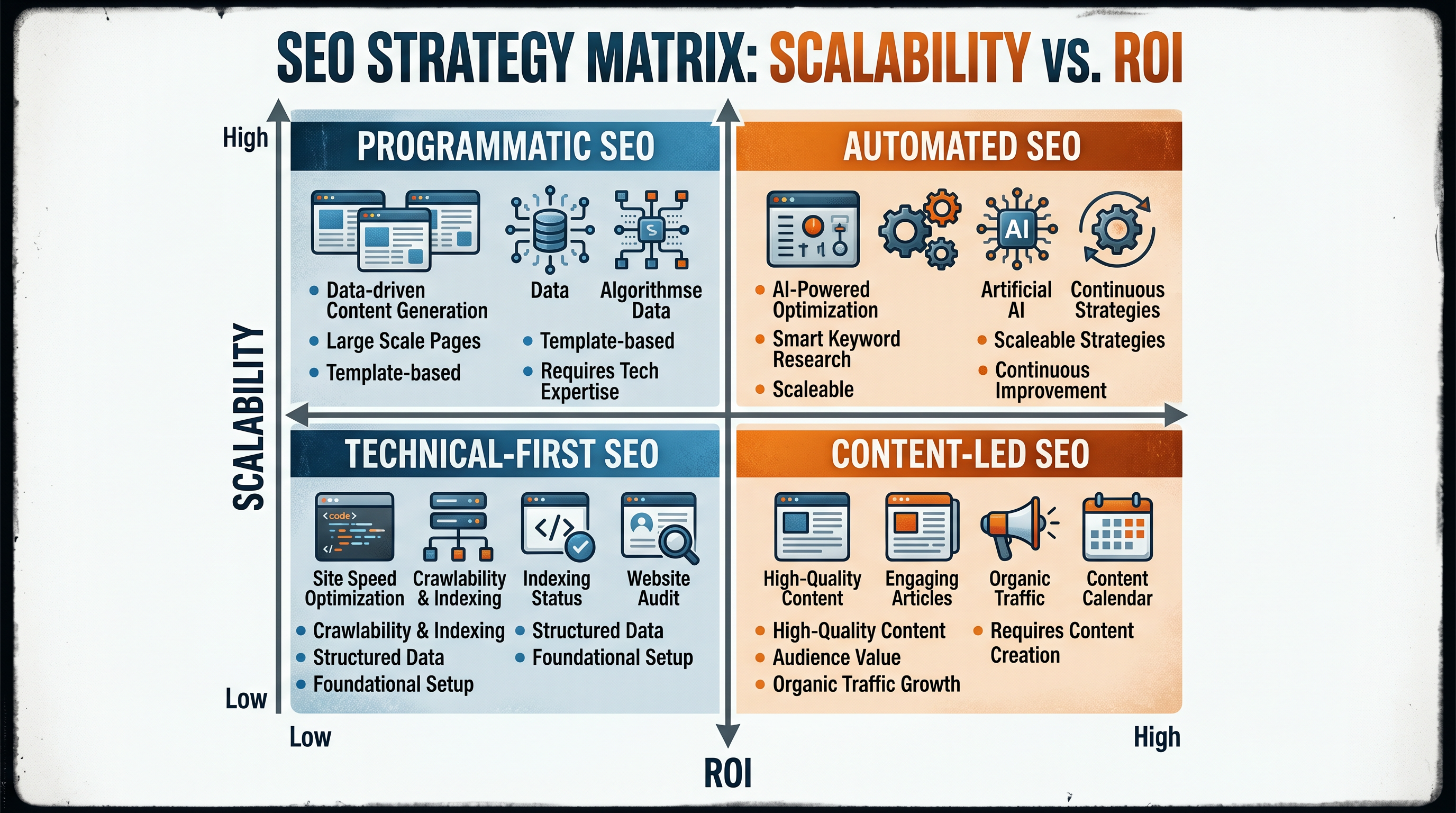
We evaluated four distinct SaaS SEO strategies that serious growth teams are deploying right now: Content-Led SEO, Programmatic SEO, Technical-First SEO, and Automated SEO. This is a definitive head-to-head so you can stop waffling and start executing. Our full methodology is below.
What We Tested: Methodology and Criteria
We evaluated each strategy against three specific criteria that actually move the needle for SaaS growth teams:
- Organic Traffic ROI (3-year horizon): How does each approach compound over time? We used published industry benchmarks and real case study data to score each strategy's return relative to investment.
- Time-to-First-Ranking: How fast does the strategy produce visible SERP results? For early-stage SaaS companies, speed matters enormously. A strategy that takes 18 months to show signal is a VC-funded luxury, not a bootstrap reality.
- Scalability Without Headcount: Can a team of 1-3 people sustain this approach, or does it require an agency or a full content department to maintain? This is the criterion that separates strategies that look good in slide decks from ones that actually get executed.
We used benchmark data drawn from multiple primary research sources published between 2024 and 2026, real SaaS case studies with documented traffic outcomes, and first-hand experience running content programs across different growth stages. The trade-offs between automated and manual SEO execution were central to our scoring, since execution speed is what separates theory from results.
The Four Contenders: A Quick Briefing
Strategy 1: Content-Led SEO (Pillar-Cluster Model)
This is the dominant playbook among B2B SaaS companies right now. For SaaS companies, a pillar-cluster model, where a comprehensive pillar page links to and from multiple in-depth cluster articles, is an effective architecture for building topical authority. You build a cornerstone "pillar" page targeting a broad category keyword (3,000-6,000 words), then surround it with 10-30 supporting cluster articles targeting long-tail variations. Every cluster links back to the pillar. The pillar links out to the clusters. Google reads the web of internal links as a signal of genuine topical expertise.
The upside is real and documented. Companies publishing 9+ blog posts monthly increased organic traffic by 35.8% year-over-year, while SaaS websites offering original research saw 29.7% organic traffic increases versus 9.3% for those without. The downside is execution cost. Building and maintaining 30+ interconnected articles per cluster is genuinely hard work for a lean team. Most SaaS companies start strong and then publish one post a month when growth priorities shift.
Strategy 2: Programmatic SEO
Programmatic SEO means using structured data and templated page architecture to generate hundreds or thousands of indexable pages at scale. Think "best CRM for [industry]" pages, or "[tool] vs [competitor]" pages auto-generated across every combination relevant to your product. It works spectacularly when done right. One documented case grew a SaaS product's organic traffic from roughly 50 monthly visits to 8,800+ monthly visits in under a year using programmatic templates tied to keyword research.
The strategy has a strict entry requirement: your product must have structured data that legitimately supports unique page variants. Thin programmatic pages, meaning pages that repeat the same template with minor variable swaps and no genuine depth, get penalized fast. 96.55% of content on the internet receives zero traffic from Google, and a significant chunk of that graveyard is failed programmatic content farms that generated volume without genuine value.
Strategy 3: Technical SEO-First
This strategy prioritizes fixing and optimizing your site's technical foundation before, or instead of, producing new content. Core Web Vitals, crawl budget, site architecture, schema markup, internal link equity distribution, and canonical management. The argument is that all your content investment is wasted if Google can't properly crawl, index, and understand your site.
The SaaS-specific version of this matters because most SaaS marketing sites have structural quirks. Blocking dynamic, user-specific app URLs via robots.txt prevents crawl budget waste, and all feature pages and pricing pages must be accessible to crawlers, not hidden behind login walls. Technical SEO as a primary strategy is typically a short-term intervention, not a long-term growth engine on its own. It clears the runway but doesn't fuel the plane.
Strategy 4: Automated SEO
Automated SEO means using a platform to handle keyword research, content generation, optimization, and publishing without requiring constant manual input from your team. This is the fastest-growing approach among founder-led SaaS companies that understand the value of organic traffic but genuinely cannot staff a content department. The category ranges from AI writing assistants (Jasper, Writesonic) that still require humans to direct strategy, to fully automated pipelines like Rankcow that handle everything from keyword discovery through CMS publishing.
The key distinction in this category is autonomy. Writing assistants accelerate execution but still require a strategist. Full-pipeline automation actually removes the bottleneck. Rankcow, for example, identifies high-intent, low-competition keywords, generates and optimizes long-form content, handles internal linking, and publishes directly to WordPress, Webflow, Shopify, and other CMS platforms, at 30 articles per month, all without requiring editorial oversight on each piece. The platform has delivered an average 8.4x traffic lift across its user base. That's not a writing tool, that's an SEO engine.
Head-to-Head Comparison: The Full Battle Matrix
| Criteria | Content-Led SEO | Programmatic SEO | Technical-First SEO | Automated SEO |
|---|---|---|---|---|
| 3-Year ROI Potential | ⭐⭐⭐⭐⭐ Very High | ⭐⭐⭐⭐ High (if done right) | ⭐⭐ Low standalone | ⭐⭐⭐⭐⭐ Very High |
| Time to First Rankings | 3-6 months | 2-4 months (at scale) | 1-3 months (existing content) | 2-4 months |
| Headcount Required | High (2-5 people) | Medium (dev + SEO) | Low-Medium | Very Low (1 person or zero) |
| Monthly Content Output | 4-12 pieces (manual) | 100s of pages (one-time build) | 0-4 pieces | 30+ pieces (automated) |
| AEO / AI Search Ready | Yes (if structured well) | Partially | Partially | Yes (structured E-E-A-T content) |
| Scalability Without Team Growth | Low | Medium | Low | Very High |
| Risk of Google Penalty | Very Low | Medium (thin pages risk) | Very Low | Low (E-E-A-T compliance) |
| Ideal Company Stage | Series A+ | Growth stage | All stages (foundational) | Pre-seed to Series B |
| Monthly Cost Range | $5,000-$20,000+ (agency/team) | $3,000-$15,000 (build + maintain) | $1,500-$8,000 | $99-$499 (platform) |
| Verdict | Best for well-resourced teams | Best for data-rich products | Best as a support layer | Best for lean, fast-moving teams |
Deep Dive: Strategy-by-Strategy Breakdown
Content-Led SEO: Your Secret Weapon (If You Can Staff It)
Content-led SEO remains the gold standard for building durable topical authority. Google increasingly evaluates websites based on topical depth and subject authority rather than isolated keyword usage, so SaaS companies should build topic clusters around core product categories using interconnected blog posts, landing pages, guides, and resource hubs. The pillar-cluster model is the tactical execution of that principle.
The problem is execution reality. Most SaaS teams commit to a content-led strategy, publish 8-10 articles in the first two months, and then stall when the sprint ends and no one is assigned to own it. One of the most common bottlenecks in SaaS organic growth is content velocity. Building topical authority requires publishing consistently across a wide range of keywords and intent levels. Publishing four articles a month when a competitor is publishing thirty is not a strategy, it's a slow retreat.
The content-led approach also demands sophisticated SaaS keyword research upfront, specifically mapping intent across the full funnel from awareness to decision. Skipping this and just writing "informational" blog posts produces traffic that does not convert. Over-indexing on awareness content, publishing only informational articles, builds traffic but not a pipeline. If your content doesn't touch decision-stage queries, organic visitors won't convert into trials.
Verdict: For Series A+ SaaS companies with a dedicated content team of 2+ people, content-led SEO wins on long-term ROI. For everyone else, the execution gap kills the strategy.
Programmatic SEO: High Ceiling, High Risk
Programmatic SEO is the most powerful scalability play in the SaaS SEO arsenal, but it comes with a hard prerequisite: your product must generate genuinely different, useful data across page variants. Comparison pages (your tool vs. competitors), use-case pages ("CRM for real estate teams"), integration pages ("[your product] + [tool]"), and location-specific pages all work. Generic template spam does not.
Comparison pages target users evaluating competing tools, making them highly effective for capturing commercial-intent traffic. That is the sweet spot for programmatic SEO in SaaS. The buying intent on "[your product] vs [competitor]" is sky-high, and these visitors are already in decision mode. Win that page and you win the conversion too.
The key concern is the AI Overviews shift. A Seer Interactive study found that Google's AI Overviews caused a 70% drop in click-through rates for organic results on queries where an AI Overview appeared. Programmatic pages that target informational queries are the most exposed to this trend. Pages built around commercial and transactional queries hold their value because AI Overviews are less likely to fully answer "which tool should I buy" queries.
Verdict: For growth-stage SaaS products with rich structured data and developer resources, programmatic SEO is the highest-upside bet. For early-stage companies without structured data or dev capacity, skip it.
Technical-First SEO: The Foundation, Not the House
We will be blunt: technical SEO as a primary growth strategy is a myth sold by agencies that are better at auditing than producing content. Technical SEO is mandatory infrastructure, not a standalone growth lever. You cannot rank with clean code and no content. You absolutely will not rank well with great content and broken infrastructure.
The non-negotiables for SaaS technical SEO in 2026 include Core Web Vitals compliance (Google's page experience signals), proper crawl budget management (blocking app URLs, ensuring marketing pages are fully indexed), schema markup for software applications, and clean URL structure. Implementing structured data (JSON-LD schema) helps search engines understand the context of your content. SaaS companies can implement SoftwareApplication schema, which enables product ratings, pricing, and feature information to appear in rich results. That last point is actionable and underused. Get your schema right and your product pages earn rich results that your competitors are not capturing.
Among companies with 200+ employees, 83% reported improvements in SEO performance since they started using AI tools for technical auditing and optimization. Tools like Screaming Frog, Sitebulb, and Google Search Console remain the core audit stack. Run a technical audit quarterly, not annually.
Verdict: Technical SEO is the entrance fee, not the strategy. Every SaaS company needs it. No SaaS company should rely on it alone. Use it as the foundation and layer content and automation on top.
Automated SEO: The Lean Team's Secret Weapon
This is the strategy that is genuinely changing the game for resource-constrained SaaS companies. The promise of automated SEO is simple: all the output of a content-led strategy without the headcount. The reality, in 2026, is that this promise is increasingly delivered.
The distinction that matters here is the difference between AI writing assistants and true end-to-end SEO automation. Writing assistants (Jasper, Writesonic, Copy.ai) generate text, but you still need a strategist to choose keywords, a writer to edit the output, a VA to handle internal linking, and a developer or editor to publish. That is not automation. That is a partial acceleration of manual work.
Full-pipeline platforms automate the entire sequence: keyword discovery, article generation, on-page optimization, internal linking, and CMS publishing. Platforms operating in this space, like Rankcow, are built specifically for this workflow. Their system identifies high-intent, low-competition keywords for your niche, writes long-form brand-aligned content, generates internal links automatically, and publishes directly to your CMS via webhooks, with compatibility across WordPress, Webflow, Shopify, Framer, Notion, and custom blogs. At 30 articles per month, a single founder can maintain a content velocity that competing teams of five cannot match manually. The platform's 8.4x average traffic lift for users is what full-pipeline automation actually delivers versus the manual alternative.
"Any agency still reporting on traffic as a primary KPI is running a 2019 playbook. The 2026 SaaS SEO program needs keyword-to-CMS automation, AEO structuring, and pipeline-focused metrics all working as one system."
Automated SEO is also the most AEO-ready approach by default, because platforms purpose-built for SEO structure content to meet E-E-A-T requirements in modern digital marketing, using proper heading hierarchies, structured data signals, and comprehensive topical coverage that AI search engines are trained to cite. Automated, consistent SEO builds compounding visibility across the full buyer journey from early problem awareness through to final decision, and in 2026, strong organic presence increasingly determines whether you show up in AI-generated answers too.
Verdict: For pre-seed through Series B SaaS companies without a dedicated content team, automated SEO wins. Period. The cost-to-output ratio is not close.

Scenario-Based Decision Framework
| Your Situation | Recommended Strategy | Why It Wins Here |
|---|---|---|
| Pre-seed, solo founder, no content budget | Automated SEO | Maximum output for minimal time and cost. Focus on building the product, not the blog. |
| Seed stage, 1-2 person marketing team | Automated SEO + Technical Foundation | Fix technical issues first (one-time effort), then let automation handle ongoing publishing. |
| Series A, content team of 3+, 12-month runway | Content-Led SEO (Pillar-Cluster) | Team can sustain the execution velocity required. High-quality clusters build durable authority. |
| Growth stage, data-rich product (marketplaces, directories) | Programmatic SEO + Content-Led | Programmatic captures long-tail at scale; editorial content anchors topical authority. |
| Established SaaS, declining organic traffic | Technical-First + Content Refresh | Existing content is the asset. Fix technical issues, refresh top-50 pages, rebuild internal linking. |
| Enterprise SaaS, multiple product lines | Content-Led + Automated (hybrid) | Editorial for flagship product; automation for expansion product lines and international markets. |
| Global SaaS, 5+ target languages | Automated SEO | Manual multilingual content programs are prohibitively expensive. Automation handles 150+ languages at flat cost. |
The Task-vs-Tool Matrix: What Handles What
| SEO Task | Content-Led | Programmatic | Technical-First | Automated SEO |
|---|---|---|---|---|
| Keyword discovery | Manual (SEO tools) | Manual + templated | Manual | ✅ Automated |
| Content creation | Manual (writers) | Templated (dev) | Minimal | ✅ Automated |
| Internal linking | Manual | Partially auto | Manual audit | ✅ Automated |
| CMS publishing | Manual | Dev-built pipeline | Manual | ✅ Automated (webhooks) |
| Technical audit | Separate tool | Separate tool | ✅ Core focus | Separate tool |
| Brand tone consistency | High (human writers) | Low (templates) | N/A | High (AI brand voice) |
| AEO / AI search optimization | Manual (if skilled) | Partial | Partial | Built-in (E-E-A-T) |
| Multilingual content | Very expensive | Costly | N/A | ✅ 150+ languages |
The AEO Factor: The Battlefield Nobody Warned You About
Here is the shift that changes the entire strategic calculus in 2026. AI Overviews reduce organic CTR by 61% for affected queries, but brands cited within AI Overviews achieve 35% higher organic CTR than brands that are not cited. Read that again. Being cited in an AI Overview is now more valuable than ranking #1 in traditional organic results for those same queries. The winner's circle just got redefined.
85% of marketers say they are reshaping their SEO strategy because of AI's impact on search behavior. 88% of marketers are optimizing for AI-driven search experiences like ChatGPT and Google's AI Overview. Yet only a minority have actually restructured their content to reflect this priority. The gap between intention and execution is your competitive window.
Every strategy in this comparison must now include AEO as a layer. 67% of SaaS leaders believe Google's AI Overviews favor branded or expert-level content over general articles. That finding has direct tactical implications: your content needs clear author signals, first-hand expertise markers, proprietary data, and structured answers to specific questions. The pillar-cluster model, when executed correctly, naturally satisfies these requirements. So does automated SEO when the platform is built with E-E-A-T compliance in mind.
A dedicated guide on your SEO pillar page architecture is worth studying before you build your first cluster. Getting the structure right at the start is far cheaper than retrofitting 40 articles later.
What We Use (And Why)
We use a hybrid approach: automated publishing for topical coverage at volume, combined with manual editorial oversight for high-stakes comparison pages and bottom-of-funnel landing pages. The reasoning is straightforward. In SaaS, organic traffic generates leads at roughly $147 per lead versus $280 for paid search. That 47% cost advantage compounds at scale. The combination of automated volume publishing and strategic manual content at the decision stage gives you the best of both: breadth and depth.
The one thing we would tell any SaaS founder running their own SEO: stop trying to rank for high-volume, low-intent keywords. Long-tail keywords make up 70% of all search traffic and they carry higher purchase intent with lower competition, which is exactly where early-stage SaaS companies win. Target those, automate the production, and measure on trial signups and demo requests, not just traffic.
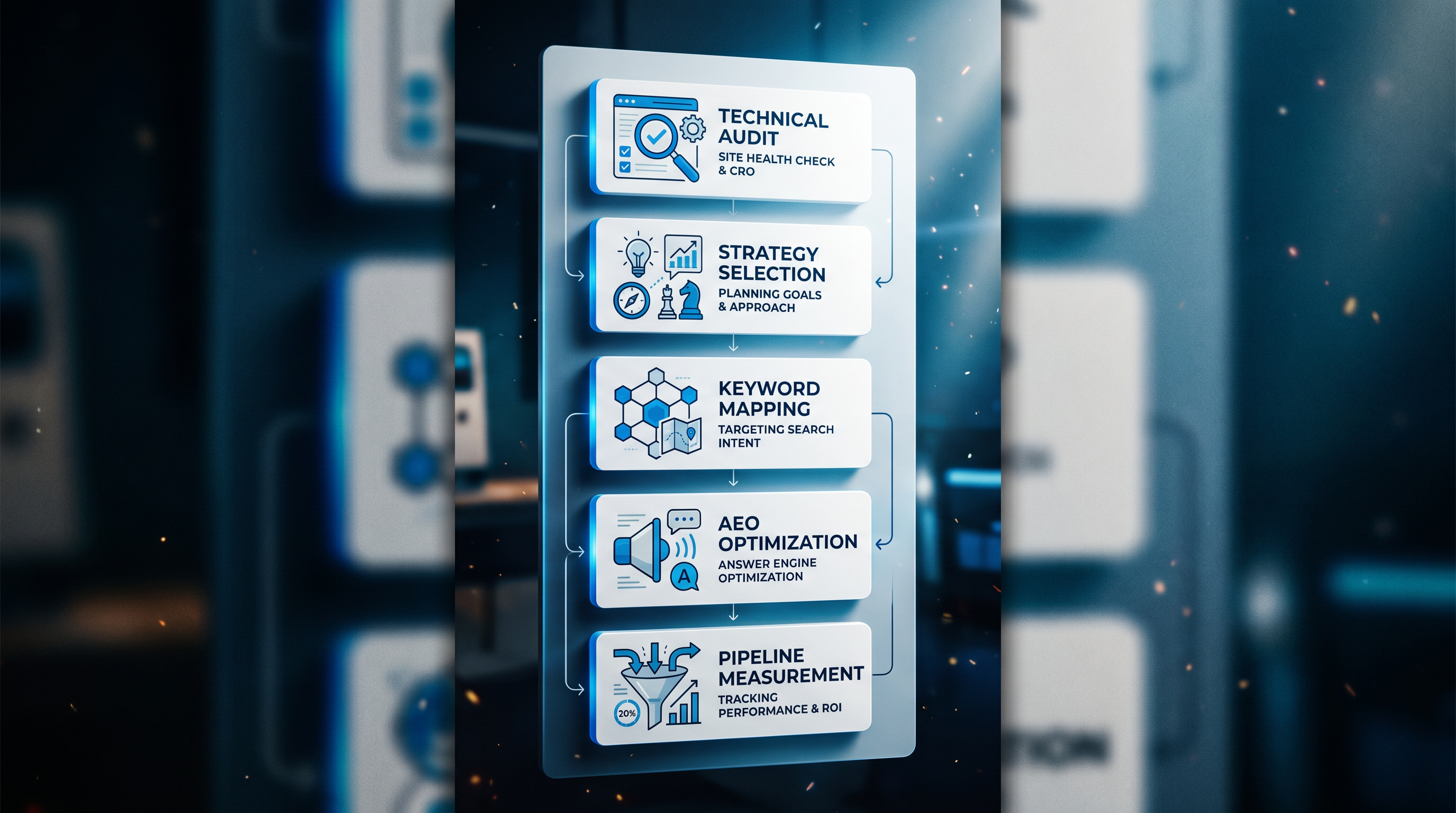
How to Use These Findings: The 5-Step Execution Framework
- Audit your technical foundation first. Run a crawl audit using Google Search Console and Screaming Frog. Fix broken internal links, resolve crawl errors, check Core Web Vitals. This is the one-time investment that makes everything else more effective. Budget 2-4 weeks.
- Choose your primary strategy based on team size. Use the scenario table above. If you are a team of 1-3 with no dedicated content function, automated SEO is your primary strategy, full stop. If you have a 3+ person content team, build a pillar-cluster architecture.
- Map keywords by funnel stage, not just volume. Build three keyword buckets: awareness (problem-aware queries), consideration (evaluation queries like "best [category] software"), and decision (comparison and alternative queries). Assign content types to each bucket. A detailed keyword analysis framework helps here, particularly for identifying commercial-intent gaps competitors are leaving open.
- Add AEO structuring to everything you publish. This means: clear H2/H3 structure with question-format headings, FAQ sections with precise answers, first-party data or expert attribution, and schema markup on key pages. Content structured this way performs better in both traditional search and AI citations.
- Measure on pipeline, not pageviews. Connect Google Search Console to your CRM. Track organic-attributed trial signups, demo requests, and MQLs by landing page. If a cluster of articles drives 500 monthly visits but zero trials, the keyword targeting was wrong, not the content volume.
Frequently Asked Questions
How long does SaaS SEO take to show real results?
SaaS SEO delivers exceptional ROI with returns averaging 702% and becoming profitable in as little as 7 months. The 7-month figure assumes consistent publishing velocity (10+ articles per month), proper keyword targeting (commercial and long-tail intent, not just informational), and clean technical infrastructure. Companies that publish sporadically or target only high-difficulty keywords typically see longer runways before meaningful traffic arrives. The fastest results come from automated publishing platforms that compress the time-to-volume significantly.
Should SaaS companies use an SEO agency or handle it in-house?
The honest answer: it depends on your stage and your bottleneck. Agencies make sense when you have budget ($5,000-$20,000 per month minimum for quality), a product with proven retention, and you need to scale faster than your internal team can build. In-house makes sense when you have strong editorial talent and a clear content strategy already defined. The third option, automated SEO platforms, is what neither camp typically mentions: a flat-rate, high-volume alternative that replaces the agency model at a fraction of the cost. For most SaaS companies pre-Series A, automated SEO provides better output-to-cost ratios than either agency or in-house models.
What is the difference between SEO and AEO for SaaS?
Traditional SEO optimizes content to rank in Google's blue-link results. AEO (Answer Engine Optimization) optimizes content to be cited by AI systems including ChatGPT, Perplexity, Google AI Overviews, and Claude when users ask buying-intent questions. Visibility inside AI answers now drives a third of vendor selections that wouldn't have happened otherwise. G2's March 2026 Answer Economy report found that 33% chose a vendor they had never previously considered after discovering them via an AI answer. In 2026, SaaS companies need both. SEO without AEO leaves visibility on the table. AEO without SEO lacks the content authority foundation that AI systems use to determine which sources to cite.
How many articles per month does a SaaS company need to publish to see results?
Companies publishing 9+ blog posts monthly increased organic traffic by 35.8% year-over-year. That is the minimum threshold for consistent, compounding growth. Companies publishing under 4 articles per month typically plateau after an initial burst and struggle to build topical authority at pace. The challenge is that 9+ articles per month is a substantial manual workload. A 2,000-word article takes a skilled writer 4-6 hours. Nine articles per month is essentially one full-time content hire. For teams that cannot absorb that headcount cost, automated publishing is the direct solution.
Is programmatic SEO worth it for early-stage SaaS?
For most early-stage SaaS companies, programmatic SEO is not the right first move. It requires developer resources to build the templating system, structured product data to differentiate page variants, and enough domain authority for Google to trust the pages. Early-stage companies typically lack all three. The better play is to use content-led or automated SEO to build domain authority first, then layer programmatic expansion once you have 20+ topical authority signals established. If your product is a marketplace or directory with inherently structured data, move programmatic higher in your priority queue, but still pair it with editorial content for authority building.
Rankcow takes the hardest part of SaaS SEO, consistent, high-volume, brand-aligned content publishing, and puts it on autopilot. With 30 articles per month published directly to your CMS, automated internal linking, and E-E-A-T-compliant content generation, it is the strategic answer for SaaS founders and lean marketing teams who want compounding organic growth without the headcount cost. If you are serious about building an organic growth engine in 2026, start your Rankcow subscription and watch your topical authority compound while you focus on building your product.