Automated SEO vs Manual SEO: The 2026 Showdown (With Clear Verdicts for Every Use Case)
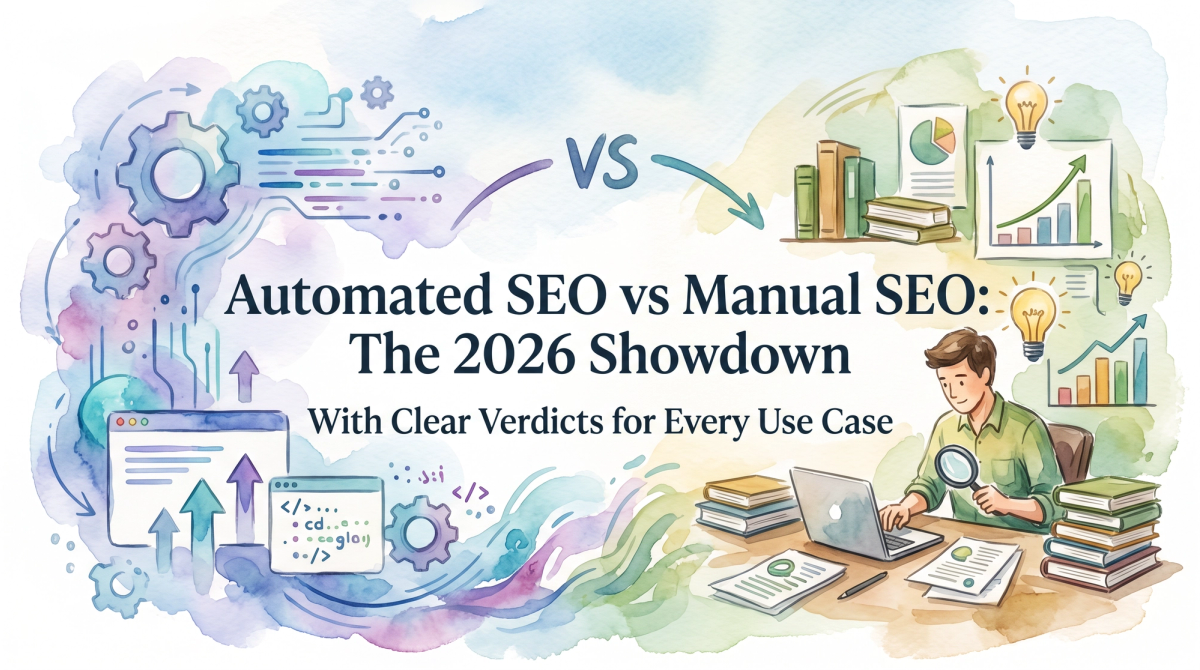
Automated SEO wins on speed, scale, and cost. Manual SEO wins on depth, authority, and originality. The real question is not which one is better in the abstract — it is which one fits your resources, your goals, and your timeline. For most small-to-medium businesses and SaaS founders, the answer in 2026 is a hybrid model that automates execution while preserving human strategy at the top of the funnel. Below, we break down exactly where each approach dominates, where it fails, and how to build your own arsenal to win organic traffic consistently.

What We Tested (Our Methodology)
We evaluated automated SEO and manual SEO across three specific criteria: (1) total cost of ownership, including labor and tooling over a 12-month period; (2) content quality compliance with Google's E-E-A-T framework and 2026 algorithm standards; and (3) scalability, meaning how each approach performs as content volume requirements grow from 4 articles per month to 30+. We also factored in real-world data from recent industry research and algorithm update impacts to ground every verdict in observable outcomes, not vendor marketing.
Where we found competitor marketing to be misleading, we call it out. Writing assistants like Jasper or optimization-only tools like SurferSEO are frequently marketed as "SEO automation" — but they still require a human to do the keyword strategy, briefing, editing, and publishing. That is not automation. That is assisted manual work. We treat the distinction seriously.
Why This Comparison Matters in 2026
The global SEO services market is estimated at $83.98 billion in 2026, projected to reach $148.86 billion by 2030. That growth is pulling in two directions at once: automation adoption is accelerating, but so are Google's quality filters. The December 2025 Core Update alone caused 40–60% of websites globally to see measurable ranking changes, with sites publishing mass-produced AI SEO output taking the hardest hits. The stakes for choosing the wrong approach have never been higher.
At the same time, 65% of marketers say they automated at least half of their SEO tasks in 2025. Sitting entirely on the manual side of this equation is not a badge of quality — it is a capacity problem. The businesses winning right now are the ones who automated the right tasks and kept humans in the right seats. Understanding how SEO functions within a full digital marketing strategy makes clear which tasks genuinely require human judgment and which ones are simply burning your team's hours.
Automated SEO: Full Breakdown
What Automated SEO Actually Does
True SEO automation is not a writing assistant that helps you draft a paragraph faster. SEO automation tools handle repetitive, rules-based tasks without requiring manual input each time — including scheduled site audits, automated rank tracking alerts, bulk meta tag generation, internal linking suggestions, and automated client reporting. At the enterprise end of the spectrum, full-pipeline platforms like Rankcow go further: identifying high-intent, low-competition keywords, generating brand-aligned long-form content, and publishing directly to your CMS without any manual steps in between. That is the difference between a tool that shows you data and a tool that acts on it.
Where Automated SEO Wins
- Speed: Tasks that used to take a technical SEO analyst 20 hours a week can now be executed by machine learning algorithms in minutes.
- Scale: SEO automation allows you to manage 100 pages or 10,000 pages with the same core efficiency.
- Cost efficiency: Entry-level platforms starting at $99–$299/month can replace $3,000–$5,000/month in agency fees while providing more consistent, data-driven optimization.
- Consistency: Automated systems do not miss a Monday because of bandwidth issues or staff turnover.
- Internal linking: Companies using automated internal linking tools see a 21% increase in average time-on-site.
Where Automated SEO Falls Short
The March 2026 Core Update placed heavier weight on firsthand experience, verified expertise, and original analysis — the exact signals AI SEO tools cannot generate on their own. A crawler cannot have an industry opinion. An algorithm cannot draw on a decade of niche experience. This is where blindly mass-producing AI content without brand expertise baked in becomes a liability. Content where "all or almost all" the main content is AI-generated and lacks effort, originality, and added value can receive the "Lowest" quality rating from Google's human raters.
The nuance that most automation vendors gloss over: Google is not penalizing AI-generated content by default. Google's ranking system no longer penalizes content simply because it is AI-generated; instead, it focuses on overall content quality using the E-E-A-T framework. That means well-structured, brand-specific, experience-informed automated content can and does rank. Rankcow's approach to this is worth noting: their platform is built to mimic brand tone and comply with E-E-A-T guidelines rather than generating generic filler at volume.
Manual SEO: Full Breakdown
What Manual SEO Actually Involves
Manual SEO is the complete human-driven process: hand-picking keywords, writing content from personal experience, building links through outreach, monitoring rankings in spreadsheets, and adjusting on-page elements one by one. It is time-intensive by design. A full manual SEO workflow for a 10-article-per-month content program can consume 40+ hours of skilled labor. Those looking to understand what a rigorous keyword analysis process looks like manually will appreciate how much of that time is just the research phase alone.
Where Manual SEO Wins
- Firsthand experience signals: Only a human can write from real product use, cite original research, or produce an opinion that an AI would not generate.
- Creative link-building: Relationship-based outreach, digital PR, and earning editorial mentions still require human nuance.
- Niche authority: In highly specialized verticals — medical, legal, financial — expert-authored content carries weight that automated content cannot replicate.
- Strategic pivots: Humans can detect context shifts, brand positioning changes, and competitor moves faster than any dashboard.
Where Manual SEO Falls Short
Manual SEO has one unbeatable enemy: time. A typical SEO tool stack (Semrush + Surfer + ContentKing + AgencyAnalytics) runs $400–700/month and still requires 15–25 hours per week of human implementation time. For a small business owner or a solo SaaS founder, that is simply not available. And the scaling problem is brutal: expanding content output requires proportional headcount growth — there is no velocity multiplier without adding staff.

Head-to-Head Comparison Tables
Feature Matrix: Automated SEO vs Manual SEO
| Criteria | Automated SEO | Manual SEO | Winner |
|---|---|---|---|
| Monthly content output | 20–60+ articles | 4–10 articles | 🤖 Automated |
| Cost per article (SMB) | $10–$30 | $150–$600 | 🤖 Automated |
| E-E-A-T compliance (generic AI) | Moderate risk | High compliance | ✍️ Manual |
| E-E-A-T compliance (brand-trained AI) | Moderate-to-high | High compliance | 🤝 Tie |
| Technical audit speed | Minutes | Hours–Days | 🤖 Automated |
| Internal linking at scale | Excellent | Poor | 🤖 Automated |
| Link-building (outreach) | Poor | Excellent | ✍️ Manual |
| Topical authority building | Excellent (volume) | Good (depth) | 🤖 Automated |
| Scalability without added headcount | Excellent | None | 🤖 Automated |
| Niche/specialized content depth | Limited | Excellent | ✍️ Manual |
| Setup time to first published content | Days | Weeks | 🤖 Automated |
| CMS compatibility (WordPress, Webflow, etc.) | Excellent (webhooks) | Native | 🤝 Tie |
Task vs Best Approach: Your Decision Arsenal
| SEO Task | Best Handled By | Notes |
|---|---|---|
| Keyword research | Automated | AI identifies high-intent, low-competition clusters at scale |
| Content briefing | Automated | AI generates SERP-informed outlines faster than manual research |
| Long-form article writing | Hybrid (brand-trained AI) | Pure AI content without brand voice or experience signals is risky |
| Technical audits | Automated | Manual audits are too slow and error-prone at scale |
| Internal linking | Automated | 21% increase in time-on-site from automated linking |
| Meta tag generation | Automated | AI meta tags outperform manual ones in 52% of A/B tests |
| Rank monitoring | Automated | Real-time alerts beat monthly manual checks |
| Link building outreach | Manual | Relationship-based — automation produces spam signals |
| Brand positioning strategy | Manual | Requires human judgment, market context, and business goals |
| Content publishing to CMS | Automated | Webhooks eliminate manual uploads entirely |
| Original research / data journalism | Manual | AI cannot generate new primary data |
| Image alt text at scale | Automated | AI image generation and tagging removes hours of work |
Clear Verdicts for Every Scenario
"The highest ROI is consistently achieved by teams that use automation to eliminate repetitive tasks and surface data-driven insights, while humans focus on strategy, content quality, and relationship-building for link acquisition." — rankauthority.com
We run through seven real-world scenarios below. No hedging.
Scenario 1: SaaS Founder, Solo or Small Team
Verdict: Automated SEO wins. Period. You do not have 20 hours a week for content. You need a pipeline that identifies what to write, writes it, and publishes it without you touching a spreadsheet. Platforms like Rankcow (30 articles/month, flat subscription, cancel anytime) are purpose-built for this. We use this approach because the alternative — hiring an agency at $3,000–$5,000/month — produces fewer articles at 10x the cost.
Scenario 2: E-Commerce Brand, 500+ Product Pages
Verdict: Automated SEO wins. Period. No human team can manually optimize 500 meta titles, monitor 500 pages for thin content, and internally link across a changing product catalog. Automation is not optional here — it is the only viable path.
Scenario 3: Medical, Legal, or Financial Content
Verdict: Manual SEO wins. Period. YMYL content (Your Money or Your Life) is evaluated with the highest E-E-A-T scrutiny. A licensed professional writing from real clinical or legal experience cannot be replicated by a content automation platform. Automation can assist with structure and technical SEO, but the authored content must carry genuine credentials.
Scenario 4: Blogger Building Topical Authority
Verdict: Automated SEO wins. Building topical authority through SEO requires consistent publishing across a topic cluster — dozens of supporting articles that signal comprehensive coverage to Google. A human publishing 4 posts a month will lose this race to a competitor publishing 30. Automation is the only way to build topical depth at the speed search engines reward.
Scenario 5: Established Agency Managing 20+ Clients
Verdict: Hybrid wins. Agencies need automated reporting, rank tracking, and audit workflows to stay profitable. But client strategy, link-building, and performance storytelling still require human account managers. The tactical execution goes to automation; the relationship and strategy stays with people.
Scenario 6: Enterprise Brand with Dedicated SEO Team
Verdict: Hybrid wins. Enterprises have the budget for human strategists AND automation. The right play is using automation to eliminate the 20 repetitive hours per week and redeploy that talent on competitive intelligence, creative campaigns, and digital PR. The businesses that win are those that empower their experts to focus on strategy and creativity — not reporting and republishing.
Scenario 7: Budget-Constrained SMB, No In-House SEO
Verdict: Automated SEO wins. Decisively. For small businesses, automated SEO solutions often deliver the highest proportional ROI because they provide enterprise-level capabilities at a fraction of the cost of hiring an in-house specialist or retaining an agency. A flat-rate content automation subscription gives you consistent publishing, keyword coverage, and CMS integration for less than a single month of agency retainer.
Decision Framework: Which Approach Is Right for You?
Run through this numbered methodology to determine your ideal configuration:
- Audit your current time budget. Can you dedicate 15+ hours per week to SEO execution? If not, manual-first is not realistic.
- Calculate your content velocity need. How many articles per month do you need to build topical authority in your niche? Under 6: manual may work. Over 10: you need automation.
- Assess your content sensitivity. Is your content in a YMYL category? If yes, prioritize expert-authored content even if it is slower and more expensive.
- Map your existing tool stack. Are you already paying for separate tools that do rank tracking, auditing, and content? Consolidating to a full-pipeline platform often costs less and produces more.
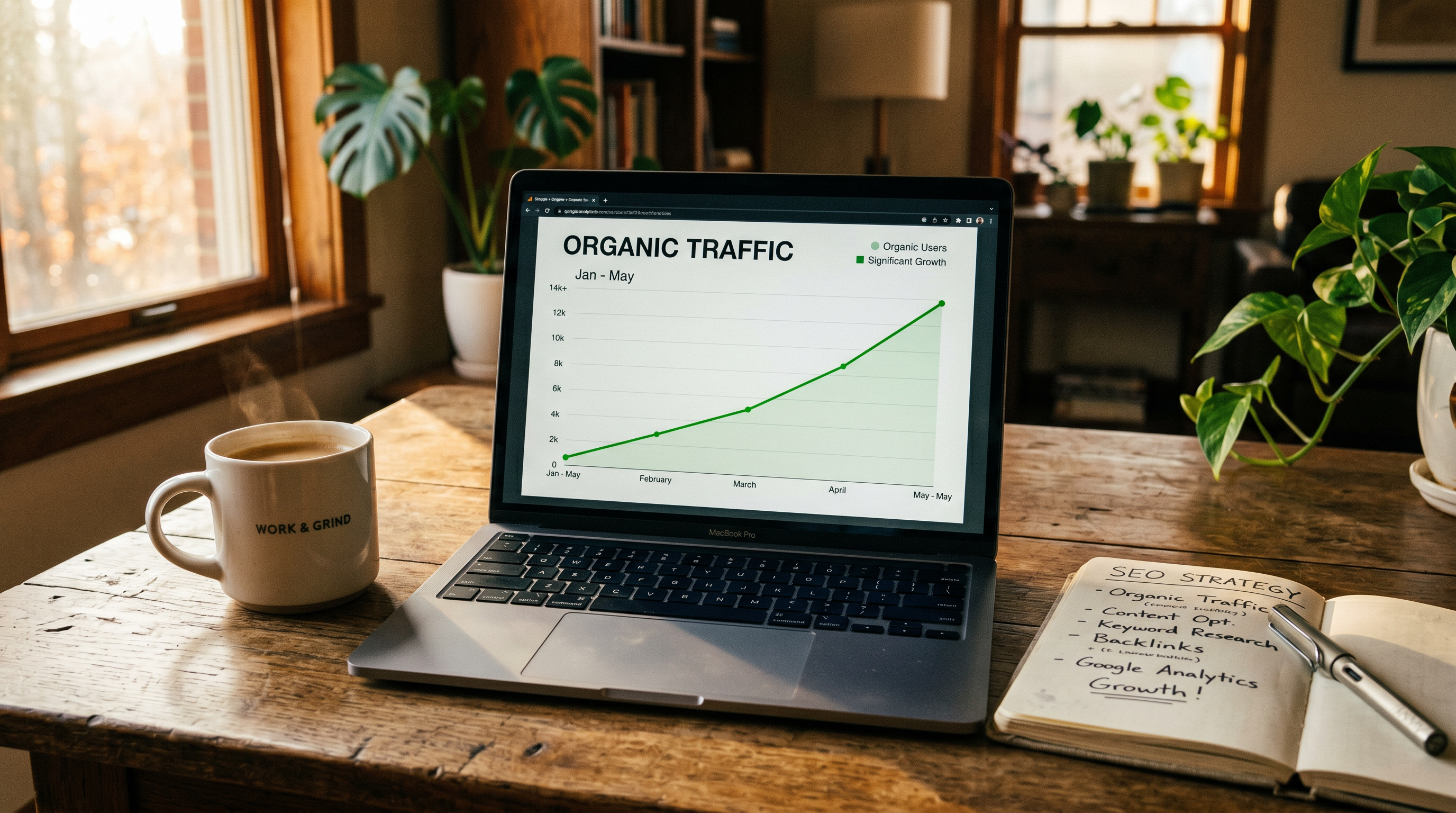
- Set a 90-day baseline. Whatever you choose, track organic sessions, keyword positions, and conversion rate monthly from day one. SEO ROI is invisible without a documented baseline.
For teams choosing the automation route, reviewing current SEO automation platform reviews side by side is a useful next step before committing to a subscription — not all platforms actually automate the full pipeline, and the distinction matters enormously for your workload.

The Real Hidden Cost Nobody Talks About
Marketing blogs love to compare subscription prices. They rarely compare the full cost of doing nothing, or doing things slowly. Here is the real math: SEO automation reduces manual tasks by 60–70%, and agencies report 15–20 hours saved per week using SEO automation platforms. At a conservative $60/hour for a skilled SEO professional, that is $4,680/month in recovered labor — before you account for a single ranking improvement.
The SaaS-specific case is even sharper. A strong SaaS SEO strategy requires consistent content at scale to capture bottom-of-funnel search intent across a product category. A SaaS founder spending 15 hours a week manually writing and optimizing content is not doing SEO — they are doing a $200/hour job that a $99/month platform could handle better and faster. That opportunity cost is the real price of staying manual.
When evaluating the quality tradeoff on content, the picture is also not as bleak for automation as legacy thinking suggests. 67% of businesses see an improvement in content quality when using AI. The caveat: that improvement depends on whether the AI is producing generic filler or brand-specific, structured content that reflects actual expertise.
What About Google's E-E-A-T and the 2026 Algorithm Updates?
This is the part where most automated SEO vendor pitches go quiet. We do not. Google's E-E-A-T framework is now applied well beyond health and finance content — the September 2025 update expanded E-E-A-T evaluation across all content categories, rewarding verified author profiles, real-world case studies, and firsthand perspectives. That is a real constraint for any automated content system that generates generic articles without brand context.
The way around this is not to abandon automation — it is to choose platforms that are built with E-E-A-T compliance in mind. Rankcow, for example, uses proprietary AI to mimic brand tone and generate content that reflects a specific brand's positioning rather than producing the same generic article structure for every client. That distinction is what separates a compliant automated content system from the mass-produced AI content farms that took ranking hits in 2025–2026. Those interested in understanding what good AI-generated content actually looks like compared to human writing can find a detailed breakdown in the AI content vs human content analysis.
FAQ
Can automated SEO fully replace manual SEO?
No — and any vendor claiming otherwise is overselling. Automated SEO solutions excel at scale, speed, and consistency, but they cannot replace the creative thinking, competitive intuition, and brand understanding that skilled human strategists provide. Automation handles execution. Humans handle strategy, link-building relationships, and experience-driven insights. The two are not competitors; they are a team.
Will Google penalize AI-generated content in 2026?
Not automatically. Google's position is clear: quality is the filter, not origin. Content that is thin, repetitive, and adds no original value will be penalized regardless of whether a human or an AI wrote it. Brand-trained, structured, and expertise-informed AI content can rank well — and does, consistently, for platforms built with quality controls rather than volume alone.
How long does automated SEO take to show results?
Expect 60–120 days for meaningful organic traffic movement from an automated content program. This is similar to the timeline for manual SEO. The difference is that at month 6, an automated system may have published 150+ articles while a manual program may have produced 25. That volume difference compresses the topical authority timeline substantially.
Is automated SEO safe for a new website?
Yes, with one condition: the automated content must be brand-specific and structurally sound, not spun generic articles. New sites benefit significantly from automated publishing because they need to establish topical coverage quickly. A platform that identifies keyword clusters and publishes consistently gives a new site the content depth it needs to rank within its first year.
What tasks should never be automated?
Link-building outreach, original research and data gathering, brand strategy and positioning, niche expert writing in YMYL categories, and crisis response. These all require judgment, relationships, or firsthand experience that no algorithm currently replicates. Everything else — auditing, rank tracking, meta tag generation, internal linking, content publishing — is fair game for automation.
Rankcow delivers the automated SEO approach that wins for time-strapped founders, content marketers, and SMBs — a full-pipeline system that identifies the right keywords, generates brand-aligned long-form content, and publishes directly to your CMS at 30 articles per month. If you are spending hours on SEO execution that a platform could handle for a flat monthly fee, it is time to put your content program on autopilot. Start your Rankcow subscription and see what an 8.4x average traffic lift looks like for your site.