Pillar Cluster Content Strategy: The Complete Guide to Building Topical Authority
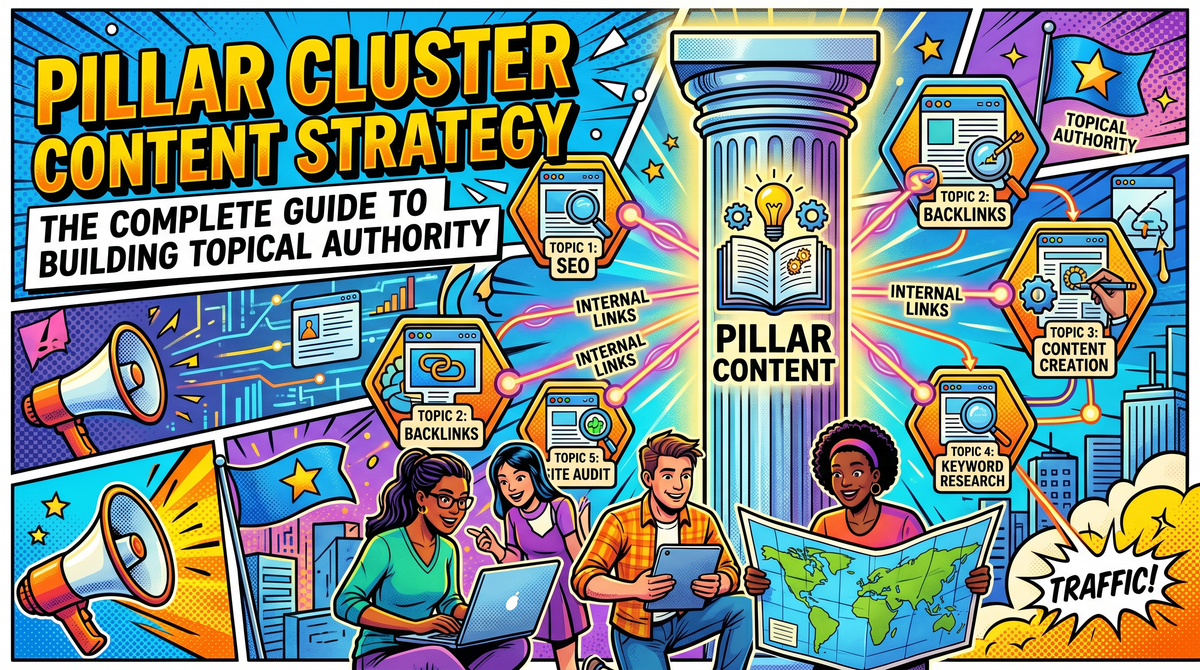
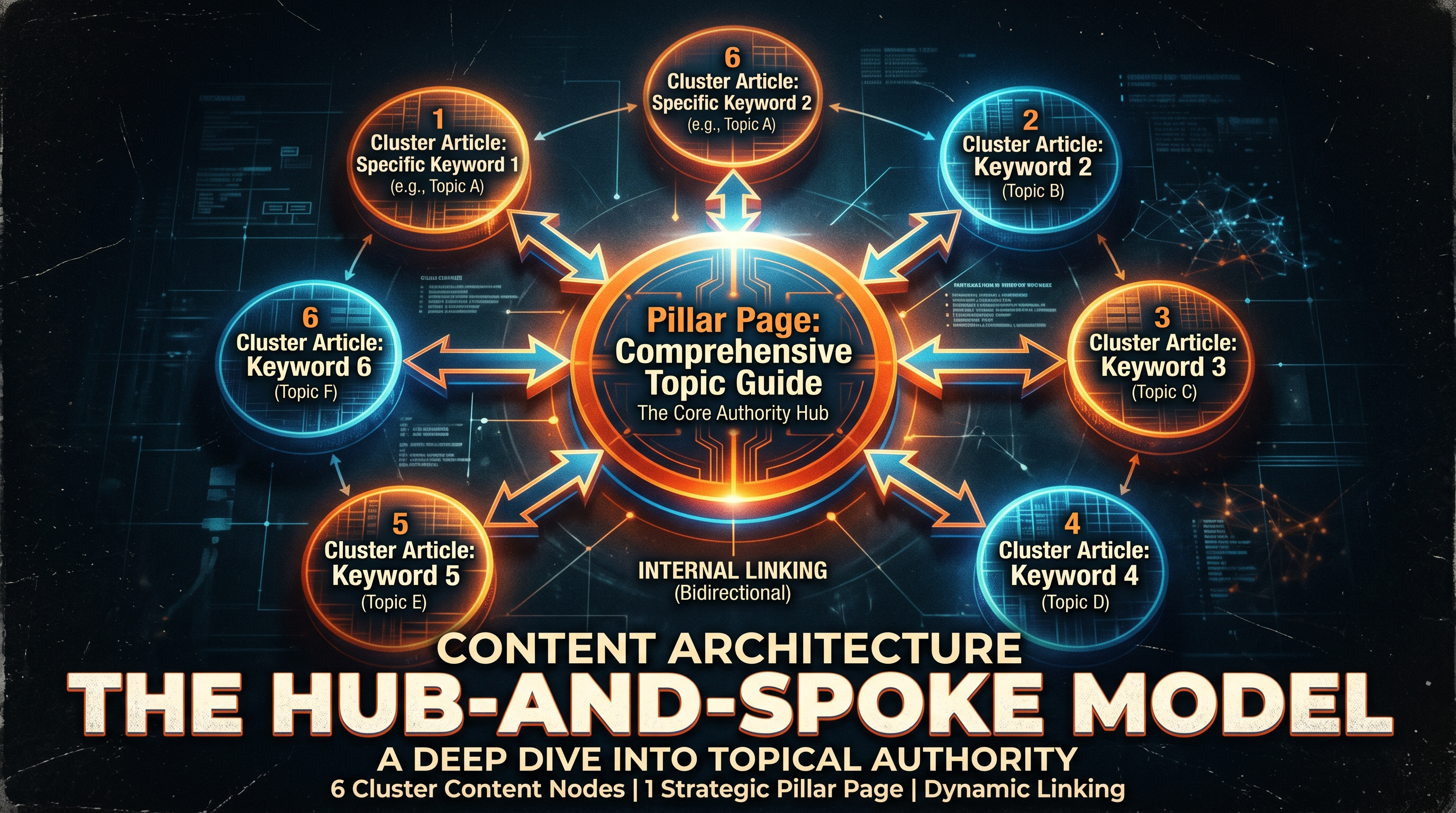
A pillar cluster content strategy organizes your website content around one broad "pillar" page supported by multiple focused "cluster" articles, all linked together. The pillar covers a topic at a high level, each cluster dives deep into a specific subtopic, and every cluster page links back to the pillar — creating a hub-and-spoke structure that signals topical authority to Google and AI search engines. This is now the dominant SEO architecture, and sites that implement it correctly see an average 40% increase in organic traffic compared to non-clustered content strategies.
Why Most People Get This Wrong at First
This confused me too when I first heard it. I thought "just write more blog posts and you'll rank." Makes sense, right? More content, more chances. But that logic falls apart fast.
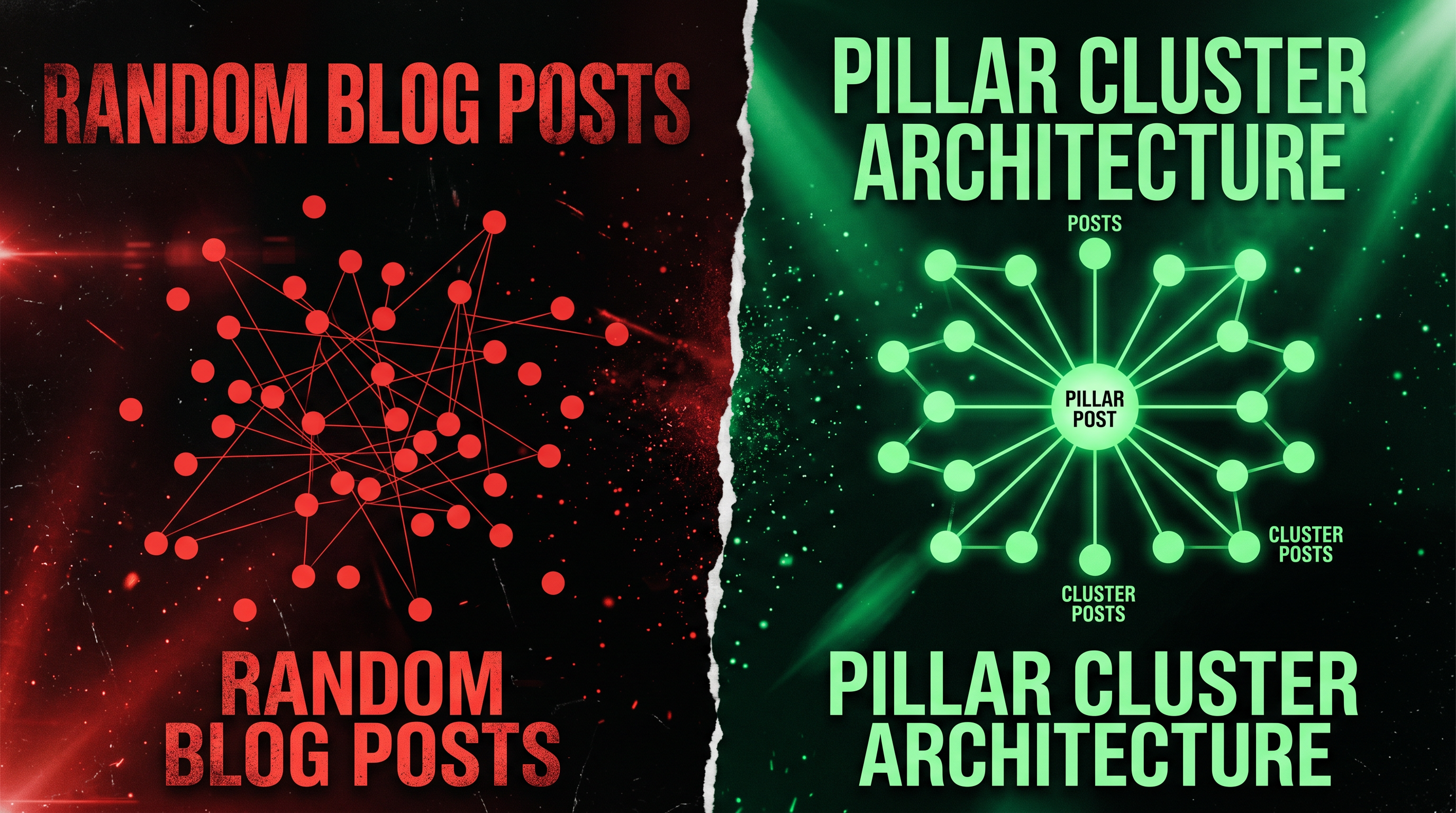
Studies show that nearly 96.55% of web pages receive little or no organic traffic from Google, often because they target isolated keywords without a clear topical strategy. The problem isn't writing volume — it's the lack of connective structure. Think of it like a library where every book is shelved randomly. You have great information, but nobody can find what they need, and the library itself looks disorganized to everyone who walks in.
A pillar cluster strategy is the shelving system. It tells Google, and now AI search engines, exactly what your site is an expert on — and proves it with depth, not just one impressive book.
The Core Building Blocks (Simple to Advanced)
The Pillar Page
A pillar page is your flagship piece of content on a broad topic. Think "The Complete Guide to Email Marketing" or "Everything You Need to Know About Project Management." Pillar pages require 3,000–5,000 words of comprehensive coverage, must address the full topic at a high level, link to every cluster page, and serve as the canonical authority on the subject. It doesn't go ten miles deep on any single angle — that's what the clusters are for.
A good well-structured pillar page covers every major subtopic briefly, then hands readers off to deeper cluster articles for the full treatment. It's less an encyclopedia entry and more a table of contents that actually teaches as it navigates.
The Cluster Pages
Cluster pages are the depth. Each one targets a specific long-tail keyword that lives inside your pillar topic. If your pillar is "Content Marketing," your clusters might be "How to Write a Content Brief," "Content Distribution Strategies," "Measuring Content ROI," and so on. A healthy cluster typically includes 8–20 supporting articles on specific subtopics, each targeting a long-tail keyword, with individual pieces running 1,000–3,000 words each.
The Internal Links (The Glue)
This part is where the real SEO magic happens, and where most people underinvest. Every cluster page must link back to the pillar, and the pillar must link out to every cluster. Research from Authority Hacker's study of over 1 million websites shows that proper internal linking boosts rankings by up to 40%. Following smart internal linking patterns within your cluster also passes link equity from high-authority pages throughout the whole structure — so a single backlink to your pillar benefits every cluster page connected to it.
Why This Strategy Works So Well Right Now
Google's algorithms have been moving away from keyword matching and toward topic comprehension for years. SEO has evolved from focusing on keywords and metadata to focusing on how content fits together — Google cares more about context, relevance, and structure than ever before.
But here's the newer layer most guides miss: AI search is accelerating the value of this approach significantly. Yext's 2025 AI Citation Study, analysing 6.8 million AI citations, found that websites with topic clusters receive 3.2× more citations than single-page competitors. When ChatGPT, Perplexity, or Google AI Overviews generates an answer, a site with ten interconnected articles on a topic is far more likely to be cited than one with a single long post.
Understanding topical authority in SEO helps explain why this works mechanically: Google's systems evaluate not just what a page says, but how well the entire domain covers a subject. A cluster proves that coverage through structure, not just word count.
The Bookmark-Worthy Framework: Build a Cluster in 5 Steps
Here's the mental model worth saving. Think of it like building a solar system: your pillar is the sun, your clusters are the planets, and your internal links are gravity.
| Step | Action | Output |
|---|---|---|
| 1. Pick Your Pillar Topic | Choose a broad, high-search-volume topic central to your business | One target "head" keyword (e.g., "email marketing") |
| 2. Map Your Clusters | Find 8–15 subtopics and long-tail keyword variations under that topic | A content roadmap with specific article titles |
| 3. Write the Pillar First | Create 3,000–5,000 words covering all subtopics at a high level | One authoritative hub page |
| 4. Publish Clusters Progressively | Write each cluster article, going deep on each subtopic | 8–15 long-tail-ranking articles |
| 5. Link Bidirectionally | Pillar links out to each cluster; each cluster links back to pillar | A closed, authority-flowing content network |
Key insight: Clusters don't produce results overnight. Sites that sustain cluster publishing for 12+ months see 40% higher organic traffic than comparable single-page strategies. Treat each cluster as a long-term asset, not a short-term traffic play.
Pillar vs. Cluster: Quick Reference
| Feature | Pillar Page | Cluster Page |
|---|---|---|
| Keyword type | Broad, high-volume head term | Specific, long-tail subtopic keyword |
| Word count | 3,000–5,000 words | 1,200–3,000 words |
| Depth | High-level overview of full topic | In-depth treatment of one subtopic |
| Internal links | Links out to all cluster pages | Links back to pillar (and sibling clusters) |
| Primary goal | Rank for competitive head keyword | Capture long-tail traffic, support pillar authority |
| Update frequency | Quarterly review | When new data or industry changes arise |
Practical Application: What a Real Cluster Looks Like
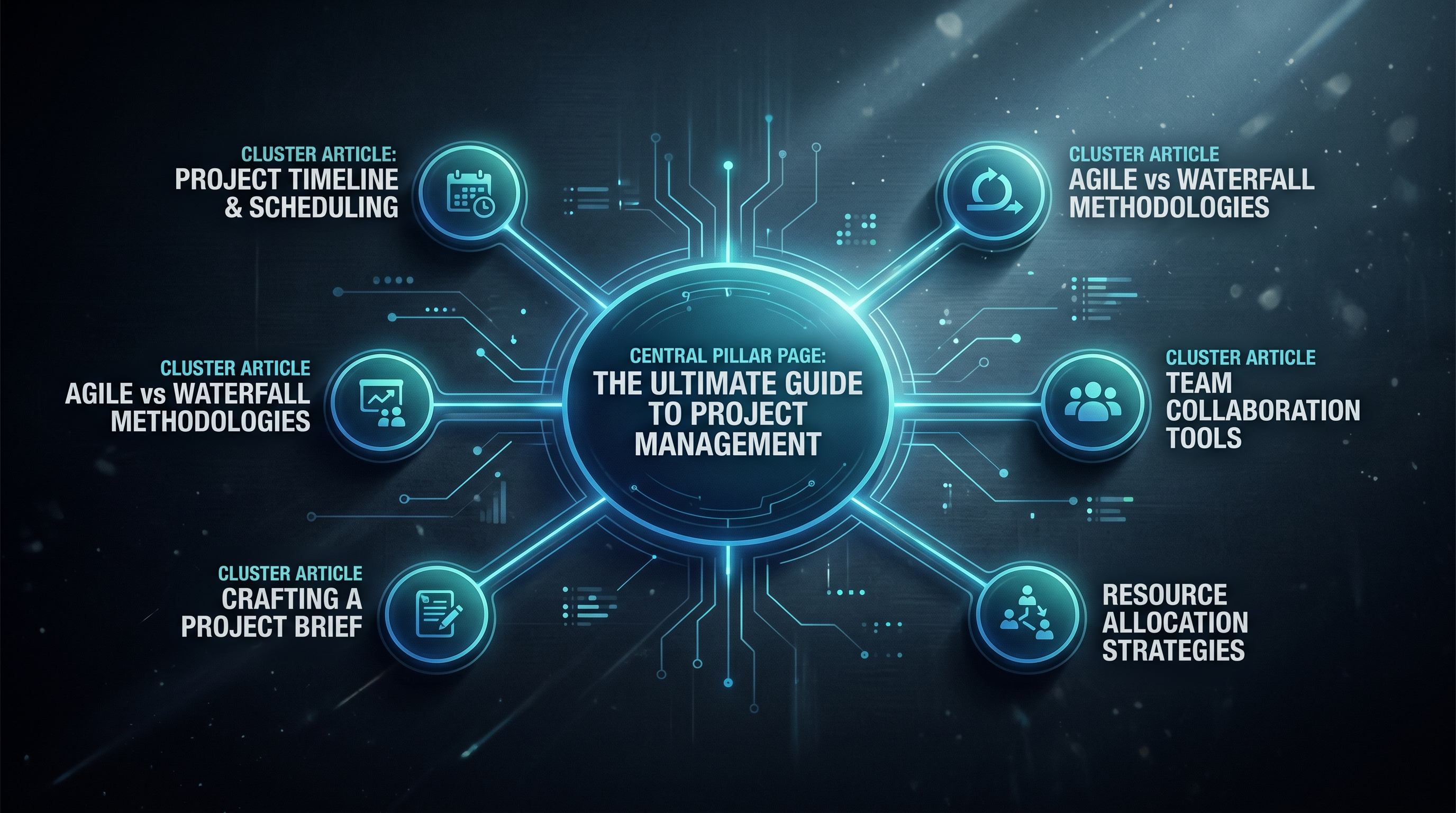
Say you run a project management SaaS. Your pillar might be "The Complete Guide to Project Management." Under it, your cluster articles could include:
- "How to Create a Project Timeline" (targeting "project timeline template")
- "Agile vs. Waterfall: Which Method Is Right for Your Team?" (targeting "agile vs waterfall")
- "How to Write a Project Brief" (targeting "project brief template")
- "Project Risk Management: A Step-by-Step Guide" (targeting "project risk management")
- "Best Project Management Tools for Remote Teams" (targeting "remote project management tools")
Each article ranks independently for its long-tail term. But the real power comes from the network. A study of 50 B2B SaaS websites showed pillar-cluster architectures led to 63% more keyword rankings within 90 days. Building a topic cluster model like this means every new article you publish makes all the previous ones more powerful — not less.
Common Mistakes (and How to Avoid Them)
Mistake 1: Choosing a Pillar Topic That's Too Narrow
If your pillar topic can only support 3–4 subtopics, it's not a pillar — it's a cluster article itself. Good pillar topics should comfortably generate 8–15 distinct subtopic articles. "Email marketing" works. "Email subject line best practices" doesn't.
Mistake 2: Forgetting the Bidirectional Links
One-directional linking is the most common execution error. You write the pillar, link out to clusters, then forget to go back and add the return links from each cluster page. Both directions matter. The cluster-to-pillar link is what consolidates authority back to your hub page.
Mistake 3: Publishing Everything at Once and Then Stopping
Launching a pillar and 12 clusters in one week is fine, but clusters compound over time. A cluster that receives consistent additions over 6–12 months dramatically outperforms one that was published and abandoned. Plan for ongoing publishing, not a one-time launch.
Mistake 4: Treating All Clusters as Equal
Some subtopics have ten times the search volume of others. Use keyword data to prioritize which cluster articles to write first — starting with the ones that will generate the fastest early traffic signal strengthens the whole cluster faster.
Mistake 5: Ignoring AI Citation Signals
HubSpot's State of AEO 2026 report analyzed thousands of citations from ChatGPT, Gemini, Perplexity, and Google AI Overviews and found that pages with outbound links, statistics, author bios, and visible "last updated" dates correlate with higher citation rates. Build these trust signals into every page in your cluster — not just your pillar.
Frequently Asked Questions
How many cluster articles do I need before the strategy starts working?
There's no hard minimum, but most practitioners find meaningful authority signals start appearing after 5–8 interconnected cluster articles are live and indexed. Publishing the pillar and the first 6–8 clusters together — with all internal links set up on day one — tends to produce the fastest early results. Don't wait to have 20 articles ready before publishing anything.
Should I build one big cluster or several smaller ones?
Start with one well-executed cluster on your most important topic before branching out. Depth on one subject consistently outperforms shallow coverage across many. Once your first cluster gains traction, you can launch a second around a different pillar topic. Most serious content strategies eventually run 3–5 active clusters simultaneously.
Can I turn existing blog posts into a cluster retroactively?
Yes, and it's often faster than starting from scratch. Audit your existing content, identify posts that naturally cluster around a broad topic, designate the strongest one as the pillar (or write a new pillar page), then add bidirectional internal links between all related posts. You may need to fill gaps with new cluster articles, but retrofitting beats rebuilding entirely.
Does this strategy still work with AI search (ChatGPT, Perplexity, Google AI Overviews)?
It works better with AI search than the old keyword-targeting approach. AI systems evaluate topical depth across a site's interconnected pages as a trust signal. A cluster that proves comprehensive coverage of a subject is exactly the kind of source these systems prefer to cite. In fact, websites with pillar-cluster architecture saw AI citation rates increase in one study from 12% to 41% for pillar-organized topics.
How long does a pillar cluster strategy take to show results?
Expect initial long-tail keyword rankings within 4–8 weeks of publication for cluster articles, and competitive rankings on the pillar's head keyword within 4–9 months. The structure rewards patience — authority compounds as more articles are indexed, more internal links are crawled, and Google's systems build a clearer picture of your site's expertise.
Rankcow is built specifically to execute pillar cluster strategies on autopilot — identifying the right pillar topics, generating and publishing up to 30 SEO-optimized cluster articles per month, and automatically handling internal linking across your entire content architecture. If you're ready to build topical authority without managing every piece manually, Rankcow's end-to-end platform handles the full pipeline from keyword research to publication, across 150+ languages and any major CMS.