How to Build Topical Authority: The Complete Step-by-Step Guide (2026)
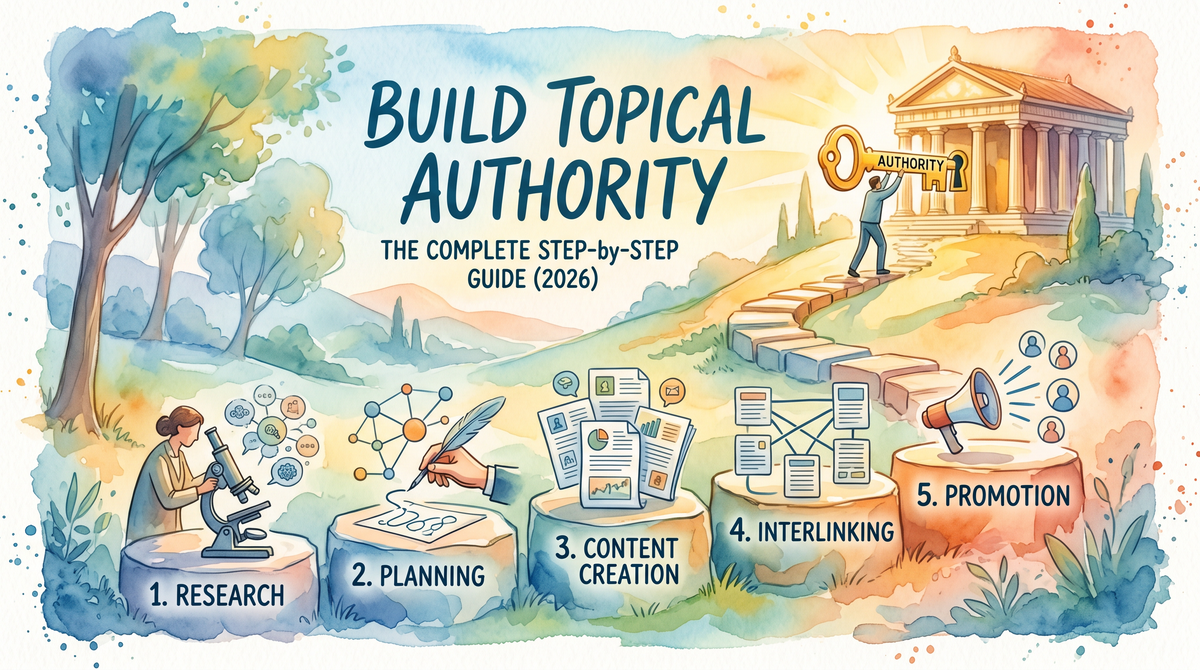
To build topical authority, you need to pick one focused subject area, create a pillar page covering that topic broadly, surround it with interconnected cluster articles that cover every related subtopic in depth, and link them all together strategically. That's the core system. Done consistently over 6–12 months, it signals to Google that your site is the most comprehensive, trustworthy resource in your niche, which is exactly what earns lasting rankings in 2026. What I wish someone had told me early on: this is not a keyword-volume game. It's a coverage game. The sites winning right now are not publishing the most content — they're publishing the most complete content on a focused set of topics.

What Is Topical Authority (And Why It Changes Everything)
Topical authority means becoming the most trusted and complete source on a specific subject, not just ranking for a few keywords. Google no longer evaluates your pages in isolation. In 2026, Google evaluates the topical competence of an entire domain, and websites that cover a subject area comprehensively, deeply, and structurally benefit from faster rankings, higher traffic, and greater resilience against algorithm updates.
Here's the thing: most site owners have been playing the wrong game for years. They chase individual keywords, publish unrelated articles, and wonder why their traffic stagnates. The 2024 Google Content Warehouse API leak confirmed what many SEOs suspected — Google uses 'siteFocus' and 'siteRadius' metrics to assess how concentrated a site is around its core topics, where 'siteFocus' measures depth and authority within a subject area, while 'siteRadius' evaluates how far content strays from that focus. Stray too far, and you dilute your own signal.
| Factor | Domain Authority | Topical Authority |
|---|---|---|
| What it measures | Overall site backlink strength | Depth of expertise on a specific subject |
| How it's earned | Backlinks from external sites | Comprehensive, interlinked content clusters |
| Speed to results | Slow; depends on third parties | Faster when clusters hit critical mass |
| 2026 relevance | Still matters, but less decisive | Primary ranking driver for informational queries |
| AI citation impact | Low direct correlation | High — AI engines prioritize topic experts |
Analysis of 400+ SEO campaigns shows that sites focusing on topical authority first see ranking gains up to 3x faster than those chasing domain authority alone. That's not a small edge. That's a fundamental rethink of where your effort goes.
Why Topical Authority Matters Even More in 2026 🔍
Let's be honest: the SERP is a different place now. AI Overviews are eating clicks. ChatGPT is answering questions your blog posts used to own. A 2024 study by Graphite found that pages with high topical authority gain traffic 57% faster than those with low authority. And with topical authority SEO becoming the primary filter for both Google rankings and AI citations, building it isn't optional — it's the whole strategy.
The real talk is this: websites with strong topical authority benefit from faster indexing, more stable rankings, and higher visibility in AI answers. When an AI Overview needs a source, it pulls from the sites it considers topical experts. That's a new traffic channel most people aren't optimizing for yet.

The Core Methodology: How to Build Topical Authority Step by Step
Before we go step by step, here's a quick-reference checklist you can bookmark and return to every time you start a new content push.
📋 Topical Authority Quick-Reference Checklist
- Choose one focused core topic aligned with your business goals
- Map every subtopic and related user question using keyword research
- Build a comprehensive pillar page covering the core topic broadly
- Create 10–30 cluster articles targeting specific subtopics and long-tail queries
- Interlink every cluster article back to the pillar (and to each other where relevant)
- Align every piece of content with clear search intent
- Add E-E-A-T signals: author bios, original data, real experience
- Update and expand existing content on a quarterly basis
- Track rankings for the whole cluster, not page by page
- Repeat the cluster model for adjacent topics once the first one gains traction
Step 1: Pick Your Core Topic (and Resist the Urge to Go Broad)
This step takes longer than you'd expect — and getting it wrong wastes months of effort. Your core topic needs to be specific enough that you can realistically become the go-to source, but broad enough to support 20–30 pieces of related content. A SaaS company covering "project management software" is competing with giants. The same company covering "project management for remote engineering teams" has a real shot. Aim to become the leading online source of information on a few niche topics — it's much more time- and cost-effective than setting your sights on a broad, highly competitive field.
Step 2: Map Your Topical Universe
Once you have a core topic, map every connected subtopic, user question, and angle around it. Think of this as your content blueprint. Group ideas into clusters: informational subtopics (what, why, how), comparison pieces, use-case articles, and beginner vs. advanced guides. A good keyword analysis at this stage will surface hundreds of long-tail queries you'd never have found by guessing. Each cluster article you plan here becomes a brick in your authority wall.
Step 3: Build Your Pillar Page
Your pillar page is the centerpiece. It covers the core topic comprehensively — broad enough to address every major angle, deep enough to be genuinely useful. Think of it as the authoritative overview that answers the main question and signals to both readers and search engines that everything connects here. A well-built SEO pillar page does not try to rank for 50 keywords at once — it earns its rankings by being the clearest, most organized guide on the topic and by attracting links from all the cluster content around it.
Step 4: Create Your Cluster Content
Here's where the real work happens. Most websites achieve faster and more sustainable ranking improvements by building at least 25–30 high-quality, interlinked articles within a single content cluster before investing heavily in link acquisition. Each cluster article targets a specific long-tail query, answers it fully, and links back to the pillar page. Do not thin these out. A shallow cluster article that barely covers its subtopic actually hurts your authority signal more than no article at all.
What I wish someone had told me: your first 10 cluster articles will feel like they're not working. The first cluster articles typically take the longest to build rankings, while later content benefits from the already established topical strength and becomes visible significantly faster. Push through that phase. The compounding effect is real.
Step 5: Build a Tight Internal Linking Structure
Internal links are the connective tissue of your topical authority strategy. Every cluster article should link back to the pillar. The pillar should link out to every cluster. Related cluster articles should cross-link where it makes sense for the reader. Understanding how internal links distribute authority across your site is one of the highest-leverage moves in SEO — it keeps link equity flowing through your content ecosystem and makes it much easier for Google to identify the topic relationships between your pages.
Step 6: Bake E-E-A-T Into Every Page
The March 2026 Core Update confirmed E-E-A-T as a primary ranking factor. Experience, Expertise, Authoritativeness, and Trustworthiness are not just boxes to tick. They show up in author bios with real credentials, original data points, cited sources, first-hand perspectives, and transparent attribution. A cluster article written by an anonymous "Admin" with no sources or original insight will drag your topical authority down, not up.
Step 7: Update and Expand Continuously
Topical authority is not a one-time build. A fixed editorial calendar that reviews and updates existing cluster content quarterly is part of every sustainable SEO strategy. Outdated stats, missing subtopics, and changed search intent all erode your authority signal over time. Treat your content clusters like living documents, not archived posts.

Frameworks for Building Topical Authority: Which Model Fits You?
| Framework | Best For | Content Volume Needed | Time to See Results |
|---|---|---|---|
| Pillar + Cluster | Most businesses, SaaS, blogs | 1 pillar + 10–30 clusters per topic | 3–6 months |
| Hub and Spoke | Publishers, media sites | 1 hub page + ongoing spoke articles | 4–8 months |
| Content Silo | E-commerce, large sites | Category + subcategory + product pages | 6–12 months |
| Topical Map First | New sites, tight niches | Full map before publishing anything | 6–9 months |
The topic cluster content strategy works across almost every niche, which is why it's the most widely adopted model. Pick the framework that matches your site's size and publishing capacity, then commit to it for at least 12 months before judging results.
Common Mistakes That Destroy Topical Authority
- Publishing off-topic content to chase trending keywords — this increases your siteRadius and confuses Google about what your site actually covers.
- Thin cluster articles that answer one sentence and pad the rest with fluff — these create noise, not authority.
- Ignoring internal links after publishing — a cluster article with no internal links is an island, not a signal.
- Measuring too early — most sites abandon the strategy at month 3 or 4, right before the compounding kicks in. Building topical authority takes time, and most sites give up after 3–4 months when they don't see immediate results — but topical authority is a 6–12 month investment.
- Covering too many core topics at once — spreading across five unrelated subject areas in year one is the fastest way to signal nothing to Google.
- Never updating old content — outdated stats and missing context quietly erode your authority rankings quarter by quarter.
Tools You Need to Execute This Strategy 🛠️
- Google Search Console — track impressions and clicks across your entire topic cluster, not just individual pages.
- Keyword research tools — map every subtopic and user question before you write a single word.
- Content audit tools — identify thin pages, cannibalization issues, and internal linking gaps.
- Automated content platforms — for founders and small teams who cannot maintain a 20–30 article publishing pace manually, platforms like Rankcow automate the entire pipeline: keyword discovery, content creation, internal linking, and CMS publishing — all aligned to your brand voice and topical focus.
Let's be honest: the volume of content required to achieve genuine topical authority is the biggest barrier most teams face. Rankcow publishes 30 brand-aligned, SEO-optimized articles per month — which means you can fill out a complete content cluster in a single month rather than grinding through it for a year.

Frequently Asked Questions
How long does it take to build topical authority?
Realistically, you should expect 6–12 months before significant compounding results appear. The first 3–4 months are about laying coverage: publishing your pillar page and getting at least 15–20 cluster articles live. Months 5–12 are when Google starts recognizing your topical footprint and rankings begin to lift across the whole cluster. Sites that publish consistently and maintain strong internal linking tend to see results on the faster end of that range.
How many articles do I need to build topical authority?
The quickest way to increase topical authority is by publishing at least 25 authoritative articles within one tightly connected content cluster — sites that achieve this threshold typically see a 40–70% increase in keyword rankings for their target topic within 3–6 months. Think of 25 as your minimum viable cluster. More is better, as long as every article has genuine depth and clear search intent alignment.
Can a new website build topical authority?
Yes — and this is one of the most exciting aspects of the modern SEO environment. Topical authority creates room for more niche websites to outrank traditional juggernauts, and if your content creators have experience, expertise, and credibility, you can outperform larger brands by establishing topical authority in your niche through relevant content, internal links, and strategic topic clustering. A newer site that picks a narrow niche and covers it exhaustively can beat a high-authority competitor that only touches the surface of that topic.
Does topical authority help with AI search results and citations?
Significantly. AI search tools — including Google's AI Overviews, ChatGPT, and Perplexity — evaluate topical authority when selecting sources to cite. Ranking isn't a prerequisite for a citation, but the content still needs to signal clear topical authority to Google's AI. Sites with tight, interconnected content clusters that cover a subject comprehensively are consistently the ones pulled as sources in AI-generated answers. Building topical authority today is also building AI citation authority for tomorrow.
What's the difference between topical authority and semantic SEO?
They're closely related but not the same thing. Semantic SEO is the technique: writing content that uses related entities, concepts, and terms that help search engines understand what a page is about. Topical authority is the outcome: the cumulative signal Google has about your entire site's expertise on a subject. Semantic SEO practices applied consistently across a well-structured cluster model are how you build topical authority. One is the method; the other is the result.
Building topical authority at scale requires consistent, high-quality content publishing — and that's exactly what Rankcow is built to deliver. Rankcow's end-to-end SEO automation platform handles keyword discovery, long-form content creation, internal linking, and direct CMS publishing across 150+ languages, giving SaaS founders, bloggers, and growing businesses a genuine autopilot solution for building topic cluster dominance. If you're ready to stop guessing and start compounding, explore Rankcow and see why 1,000+ sites are using it to drive an average 8.4x traffic lift.